Byakatonda uses success story to champion parents out of zero-dose status.
From Zero-Dose to Healthy Childhood

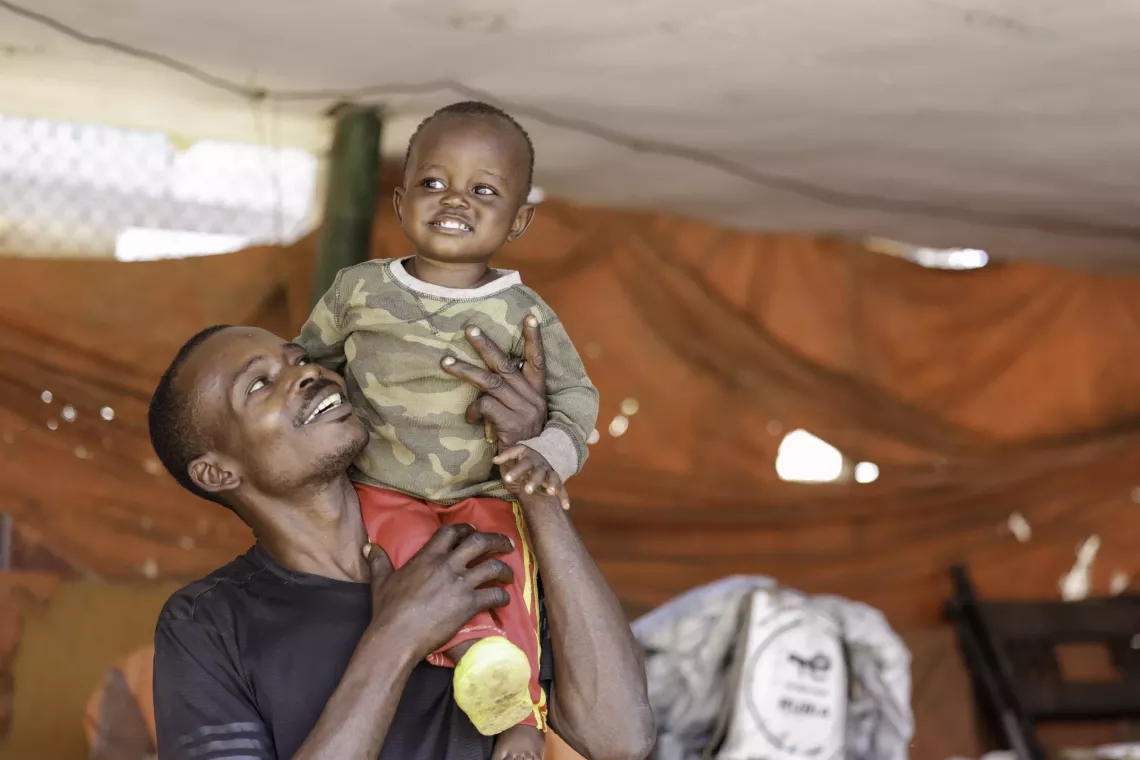
Under a semi-permanent shelter, Francis Byakatonda happily feeds his son, Joel Francis Byakatonda, aged one year and four months. The lunch time hour is an admirable bonding moment as the two smiles into each other’s eyes.
At four months, Byakatonda and his partner, Gift Birungi, had not yet taken their son for immunisation because he had not appreciated the need to, and travelled to the village in Kagamba sub county, Kooki village in Rakai District, Central Uganda where they spent four months.
On return to his home that is situated in Sserwanga zone in Lubaga division, where he does menial work at construction sites for a living, the 29-year-old father was visited by a Village Health Team (VHT) on an outreach session to sensitize locals on the importance of immunisation under the Gavi-funded Zero-dose Immunisation Program.
The public–private global health partnership with the goal of increasing access to immunization in poor countries Gavi and the World Health Organization (WHO) define ‘Zero dose’ as those children that have not received any routine vaccine. For operational purposes, zero-dose is defined as those children who have not been vaccinated with Diphtheria Pertussis Tetanus (DPT1).
Gavi, an international organisation that seeks to improve access to new and underused vaccines for children living in the world's poorest countries, has a vision of leaving no one behind with immunisation by 2030, inspired by aligned to Immunisation Agenda 2030 (IA2030) and the Sustainable Development Goals (SDGs).
About one in 10 children in Gavi-supported countries do not receive a single-dose of routine vaccines. The goal is to reduce the number of zero-dose children by 25% by 2025, and by 50% by 2030.
The Ministry of Health (MOH)/Uganda National Expanded Program on Immunization (UNEPI) is working with United Nations Children’s Fund (UNICEF) with support from Gavi and other immunisation partners in the implementation.
Byakatonda is grateful to the VHTs from Kisenyi Health Centre IV that visited his home and sensitised him about the importance of immunisation for his child. Milly Namaalwa, a Zero-dose consultant with UNICEF explains that the children’s fund facilitates provision of technical support as well as constant engagement with communities through health workers at health centres as well VHTs who are mentored and supported.
“Our slogan, ‘Leave no one behind with immunization’ and we are here to follow up as we sharpen our skills and knowledge. It is important to identify and make sure that every mother who walks in with their child is requested to present a child’s health card to make sure they are immunised at the ‘precious moments’. The VHTs play a big role as our eyes, ears and legs in communities where zero-dose children are found. The parents are sensitised on the benefits of immunisation,” Namaalwa explains.

Health facilities with high numbers of zero dose and under immunised children were prioritised and reached every month while those with less burden were reached at least once every quarter to sustain good performance.
This practice was a platform for continued skilling and capacity sharing with the DHT, health facility and VHTs to mainstream tracking and linkage of zero dose and under immunised children in their daily tasks.
Household child vaccination profiling - Home visits were used as a platform to carry out child immunisation registration by the VHTs. The health facilities have been able to have child community registers hence creating a village immunisation tracking record.
Before his child was immunised, he recalls his son persistently falling sick, ailing from fevers, diarrhoea, poor appetite, and complaints of stomach aches.
“I would continually take him to clinics for treatment which meant paying money every time we needed to treat the ailments. The cost of treatment would set me back by a considerable amount of money. I was happy to learn from the VHTs that Joel needed to be immunised for his health to stabilise. Ever since he was immunised, he has been a happy boy. He no longer suffers from fevers, or any ailments and his appetite is so good,” the jovial father explains.
A child is said to be fully immunized if they receive all due vaccines as per national immunization schedule. According to Ruth Apiot, a Registered Nurse (R.N) at Kisenyi Health Centre IV, Kisenyi is largely a slum in Kampala with a population of approximately 88, 000 people- locals and refugees of mainly Somali, Congolese and India nationalities.
She adds that the challenge in alleviating zero-dose children is that the refugees are constantly moving which makes it difficult to sensitise them and have their children fully immunised.
Apiot says an average of 30 babies are immunised at the health centre every day, most of them zero-dose babies. However, the staff also serve people seeking for services outside their catchment area; in Wakiso, Gayaza and Mukono.
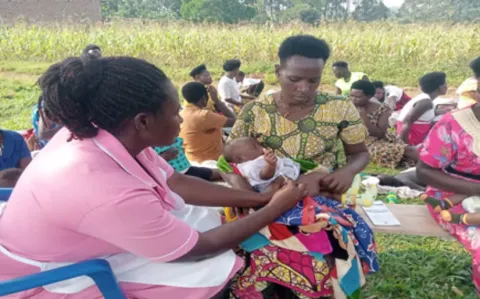
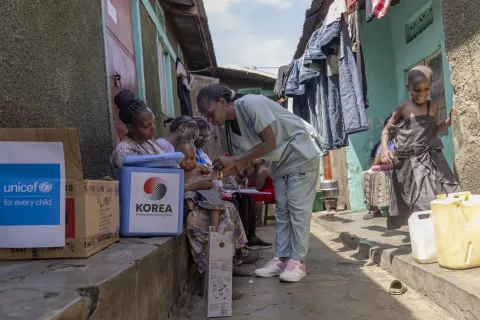
She adds that the catchment population for immunisation at Kisenyi Health Centre IV is about 12, 000. Under the zero-dose initiative, communities are reached through door-to-door contact, outreaches at work and follow-ups by VHTs so health workers immunise children in communities as well as at the health facility.
WHO states that immunization, a key component of primary health, currently prevents 3.5-5 million deaths every year from diseases like diphtheria, tetanus, pertussis, influenza, and measles.