Saving lives together: UNICEF, WHO and media continue providing accurate, clear, and reliable information to reduce health risks

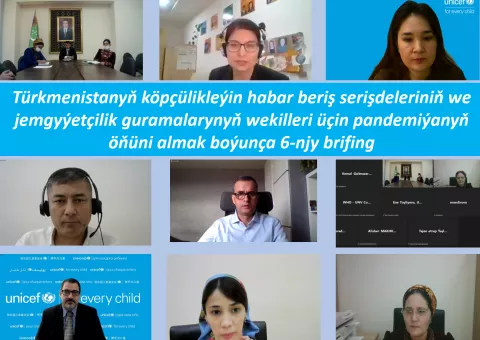
Ashgabat, 6 May 2021 – The fourth briefing on pandemic prevention for representatives of Turkmenistan’s media, organized today jointly with WHO and UNICEF is part of the Preparedness and Response Plan of Turkmenistan to Acute Infectious Disease, and builds on the previous three briefings aimed at raising awareness of journalists on the effective ways of communicating messages on pandemic prevention to the public.
During the event participants had an opportunity to get WHO updates on the global and regional situation related to COVID-19 and the latest updates in relation to the vaccines and immunization. UNICEF provided a set of the best lessons learned from regional practices and examples in communication on vaccination, and media representatives received useful advice on how to counter rumors and misinformation as well as on personal protection measures for professionals when reporting about COVID-19.
The webinar gathered over 20 participants from TV and radio channels, print media (newspapers and magazines), digital media outlets, as well as representatives from different regions of the country, officials of Health Information Centre of the Ministry of Health and Medical Industry. The media briefing provided an opportunity for media representatives to discuss with WHO and UNICEF experts how to best improve public health communication within the COVID-19 response.
“Globally, the COVID-19 pandemic and response have been accompanied by a massive ‘infodemic’ - an over-abundance of information, some accurate and some not, that makes it hard for people to find trustworthy sources and reliable guidance when they need it. We work to build partnerships with Media to strengthen the ethical, reliable and accurate information reports in every country, including Turkmenistan” – stressed WHO Project Manager, Mr. Alisher Makhkamov.
“UNICEF values the critical role media plays in communicating information that can make the difference between life and death. We believe that media professionals are key public health players, shaping perceptions of risk and targeting communities to protect health. The series of webinars was envisaged with the intention to strengthen the response against the invisible yet serious pandemic threat.” – said UNICEF Representative Christine Weigand.
The participants acknowledged a collective responsibility to collaborate to eliminate this pandemic, especially in providing reliable and accurate information to the population from the trusted sources.
As the vaccination rollout continues globally and, in the region, UNICEF and WHO with the series of media briefings intend to contribute to the efficient and strategic communication related to the process further strengthening the capacity of local media to inform the population about the risks of the pandemic and the benefits of vaccination and preventive health measures, as well as developing and disseminating necessary messages, thus confirming journalists and media contribution to the public health.
Media contacts
About UNICEF
UNICEF promotes the rights and wellbeing of every child, in everything we do. Together with our partners, we work in 190 countries and territories to translate that commitment into practical action, focusing special effort on reaching the most vulnerable and excluded children, to the benefit of all children, everywhere.
For more information about UNICEF and its work for children, visit www.unicef.org.
Follow UNICEF on Twitter and Facebook