“Every child is like a flower; if you water it properly, it will grow more beautifully.”
This is the sentence 35 year-old Halid, remembers most from the parenting sessions he attends in Kızılelma Container City in Antakya

- Türkçe
- English
“Every child is like a flower; if you water it properly, it will grow more beautifully.” This is the sentence 35 year-old Halid, remembers most from the parenting sessions he attends in Kızılelma Container City in Antakya. For him, the words capture how his understanding of fatherhood has changed.

Halid arrived in Türkiye from Hama, Syria, in 2015 with his wife. Today they live in the container city with their two young children, following the devastating earthquakes in south-east Türkiye in 2023. When he first heard about the early childhood sessions organized in the settlement, he thought they might be useful for his family. “I wanted to attend and learn something that could benefit my children and my home,” he says.
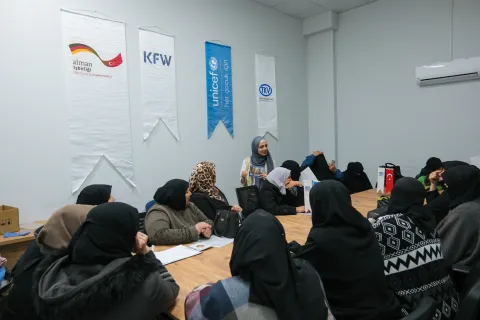
The early childhood sessions are part of a programme supported by UNICEF and implemented with the Development Foundation of Türkiye (TKV). Through six structured weekly meetings, parents and caregivers of children aged 0–8 learn about early childhood development, caregiving, parental roles and disability. The sessions apply a Social and Behaviour Change (SBC) approach, helping parents build the motivation, confidence and practical skills needed to support their children’s development.

Since September, more than 100 parents and caregivers have participated in the sessions in Kızılelma Container City alone.
According to TKV field worker Başak, who moderates the discussions, the sessions create space for fathers to reflect on their role in family life. “We see that fathers become more aware and start participating more actively in childcare at home,” she explains.
For Halid, the change has been personal. “Before, if a child misbehaved, I would raise my voice,” he says. “Now I understand that children are just being children.”


Since attending the sessions Halid reports that he spends more time with his children and supports his wife more in daily responsibilities. “My love and attention for my children and my wife have increased,” he says.

Halid is not the only father experiencing change. Anmar, a father of five who attends the sessions while his wife joins the mothers’ group, says the discussions helped strengthen communication at home. “After these sessions, our communication within the family improved, I started listening to my wife and children more and we started sharing more with each other,” he says. “In these sessions we think about what fatherhood means,” he adds. “We learn from each other and understand better how to support our families.”
For Kaled, another participant, the motivation was his child with a disability. He joined the sessions hoping to learn how to better support his child. “I realized that family life is a partnership,” he says. “A man and a woman should share responsibilities and help each other.”


Over time, he noticed changes in his relationship with his children. “Before, they were a little afraid of me,” he explains. “Now we talk more, and they feel closer to me.”
TKV field worker Dilay says these small shifts are at the heart of the programme. “We show fathers that spending time with their children is not only a responsibility but also a source of joy,” she says. Even a few minutes of playing together can support children’s emotional and cognitive development and strengthen family relationships.
In communities still recovering from the earthquakes, such changes are helping families rebuild everyday life. With financial support from the German Federal Ministry for Economic Cooperation and Development (BMZ) through KfW Development Bank, and with UNICEF’s continued assistance, parents are gaining the tools and confidence to create nurturing environments where children can learn, grow and feel safe.