Transforming Learning Through ICT in Timor-Leste
In Gleno, Ermera Municipality, digital learning is improving teaching practices and expanding opportunities for students


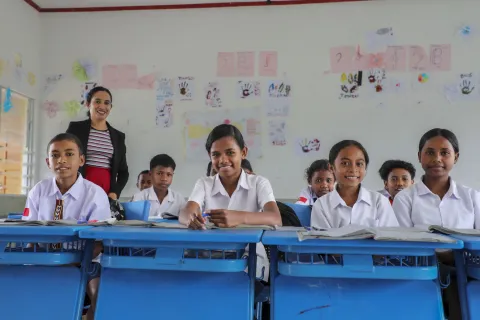
Gleno, 18 March 2025 - In the cool highlands of Gleno, where the air is fresh and the mountains stretch quietly into the distance, education is taking on a new life. At EBC 10 de Abril 99 Gleno, learning is expanding beyond chalkboards and textbooks, becoming more dynamic, visual, and full of possibility.
For 15-year-old Esterlina, a Grade 9 student, school is the first step toward her dream of becoming a doctor. As the youngest of four siblings, she carries both hope and responsibility. Her inspiration began with children’s storybooks (Lafaek), which sparked her curiosity about the world.
Esterlina’s favorite subjects are Tetum and English. For her, learning Tetum is about identity and responsibility. “It is our official language. We must protect and promote it,” she says. At the same time, she sees English as a bridge to opportunity, especially her ambition to study abroad and pursue a career in medicine.
In the same classroom, her classmate Abrão, also 15, dreams of becoming a pilot. The youngest of six siblings, Abrão’s aspirations were shaped by the films he watches, stories of travel, adventure, and discovery. He imagines himself flying across countries, connecting with people from different cultures.
To achieve this, Abrão focuses on Mathematics and English.
"To become a pilot, you need strong calculation skills and English", he explains. “If I travel to many countries, I want to be able to communicate with people.”

For students like Esterlina and Abrão, dreams are powerful, but they require support. At EBC 10 de Abril 99 Gleno, that support is increasingly coming through digital learning.
In 2025, students and teachers at the school participated in Information and Communications Technology (ICT) training, where they learned the basics of digital tools, including how to create email accounts and access the Eskola ba Uma (EbU) Learning Passport. This platform has opened a new world of learning resources, interactive lessons, summaries, and videos that make education more engaging.
“Before, we only read from books,” Esterlina shares. “Now, we can also learn through videos and digital content. It makes learning more alive.”
Students are particularly enthusiastic when teachers use projectors in class. Lessons become more visual and interactive, helping them understand concepts more easily. Beyond academic subjects, the platform also introduces them to 21st-century skills, especially in digital literacy, financial awareness, and language development.
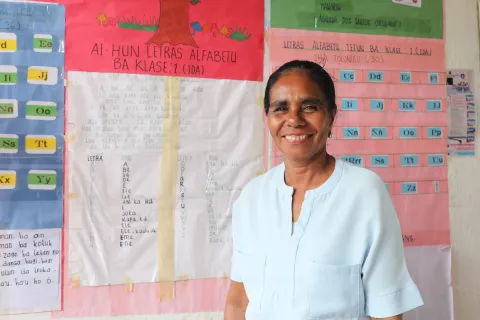
Teachers, too, are experiencing a transformation. Agata, a 35-year-old Portuguese language teacher, has been teaching at the school for two years. Before the introduction of ICT, her lessons relied heavily on writing on the board and summarizing content for students, methods that were time-consuming and limited interaction.

“With limited time, we spent too much effort writing on the board,” she explains. “This reduced our ability to engage students in practice and made it difficult to support each student individually.”
The lack of learning materials, including textbooks and dictionaries, added to the challenge.
Now, with ICT tools such as projectors, tablets, and the Eskola ba Uma (EbU) Learning Passport, Agata’s teaching approach has evolved. Lessons are more interactive, allowing more time for practice, especially in language learning. Visual aids, animations, and online dictionaries help students better understand and retain information.
“I see that students are more interested and active in class,” she says. “Learning is no longer just from books, it comes from images, videos, and interaction. The classroom feels more alive.”
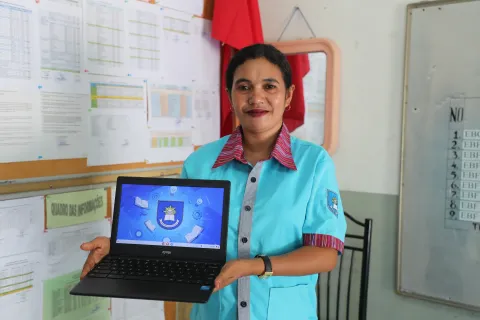
School leadership also recognizes the importance of integrating technology into education. According to Angelina Rica Mali Soares, the school’s Deputy Director, ICT is essential in preparing students for the demands of the digital era.

“If students are introduced to ICT early, they will be more confident when they continue their studies, especially at university,” she explains.
In 2025, the school, along with its six branches, participated in ICT training supported by the Ministry of Education, through the National Directorate of Basic Education (DNEB) and the National Directorate of Information Systems and Technology (DNSIT). Both teachers and students received training in basic ICT skills, including hardware and software use, Gmail creation, and access to the Eskola ba Uma (EbU) Learning Passport.
The school also received essential equipment, including tablets, projectors, laptops, television screens, and a generator to support teaching and learning activities.
Despite these advancements, challenges remain. Internet connectivity is still inconsistent, and electricity is not always stable. Continued training for teachers is also needed to ensure the effective use of technology in classrooms.
This initiative, supported by WEMADE through UNICEF Korean National Committee and implemented by UNICEF Timor-Leste in partnership with the Ministry of Education, is helping bridge the digital divide in education, reaching schools across municipalities Ainaro, Ermera and Liquica, and benefiting 364 teachers, 10,300 students including 15 with disabilities in the project schools, and 285 adolescents and youth.
For Esterlina and Abrão, ICT is more than just a tool, it is a pathway. It brings their dreams closer, making them feel possible and within reach.
In a world increasingly shaped by technology, the presence of ICT in schools like EBC 10 de Abril 99 Gleno is not just important, it is essential. It is equipping a new generation with the knowledge, skills, and confidence they need to navigate the future.
//Ends.