Complementing textbooks with digital learning tools
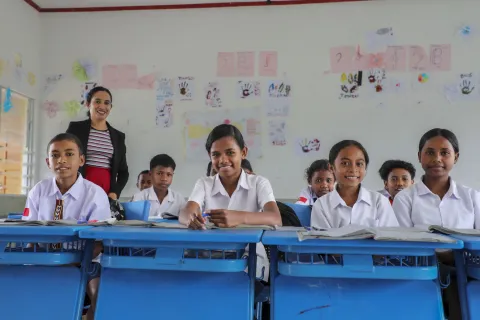
Students at Quatro Montanhas Basic Education School are learning by using ICT digital tools in the classroom

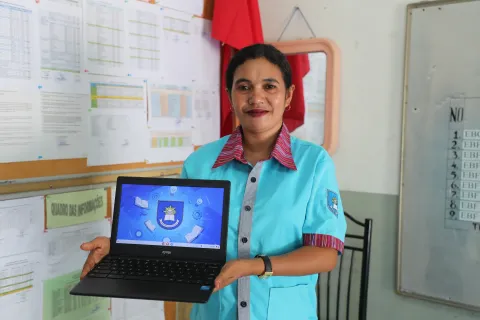
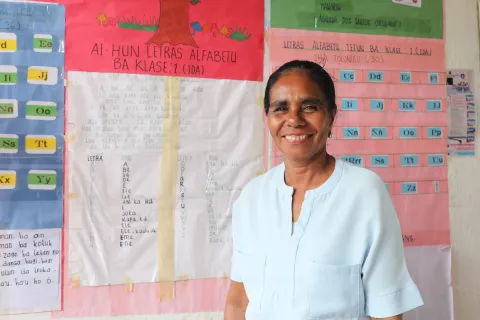
“This is the first time I am implementing the use of ICT equipment to teach students in the classroom,” says Durvalina Magno Xavier do Espirito Santo, a dedicated teacher at Quatro Montanhas Basic Education School in Ainaro Municipality.
Teacher Durvalina has been teaching health and well-being, as well as arts and culture, to seventh and eighth-grade students at the school since 2016.
Since Timor-Leste gained independence in 2002, the country has shown a strong commitment toward improving the quality of education across all levels. Progress in the education sector has improved impressively year after year. The number of children registered in the basic education system has risen, alongside daily school attendance rates.
Despite this progress, significant hurdles remain - particularly regarding internet access. At Quatro Montanhas Basic Education School, most students do not have internet access at home due to financial constraints. Instead of smartphones, many families rely on basic, older-model phones, making it impossible for children to connect and learn online.

“Most of the students at this school do not have access to the internet because they come from vulnerable families,” Teacher Durvalina explains. “Their families do not own smartphones or have the money to buy phone credit so that their children cannot access the internet every day.”
When teaching, Teacher Durvalina adapts her methods to guide her students. She often teaches using standard manual textbooks, organizing the students into small groups to facilitate peer-to-peer learning and keep the classroom interactive, before summarizing the lesson at the end.
“I use textbooks while teaching, give students time to discuss issues in groups, and make a conclusion at the end,” says Teacher Durvalina. “I organize them into small groups so they can effectively learn from one another. However, this method remains a challenge because most students struggle to understand the difficult words or terminology they encounter in the textbooks. I also conduct reviews with them as exams approach.”
She adds, “If I didn't use these interactive methods, many students might repeat the grade or even drop out of school entirely, because they wouldn't have the opportunity to support each other's learning.”
To address some of these challenges, UNICEF has been supporting the Ministry of Education since 2023 to introduce ICT and digital classrooms at the basic education level. This initiative has provided computers, projectors, and tablets to primary schools, including Quatro Montanhas Basic Education School. Comprehensive training on utilizing this technology was provided to both teachers and students, with Teacher Durvalina and several of her students attending training sessions in 2025.

“I attended two ICT training sessions - the first in 2023 and the second in 2025," Teacher Durvalina says. "I was so happy because it was the first time I truly understood the importance of ICT in the teaching and learning process. It has really helped me. During these two sessions, I learned how to use Google Chrome, create an email address, and access the ‘Eskola Ba Uma’ platform.”
Following her training, Teacher Durvalina began introducing these modern tools to her classroom. She showed her students how to open Google Chrome, set up email accounts, navigate the AMO Translator app, conduct Google searches, and even explore the ChatGPT application.


“The students from grades 5 to 7 were incredibly enthusiastic when I trained them on Google Chrome, ChatGPT, and Google Search,” says Teacher Durvalina. “I noticed one of my students, Delfier, was particularly interested in learning how to use search function for learning. He is my immediate neighbor, and I later saw him accessing the internet using his parents' smartphone. It was wonderful to see students learning skills that connect them to the digital world.”
“Today, I am happy because I can teach grade 8 students using tablets donated by UNICEF," she continues. "I teach them how to use ChatGPT and Google to search for difficult words in Portuguese, asking the system to explain the details and provide examples. The students are thrilled to use these apps because it helps them instantly understand words that previously confused them.”
Teacher Durvalina believes that if students continue to use ChatGPT and Google as learning aids, it will vastly improve their academic comprehension. By asking these tools to break down complex sentences and offer developmental ideas, students will be better equipped to pass their exams and advance to higher grades.
Utilizing ICT equipment like laptops and projectors saves valuable time and energy, allowing her to simply project the lesson onto the wall and begin explaining.
“We no longer need to spend a large amount of time asking students to copy notes down manually," she concludes. "It is much easier to use ICT equipment in the classroom; we don't exhaust our time and energy on writing. Instead, we can easily facilitate the classroom and dedicate more time to student discussions. At the end, I summarize the lesson. I love using ICT equipment because it truly empowers both me and my students.”

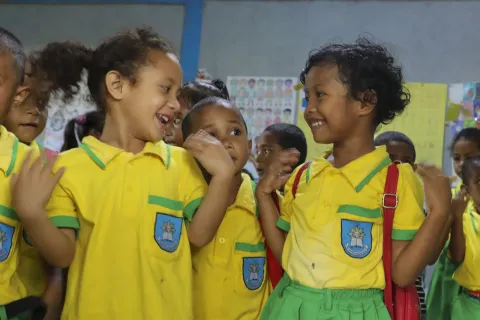
Quatro Montanhas Basic Education School consists of 24 teachers and 275 students from grades 1 to 9. It serves as a central basic education school, overseeing 5 subordinate filial schools. The institution operates under the direct supervision of the municipal branch of the Ministry of Education in Ainaro Municipality.
UNICEF has been supporting the Ministry of Education to introduce a blended approach to teaching learning with the use of responsible use of digital resources where textbooks alone do not suffice. This endeavor is also part of promoting digital literacy which is a critical 21st century skill.
This initiative is made possible through the generous support from VINCI Energies working together with French National Committee for UNICEF, UNICEF Timor-Leste and Ministry of Education to enable improvement of quality education using ICT in Timor-Leste.