Girls in Timor-Leste supported to realise their vision for the future
Girls in Timor-Leste supported to realise their vision for the future

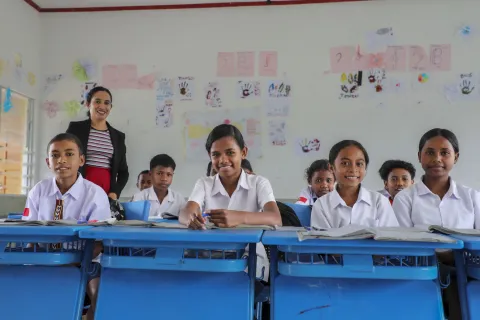
Ermera, 27th September 2024 - From an early age, a young Emerensiana, has always wanted to be a teacher, a profession which is greatly revered by everyone in her village in Ermera Municipality. Coming from a poor household, it is through pursing this profession that Emerensiana believes fortunes will turn for her family. She is therefore happy that in a month’s time, she will be sitting for my final examinations, which will pave the way for her to go to college.
“I want to pursue my dreams of becoming a Portuguese teacher and help parents and six siblings,” says Emerensiana, whose fiery determination and confidence has helped her to overcome a lot of adversities to finally reach this milestone in her life.
There is no high school in the village where Emerensiana grew up. A 10km distance between the village and the nearest high school, has for long stood as a huge barrier for girls to fulfil their dreams of advancing with their education. Coupled with pervasive household poverty and some harmful patriarchal attitudes which do not promote girls’ advancement in society, many girls from the village often opt to drop out of school and get married at an early age.
Similarly, across Timor-Leste, girls from vulnerable backgrounds often lack the capacity to take ownership of key decisions in their lives including continuing with education, marriage, pregnancy, first sexual experience, and career planning. As a result, more than 19 per cent of young women are married before they reach 18 years and 24 per cent of young women already have a child by the time they turn 20 years. With little education and low self-esteem, these girls often live in a perpetual cycle of poverty and deprivation.
Determined to set an example to other girls in her community, Emerensiana convinced her parents to allow her to be hosted by her uncle and aunt in a village which is closer to the high school. But the six years in a new family and new community, also came with its own challenges.
“I miss my family a lot and it was not easy for me to settle in with a new family,” says Emerensiana, who struggled with adjusting in the new household, with 15 other members.
It was also cumbersome for her to find ways to juggle her time between contributing to the household chores and doing her homework. She also struggled to make friends and often felt alone, nervous and excluded from the family and the community where she had moved to.
Thanks to the constant support, counselling and mentorship from a local Non-Governmental Organisation, PRADET, Emerensiana has now learnt to adjust to her new environment and to adopt coping strategies to overcome these social barriers, which almost derailed her dreams.
Through the Girls’ Empowerment Programme, which is being supported by UNICEF through PRADET, girls like Emerensiana are being engaged in lifeskills mentorship sessions on leadership, managing emotions and on reproductive health to strengthen their skills and participation in different life settings, including at school.
More than 100 girls from Ermera and Viqueque municipalities are currently a part of this programme, which is helping to girls to challenge harmful gender norms and practices at the local level, and to strengthen communities’ knowledge about availability of support services in case of violence, or other child protection issues.

“When I left home, a lot of my other friends did not get the opportunity that I have got to continue with learning. Most of them have stopped pursing their dreams. They are now married and have turned their focus to the marriage and to raising their children,” says Emerensiana, who is grateful for the Girls’ Empowerment programme for helping her find new friend and to manage the various social changes which she faced in her pursuit of an education.
The girls from the programme meet on a regular basis to exchange information and knowledge on how to prepare for their future by completing their education and through acquiring skills and knowledge to help them make better decisions and life choices. The mentors also provide emotional and psychosocial to the girls faced with vulnerable situations.
While Emerensiana is excited about completing High School, her peer, Victoria (name changed), who is also a member of the Girls’ Empowerment Group, is picking-up the pieces and taking bold steps to re-enter the classroom. Two years ago, 16-year-old Victoria had to put her education on halt as she fell pregnant and became a wife. Victoria is now getting help and encouragement to continue pursuing her set goals in life, despite her added roles of being a mother and a wife. She also wants to be a teacher and wishes to ensure that she earns enough money to help her raise her son in a safe, happy and healthy way.
“By being part of the Girls’ Empowerment programme, I have learnt that I must not lose hope because I now have a baby. The programme has helped me to regain my confidence and to overlook the societal mockery of me as an adolescent mother ”, says Victoria, who is happy that her parents have arranged for her to go back to school and continue with education.

Financial support from the Australian Government through the Australian NGO Cooperation Program (ANCP), is helping UNICEF to work closely with Pradet and relevant Government institutions to support girls like Emerensiana and Victoria overcome the barriers to the fulfilment of their vision for the future.
///Ends