Over five million girls in Tanzania to receive HPV vaccine to combat Cervical Cancer
Joint statement: Ministry of Health Tanzania, Gavi, WHO and UNICEF
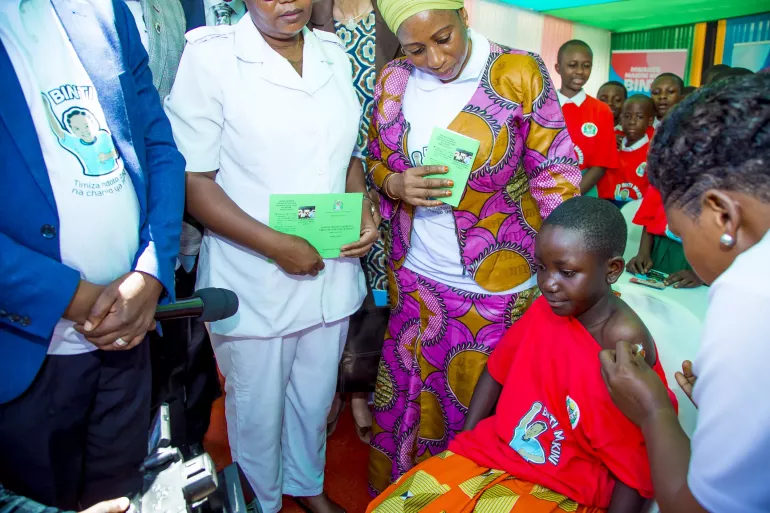
Mwanza / Geneva 22 April 2024: The Ministry of Health, in partnership with the Vaccine Alliance (Gavi), UNICEF, and the World Health Organization (WHO), today launched the national multi-age cohort (MAC) vaccination campaign against the leading cause of cervical cancer in the United Republic of Tanzania. The campaign, which is targeting five million girls aged between 9 and 14, will run from Monday, 22 April, to Friday, 26 April 2024.
While cervical cancer remains a significant cause of death among women in Tanzania, with more than 10,800 cases and 6,800 deaths in 2022 alone, it is vaccine preventable. The HPV vaccine is safe and highly effective in preventing infections. During the campaign, eligible girls will have the opportunity to receive a single dose of the HP vaccine at no cost.
Efforts to increase access to the HPV vaccine across Tanzania have made substantial progress. In 2018, the two-dose vaccine was integrated into the national routine immunization programme for 14-year-old girls, demonstrating the Government's commitment to safeguarding the health and well-being of future generations.
To date, the coverage of HPV for the first dose has reached 79 per cent and the second dose is at 60 per cent. Combined efforts are needed to ensure every girl in Tanzania receives crucial protection against this often deadly yet preventable disease. Following the MAC campaign, the vaccine will continue to be provided routinely as a single dose to nine-year-old girls. It will go a long way towards increasing girls’ protection.
Tanzania’s progress in administering the HPV vaccine is a critical part of a broader global initiative supported by the Vaccine Alliance, which has committed additional funding and resources towards reaching 86 million girls worldwide with the HPV vaccine by 2025.
The campaign will leverage the African Vaccination Week, synchronized with the World Immunization Week (24 to 30 April), during which routine childhood vaccinations along with health education will be provided for girls in schools, health facilities, and community centres countrywide.
Throughout this week, the Ministry of Health, WHO, Gavi, and UNICEF are urging communities to encourage girls to get vaccinated against cervical cancer and aim for a future where no girl is burdened by this disease.
Notes to Editors
Multi-age cohort campaigns are implemented alongside a routine immunisation introduction, to maximise impact by reaching eligible girls outside of the targeted age for HP vaccination through the yearly routine immunisation system (14 years old in Tanzania).
Resources:
Media contacts
About GAVI, the Vaccine Alliance
Gavi, the Vaccine Alliance is a public-private partnership that helps vaccinate more than half the world’s children against some of the world’s deadliest diseases. The Vaccine Alliance brings together developing country and donor governments, the World Health Organization, UNICEF, the World Bank, the vaccine industry, technical agencies, civil society, the Bill & Melinda Gates Foundation and other private sector partners. View the full list of donor governments and other leading organisations that fund Gavi’s work here.
Since its inception in 2000, Gavi has helped to immunise a whole generation – over 1 billion children – and prevented more than 17.3 million future deaths, helping to halve child mortality in 78 lower-income countries. Gavi also plays a key role in improving global health security by supporting health systems as well as funding global stockpiles for Ebola, cholera, meningococcal and yellow fever vaccines. After two decades of progress, Gavi is now focused on protecting the next generation, above all the zero-dose children who have not received even a single vaccine shot. The Vaccine Alliance employs innovative finance and the latest technology – from drones to biometrics – to save lives, prevent outbreaks before they can spread and help countries on the road to self-sufficiency. Learn more at www.gavi.org and connect with us on Facebook and Twitter.
About UNICEF
UNICEF promotes the rights and wellbeing of every child, in everything we do. Together with our partners, we work in 190 countries and territories to translate that commitment into practical action, focusing special effort on reaching the most vulnerable and excluded children, to the benefit of all children, everywhere.
For more information about UNICEF Tanzania and its work for children, visit www.unicef.org/tanzania.