MUHAS and UNICEF launch landmark course on Risk Communication and Community Engagement
Strengthening readiness for emerging public health threats in Tanzania
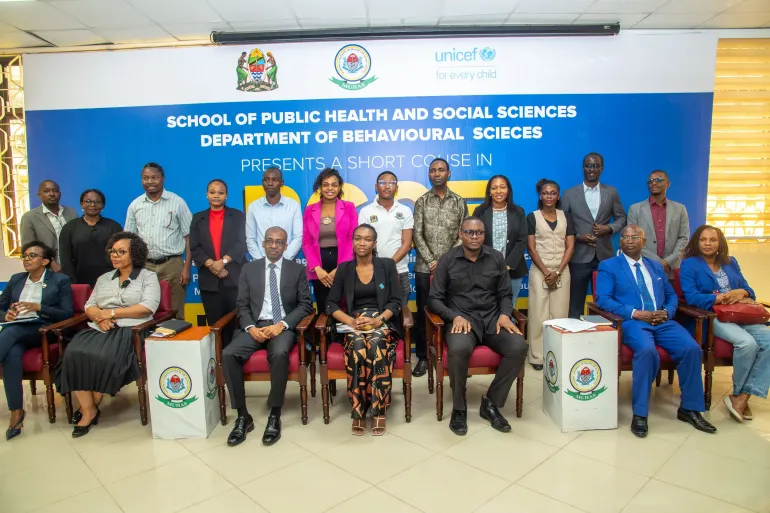
Dar es Salaam, Tanzania – 12 June 2026: The Muhimbili University of Health and Allied Sciences (MUHAS), through its School of Public Health and Social Sciences, Department of Behavioural Sciences, in collaboration with UNICEF Tanzania, today launched a new accredited course on Risk Communication and Community Engagement (RCCE), with integrated Mental Health and Psychosocial Support (MHPSS) modules. The launch brought together academic leaders, public health practitioners, development partners, government representatives, students, and members of the media.
The course is designed to strengthen national capacity in risk communication and community engagement, a critical pillar of effective public health emergency preparedness and response. It will equip health professionals, communicators, community workers, and emergency responders with the practical skills needed to deliver timely, accurate, and trusted information, while meaningfully engaging communities in shaping health responses.
Professor Emmanuel Balandya, Deputy Vice Chancellor of MUHAS, said, “The University remains firmly committed to producing graduates equipped to address emerging and complex public health challenges, including epidemics, climate-related emergencies, and the growing threat of misinformation.”
Speaking at the launch, Patrica Safi Lombo, UNICEF Deputy Representative, commended MUHAS for its leadership in advancing public health education in Tanzania, emphasizing the life-saving power of effective communication and community trust during health emergencies.
“Trust is the foundation of every effective public health response. This course is an important investment in building a skilled workforce that can communicate clearly, listen to communities, and respond in ways that protect lives. This course is part of UNICEF’s broader support to Tanzania’s preparedness efforts, and we remain committed to working with the Government and partners to strengthen systems, build capacities at all levels, and help ensure the country is ready for emerging public health threats,” she said.
On her part, Professor Emmy Metta, Head of the Department of Behavioural Sciences, appreciated UNICEF and MUHAS long standing partnership in Social and Behavior Change system strengthening.
The course draws on lessons from recent global and regional health emergencies, including COVID-19, cholera, and Marburg virus outbreaks, and aligns with the International Health Regulations (IHR 2005) and Tanzania’s national health emergency preparedness frameworks.
Enrolment details for the first cohort will be announced through the MUHAS website and official social media channels.
Media contacts
For enrollment inquiries, please contact:
Awet Araya Bahlbi, [email protected], Social and Behavior Change Lead, UNICEF.
Dr. Hussein Mohamed, [email protected] , Social & Behavior Change Liaison
School of Public Health and Social Sciences, MUHAS.
About MUHAS
The Muhimbili University of Health and Allied Sciences (MUHAS) is Tanzania's leading health sciences university, renowned for excellence in education, research, innovation, and public service. Through its schools, institutes, and centres, MUHAS trains health professionals, conducts high-impact research, and provides specialized services that contribute to improving health outcomes in Tanzania and beyond.
About UNICEF
UNICEF is on the ground in over 190 countries and territories to help children survive and thrive, from early childhood through adolescence. The world’s largest provider of vaccines for developing countries, UNICEF supports child health and nutrition, good water and sanitation, quality basic education for all boys and girls, and the protection of children from violence, exploitation, and AIDS. UNICEF is funded entirely by the voluntary contributions of individuals, businesses, foundations and governments.
For more information about UNICEF and its work visit: www.unicef.org