Canada’s support enhances access to critical services for children and adolescents in Tanzania
High-level visit to Zanzibar highlights progress in adolescent health, education, nutrition, and empowerment through partnerships with the Government of Tanzania, UNICEF, and UNFPA

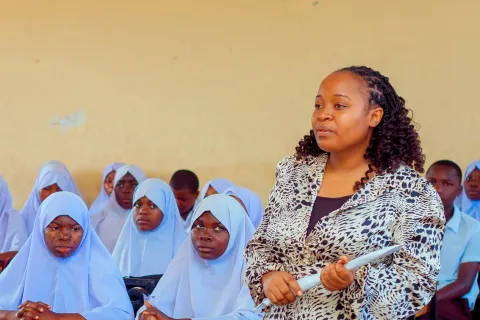
On 22 July 2025, the Canadian Secretary of State for International Development, Honourable. Randeep Sarai, Canada's High Commissioner to Tanzania, H.E. Emily Burns, visited Mwera Pongwe Secondary School in Unguja, Zanzibar, as part of a high-level visit aimed at highlighting Canada's development partner leadership in advancing adolescent health, education, and empowerment.
Accompanied by Honourable Lela Mohamed Musa Zanzibar's Minister for Education and Vocational Training, UNICEF Representative ai. Patrick Codjia and UNFPA Representative a.i Dr Azzah Nofly, the visit highlighted Canada's strategic partnership with UNICEF and UNFPA in delivering impactful, results-based programmes for adolescent girls and boys in Tanzania.
Canada's support through Global Affairs Canada (GAC) has been instrumental in advancing adolescent health, education, and empowerment. As a result of Canada's support for adolescent nutrition, through the Zanzibar School Health and Nutrition Programme implemented by UNICEF, more than 38,000 girls receive weekly iron and folic acid supplements, and over 72,000 adolescents have benefited from comprehensive nutrition education, contributing to improved health and academic performance.
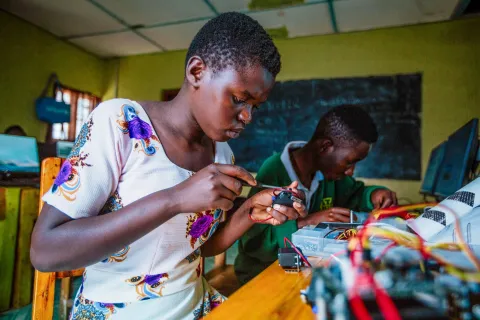
Furthermore, the delegation observed the impact of the Integrated Programme for Out-of-School Adolescents (IPOSA), which UNICEF implements in collaboration with the Ministry of Education, Science, and Technology on the mainland, as well as the Ministry of Education and Vocational Training in Zanzibar, through the Every Adolescent Girl Learns (EAGL) programme.
Since its launch in mainland Tanzania in 2019 and in Zanzibar in 2024, IPOSA and ZIPOSA have reached over 80,000 adolescents, with 68 per cent of them being girls. Notably, 70 per cent of graduates are now employed or self-employed, demonstrating the programme's effectiveness in fostering socio-economic participation.
Canada's support has also been instrumental in driving flagship initiatives on Sexual and Reproductive Health (SRH) and Education. The SRH initiatives include the five-year Girls' Reproductive Health, Rights and Empowerment Accelerated in Tanzania (GRREAT2019-2024), and the five-year Kijana Imara on improving equitable access to quality SRHR launched in 2024 jointly implemented by UNICEF and UNFPA in collaboration with the Government of Tanzania on the mainland and Zanzibar.
These initiatives have significantly improved access to gender-sensitive and adolescent-friendly sexual and reproductive health services. They have reached over 1.5 million adolescents in schools and communities, and 8.8 million through radio. The endline assessment revealed a 25 per cent increase in empowerment levels among adolescent girls, with over 80 per cent reporting access to quality SRH and nutrition services.
The results achieved in partnership with Canada exemplify scalable approaches that strengthen government systems and lay the groundwork for broader national uptake, ultimately benefiting adolescents, particularly girls, across the country.
The high-level visit underscores Canada's commitment to strategic partnerships and results-based programming that empower adolescents, advance gender equality, and improve health and education outcomes in Tanzania. The collaboration between Canada, UNICEF, UNFPA, and the Government of Tanzania continues to deliver a measurable and sustainable impact for adolescents, contributing to Tanzania's Vision 2050.
Media contacts
About UNICEF
UNICEF promotes the rights and wellbeing of every child, in everything we do. Together with our partners, we work in 190 countries and territories to translate that commitment into practical action, focusing special effort on reaching the most vulnerable and excluded children, to the benefit of all children, everywhere.
For more information about UNICEF Tanzania and its work for children, visit www.unicef.org/tanzania.