Resilience of a loving family
Mental wellbeing and psychosocial support help children and families cope with hardship

Aleppo, Syria - “I remember hiding under my bed covers whenever I heard sounds of fighting. It was my safe place. I didn’t know better then, and I am glad I didn’t,” said Waed, 12, recalling his early childhood years.
Bushra, 40, was pregnant with Waed in Aleppo city, where the family lives, at the height of the conflict in 2012. She lived in constant fear, worried about the safety of her unborn child. “I feared the present and the unknown. Everything was vague, and I felt a very difficult journey was about to start,” she said.
In 2015, the family fled their home for a safer shelter. “Most of our neighbours were gone. We felt like strangers in our building, so we decided to leave,” said Bushra. A couple of months later, the family returned home after failing to find a safer place to stay. When violence subsided in the area, Waed had turned 6, and he was ready to start school. His mother enrolled him in one near their house. “It was one of the happiest moments in my life. I remember meeting many students and thinking that my path towards a bright future begun,” Waed said.

In 2018, Bushra’s family grew bigger when she gave birth to her daughter Sara. “I hoped for better days ahead. I thought it was the time that our family would start living at ease, but the economic hardship disrupted my wishes,” Bushra said.
Bushra, who works as a teacher, and her husband, a mobile technician, struggle to make ends meet, just like many families in Syria, where 90 per cent of the people live in poverty after more than 13 years of conflict.
“Previously, our income was limited, yet we were able to have enough food on our table. Now, we stick to the basics and leave other items for special occasions,” said Bushra, who is doing her best to cope with the difficult situation. “l learnt how to make the items we couldn’t buy. I didn’t want my children to feel hungry or grow up deprived of any food they loved,” she added.
When the earthquakes struck Syria in February 2023, they brought back memories of the most difficult years in Bushra’s life.
Despite the hardship, she tried her best to shield her children. “My sister and I were terrified when the earthquake struck very early in the morning, but my mom told us not to be scared because it was a dream. I was relieved,” Waed said.
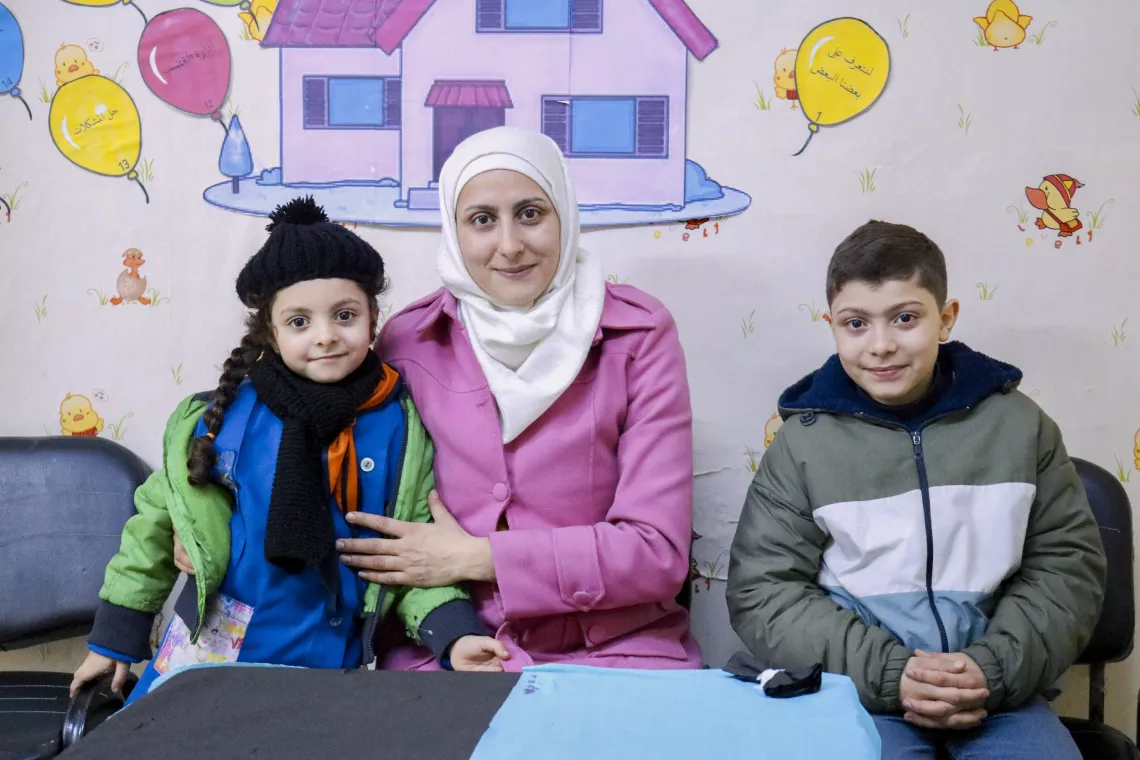
“I had been mentally exhausted for years. The conflict, the financial distress, the COVID-19 pandemic and finally the earthquakes made me more fearful. Things accumulated, and I was in dire need of help. I didn’t want to transfer my fears to my children,” said the mother. In 2023, Bushra heard from her relatives about a mental health and psychosocial support programme a UNICEF partner provides in Aleppo. She went to their centre and started attending parenting sessions while Waed and Sara benefitted from psychosocial support sessions. Bushra and her children learnt more about how to express their feelings, manage their emotions, and positively cope with life’s hardships.
“The sessions helped me to understand my emotions and communicate better. The programme improved my relationship with my children and my students at school,” she said. The positive change in Bushra’s behaviour was also visible for her children. “She is calmer now, and I see her taking deep breaths before she reacts when we make mistakes,” said Waed smiling. “She also sets a quality time for us every week. We think of topics we want to talk about, and when we’re together, we talk about them,” added Sara.
“I want to make my mom happy,” said Waed, when asked about what he wants to do in the future. “When you and your sister are alright, I am the happiest,” Bushra responded.
In 2023, UNICEF reached more than 34,800 children with mental health and psychosocial support and nearly 9,300 caregivers with parenting sessions in Aleppo. During the same period, UNICEF reached some 72,300 caregivers with the parenting programme and some 388,000 girls and boys with mental health and psychosocial support across the country. The activities were funded by the Bureau for Humanitarian Assistance (BHA/USAID); the German Federal Ministry for Economic Cooperation and Development through the KFW Development Bank; the Governments of Australia, Canada, Italy, Japan and New Zealand; the Global Humanitarian Thematic Fund; the Swiss Agency for Development Cooperation; the Swedish International Development Cooperation Agency; the Foreign Commonwealth and Development Office; UNICEF National Committees for Australia, Canada, Denmark, Germany, Ireland and UK; UNICEF Egypt, Singapore and United Arab Emirates; and United Nations Central Emergency Response Fund.