Cholera situation report 10 November 2022
Snapshot of current needs and response - concise operational document to support the coordination of the humanitarian response.

Current situation
According to the latest surveillance data from WHO Syria, 92 deaths (case fatality rate 0.3 per cent) and 35,569 suspected cases of cholera have been reported between 25 August and 9 November 2022. The number of confirmed and suspected cases continues to increase rapidly. While all 14 governorates reported confirmed cases, the governorates depending on Euphrates River for water and sewage remain among the most affected1. The water level of the Euphrates River continues to decrease, reaching a similar level to 2021, with an impact on electricity supply as well as water quality, production, and distribution. Although the Alouk water station resumed operations at the end of October, about half a million people in Al Hasakeh city and neighbouring areas are still not receiving sufficient quantities of safe water.
With the challenges in accessing appropriate and adequate WASH services and healthcare, internally displaced people (IDPs) and families remain highly vulnerable. Over 250 suspected cases have been detected in overcrowded IDP sites across Syria. IDPs in NES and rural Aleppo (86 cases) and NWS (167 cases) are the most affected.
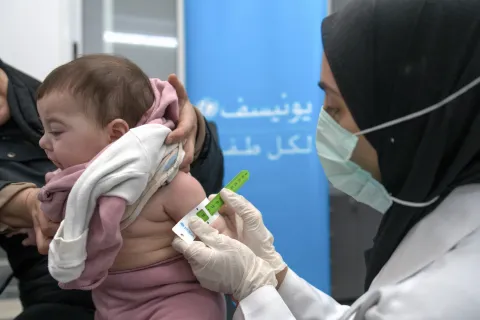
Of the suspected cases of cholera, 1 out of 4 are children under the age of 5. Malnutrition is increasing and diarrhoeal diseases further worsens the condition of malnourished children. This impacts the overall survival rate of children suffering from severe wasting.
1 The most affected governorates to date are: Deir-ez-Zor (15,885 cases, 44.7%), Ar-Raqqa (8,420 cases, 23.6%), Aleppo (5,996 cases, 16.9%), Idlib (3,305, 9.3%) Al-Hasakeh (1,501 cases, 4.2%).
Coordination and response strategy
To keep children and communities safe, UNICEF continues to invest in preventive measures and efforts to implement a rapid response at scale to curb the spread of the disease and limit its negative impacts. UNICEF and partners are actively coordinating the response, holding key roles in the incident management teams in Amman (for Whole of Syria level), Damascus and Gaziantep. UNICEF leads the pillars for water, sanitation, and hygiene (WASH) and risk communication and community engagement (RCCE), as well as contributes extensively to the case management pillar and co-leads the operations, supply and logistics pillar. As the cluster lead agency, UNICEF continues to coordinate the WASH response to cholera at Whole of Syria level as well as in northwest Syria and in Damascus at both national level and across the affected governorates.
UNICEF is working closely with WHO and partners on the ground and seeks to reach 690,000 people with its WASH, health and RCCE response until the end of December 2022. UNICEF's health response aims to provide critical services and respond to an estimated 161,000 cholera cases, including 40,000 expected severe cases. UNICEF continues to lead national RCCE coordination to leverage partnerships to scale up interventions with WASH, Health and Education sector partners in the most affected communities. Cholera response and response planning is being undertaken for all areas of Syria, including northwest Syria, northeast Syria and access for Ras Al-Ain/Tel Abiad. UNICEF and WHO Syria conducted a mission to Ras Al-Ain on 27 October 2022 to implement Health and Nutrition and WASH related assessments and provide assistance, including related to the ongoing cholera outbreak.
Health

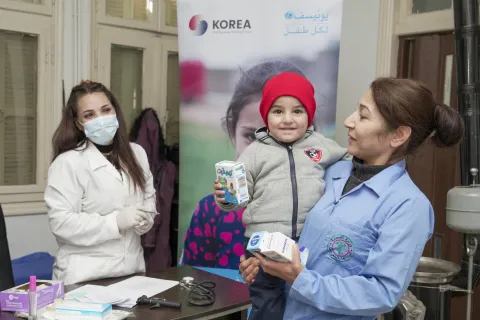
UNICEF is supporting the Ministry of Health (MoH) to conduct six rounds of training for 180 health workers on infection prevention and control (IPC) and surveillance. The first training was held in late October and included 30 participants from Homs, Lattakia, and Tartous districts. The second training will be implemented in mid-November for 30 health workers from Dara’a, Sweida and Quneitra districts.
UNICEF procured AWD kits and Personal Protective Equipment (PPE) have arrived in Turkiye. To distribute these supplies in northwest Syria (NWS), a distribution plan is being finalised, in coordination with WHO, according to the caseload. UNICEF is also finalizing the plan to support the transportation and management of supplies and the service delivery through two cholera treatment centres (CTCs), and five oral rehydration points.
Water, Sanitation and hygiene

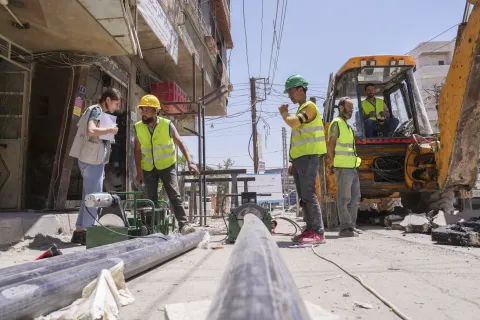
UNICEF is continuing the provision of an average of 200 m3 of water daily through water trucking to cholera-affected locations in Aleppo’s southern rural areas. In addition, UNICEF provided 300 m3 of water daily to 47 schools in rural Damascus. During the first week of November, UNICEF provided 100 tons of sodium hypochlorite for water treatment to three governorates. Since the beginning of the outbreak, UNICEF distributed more than 2,217 tons of sodium hypochlorite as a cholera prevention measure across the country for several water stations in ten governorates where the free residual chlorine dosage was increased benefiting 15.5 million people nationwide.
In northwest Syria, UNICEF continues to work in coordination with WHO and partners engaged in the establishment of CTCs/CTUs to supply safe water, adequate sanitary infrastructure, and infection prevention and control (IPC)/ personal protective equipment (PPE). UNICEF dispatched WASH supplies including aquatabs and jerrycans and have now reached 254,334 people. UNICEF has procured additional supplies of aquatabs, sodium hypochlorite, soap, cholera preventive communication materials, PPE, and hygiene kits to support at least 500,000 people at the highest risk. Sodium hypochlorite and pool testers have arrived at UNICEF warehouses in Mersin while soap is already delivered inside northwest Syria. Preparation to distribute 100,000 AWD kits in the high-risk areas is currently taking place following the WASH cluster guidelines.
Risk communication and community engagement

To prevent the spread of acute watery diarrhoea (AWD) in the most affected areas, UNICEF as risk communication and communication engagement (RCCE) lead, continue to coordinate joint UN interagency efforts to scale-up community engagement interventions at national and sub-national level. Training in interpersonal communication skills has been conducted with 136 healthcare workers, 82 case managers, 258 outreach teams, and 411 community leaders. Social and behaviour change teams reached 80,965 people with key lifesaving messages and calls to action through 6,791 community dialogues, and 16,316 door-to-door visits. In addition, 7,221 teachers and 152,216 school children have been equipped with information on cholera prevention in schools.
UNICEF has launched the data collection to assess the process and progress on RCCE interventions, while UNICEF generated social listening report capture social media users’ engagement were predominantly driven by epidemiological updates in October. Social media users projected strong reactions to the news that the Ministry of Education had partnered with UNICEF to launch a health awareness and education campaign in schools. Commenters believed that there is a need to address the lack of water and poor hygiene and cleaning conditions in schools while targeting students through an awareness campaign.
In northwest Syria, close to 50 organizations under the RCCE task force group are conducting awareness sessions in communities. Approximately 5,000 teachers, community health workers, hygiene promoters, and camp managers are being trained in the RCCE activities. Ongoing activities include the development of video testimonies featuring members in the communities, including doctors, mothers, teachers and children promoting cholera preventive measures and awareness.
Overall funding gap
As part of the Syria Acute Watery Diarrhoea (AWD)/Cholera Response Plan (September 2022), UNICEF urgently needs US$11.64 million for the emergency cholera response in the areas of health, WASH and SBC until the end of December 2022.
As of 7 November 2022, UNICEF has received US$2.7 million for targeted cholera response activities across Syria. With thanks to the support from the United Kingdom (FCDO) to its GBP 2 million and an emergency allocation of $500,000 from UNICEF’s Global Humanitarian Thematic Funding. This complemented regular programming resources which have been reprioritized to scale up the cholera response. An additional $2 million from UNICEF’s Emergency Programme Fund (EPF) was also received; EPF is a revolving fund of reimbursable loans to offices that require immediate financing of emergency programmes prior to receiving broader donor support.
UNICEF Syria also received pledges for the cholera response from the United States (USAID's Bureau for Humanitarian Assistance) and the European Union (European Civil Protection and Humanitarian Aid Operations).
With the total funds received (excluding the EPF), UNICEF continues to face significant funding gap of $8.94 million. It is critical any additional support remains flexible for UNICEF and its partners to respond, based on needs alone, regardless of where the children are.
Indicators

Who to contact for further information
Ghada Kachachi
Deputy Representative
UNICEF Syria
[email protected]
Melinda Young
Senior Emergency Advisor
UNICEF Whole of Syria
[email protected]
Eva Hinds
Chief of Communication
UNICEF Syria
[email protected]
Highlights
According to the latest surveillance data from WHO Syria, 92 deaths (case fatality rate 0.3 per cent) and 35,569 suspected cases of cholera have been reported between 25 August and 9 November 2022. The number of confirmed and suspected cases continues to increase rapidly. While all 14 governorates reported confirmed cases, the governorates depending on Euphrates River for water and sewage remain among the most affected. The water level of the Euphrates River continues to decrease, reaching a similar level to 2021, with an impact on electricity supply as well as water quality, production, and distribution. Although the Alouk water station resumed operations at the end of October, about half a million people in Al Hasakeh city and neighbouring areas are still not receiving sufficient quantities of safe water.