When water stops
Attacks on water and energy systems are cutting off essential services and deepening the humanitarian crisis for children and families across Sudan.

During emergencies, water infrastructure is highly vulnerable to attacks, including drones strikes, which can immediately cut children and families off from clean and safe water.
Strikes are damaging homes, schools, health facilities, markets and water points, disrupting essential services. Many have targeted critical water and energy infrastructure, and these attacks continue to escalate.
What happens when water is cut off?
When water and energy systems are hit, the consequences are severe.
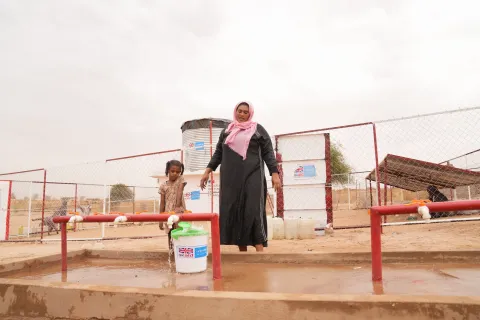
After two years of displacement, Mayer returned to Khartoum to his home, school and neighbourhood and a water point damaged. Accessing water became a daily struggle.
“I go alone. It is a very long distance.”
“Sometimes, I feel exhausted after five or six trips.”
Across Sudan, Mayer’s experience reflects a wider reality. The lack of clean and safe water means:
- Sanitation systems break down, increasing the risk of disease outbreaks.
- Health facilities are forced to suspend or reduce essential services.
- The risk of infections increases, compromising the quality of healthcare.
- Communities delay seeking healthcare when facilities lack water and adequate hygiene conditions, putting lives at risk.
- Poor hygiene and the consumption of unsafe water exposing children to diseases like diarrhoea, one of the leading causes of death among children under five years.
- Women, especially pregnant women, face increased risks of unsafe pregnancies and deliveries.
What happened when water systems were hit?
- In Rabak, White Nile State
A strike on the Um Dabaker power plant shut down the water system – reducing water production from 33,000 cubic metres per day to zero within hours. Within just 20 days, 2,600 cholera cases were reported.
- In Khartoum
Heavy fighting and unexploded ordnance damaged underground water networks across urban areas, causing leaks, contamination and stagnant water. This contributed to a cholera outbreak affecting 40,000 people, alongside thousands of dengue cases in 2025.
This pattern of strikes is repeating across the country, as attacks on infrastructure continue to intensify.

What is UNICEF doing?
From emergency response to innovation, UNICEF and its partners are adapting to the evolving situation and scaling up the emergency Water, Sanitation and Hygiene (WASH) response.
UNICEF is:
- Leading the WASH Cluster and strengthening coordination through Water Task Forces to improve preparedness in high-risk areas.
- Addressing conflict-related capacity gaps by establishing a WASH academy to train young people to rebuild essential water and energy systems.
- Deploying mobile maintenance teams to restore water systems within 48 hours using solar-powered solutions, pumps and generators.
- Leveraging innovation, including robotics and artificial intelligence, to safely detect unexploded ordnance and identify damaged pipelines.
- Investing in conflict-resilient infrastructure by rebuilding systems that can withstand shocks and continue operating during emergencies.
- Supporting local production of water treatment chemicals to reduce costs, strengthen supply chains and create jobs.
- Expanding frontline WASH capacity to help restore safe water access in priority areas.
Water: a matter of survival
During emergencies, water and energy infrastructure are lifelines that children and families depend on and must be protected.
In Sudan today, access to safe water is not just a basic service, it is a matter of survival.