UNICEF mobile clinics: A lifeline for displaced communities in Sudan
Improving Healthcare and Bringing Essential Medical Services to Vulnerable Communities

In Atbara, River Nile state, UNICEF in partnership with the Federal Ministry of health, has set up mobile clinics to provide an integrated package of services, including malnutrition screening and treatment, lifesaving immunizations for children and pregnant women, reproductive health care and general consultations, to the ever-increasing number of displaced persons.
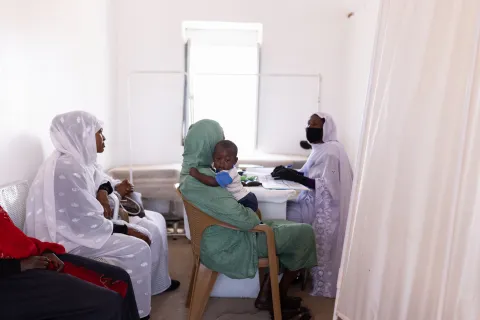
In Alsakam Alshabi camp, located in Adama locality, a team of female community health workers sit in a small room, ready to serve the population. It is early in the morning, and parents and caregivers stroll into the room to receive treatment for various illnesses. They bring along their children for assessment, vaccinations, and treatment. These mobile clinics are their only link to health care services.
“Before the mobile clinics, we gave our children painkillers whenever they were ill,” says Safaa, a displaced mother waiting in line.
Iman, a medical doctor, confirms “Many displaced families require urgent health services. These mobile clinics are a lifeline because they offer integrated services.”

Why mobile clinics?
Initiated in 2024, the mobile clinics mainly targeting internally displaced people, operate three times a week, bringing critical healthcare services closer to those who urgently need them.
Highlighting the importance of these clinics, UNICEF’s Nutrition Officer Khalid Ismail notes that this intervention addresses the sudden spike in diarrhoea, malnutrition, and acute respiratory infections among children within the displaced shelters.
Currently, five mobile clinics in Adama, Atbara and Matama localities- areas with high displacement-are fully operational and equipped with health and nutrition supplies, thanks to UNICEF. This support also ensures that the frontline health workers are compensated for their work.
In Adama locality alone, the mobile clinic serves over 2,000 people, most of whom are from Khartoum, with 17 per cent being children under 5 years old.


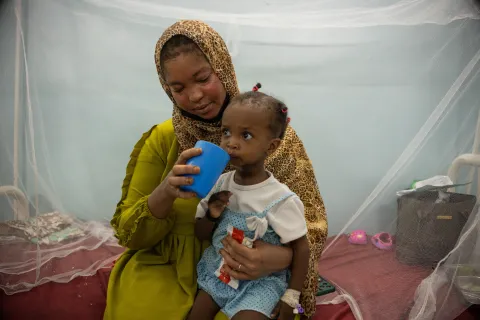
Amal, a displaced mother from Khartoum, arrives for a follow-up visit for her 11-months-old daughter Yadin, who is acutely malnourished. Three weeks ago, Yadin’s mid-upper arm circumference was only 11.3 cm; today, it reads 11.5 cm.
“When I brought my daughter, she was very sick. Her body was weak, and her eyes looked tired,” Amal shares.
“But since she started taking the supplement, she has begun eating well.”
Enrolled in the nutrition programme and provided with ready-to-use-therapeutic food (RUTF), Yadin has gained some weight and is steadily recovering. The good news is she likes the nutritious peanut paste that supports her recovery. At the end of the visit, Amal receives more sachets of RUTF that will last until the next appointment.
The faces behind the mobile clinic in Adama
As part of its emergency response, UNICEF is investing in engagement community health workers to sustain the delivery of healthcare services.

Iman, a medical doctor, handles all consultations. Since the onset of the conflict, Iman has witnessed first-hand the rising numbers of displaced families and their urgent need for healthcare services. “This is why I am here: to provide them with the medical care they need.”
With a stethoscope in hand, she examines both young and old and confirming that diarrhoea and respiratory infections are the major illnesses among children under 5 years. Through mobile clinics, quick and timely referrals for children in critical conditions are made.

Eshan, an assistant nutritionist, has set up her station complete with nutrition supplies and a colour-coded tape. Using this simple but effective tool, she screens all children for malnutrition and provides immediate treatment for those who are sick. She has observed a spike in moderate acute malnutrition, with many mothers attributing it to insufficient food. “They lack money to purchase the optimal foods needed for their children to grow.” With the nutrition supplies readily available, Eshan can save the lives of many children affected by malnutrition.

Afaf has been a vaccinator for decades. In addition to working with the mobile clinic, she also conducts house-to-house immunization drives to reach children in remote areas of Atbara. At the clinic today, she sits next to a carrier packed with vaccines for inoculating children below 2 years old. She carefully checks the vaccination cards of all children visiting the clinic to ensure their vaccinations are up to date, reminding parents of the next appointments. She is happy that despite the war, they have access to all vaccines, which makes her job much easier.
What keeps her going every day? “I want all the children to be vaccinated, and I want to be able to bring the vaccinations to their doorsteps, so no child is missed,” she says.
Community health workers like Iman, Eshan, and Afaf are the heartbeat of the healthcare service delivery at the grassroots level during the ongoing conflict. No matter what- whether in scorching sun, during heavy rains, or across long distances- they remain at the forefront, reaching vulnerable populations and saving lives. Their resilience, dedication, and passion for serving displaced and host communities is unmatched.
Thanks to the generous support from USAID, European Union Humanitarian Aid (ECHO), and UN CERF, UNICEF continues to deliver vital nutrition supplies, including ready-to-use therapeutic food (RUTF), to treat malnourished children.