Care that heals and protects
In the aftermath of conflict, one little girl’s recovery becomes her mother’s healing too

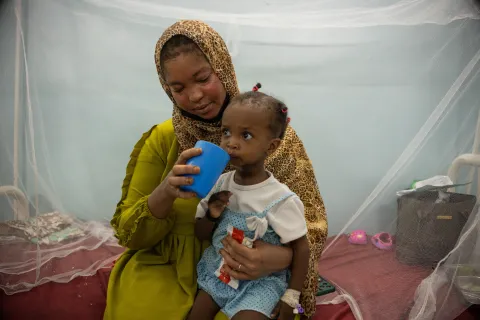
When Fatima brought her 19-month-old daughter, Sarah, to Alenaz Health Facility, she feared for her life.
At birth, Sarah was underweight and needed specialized care, particularly in her early days. This was at the peak of the conflict, when the health system was severely disrupted and on the verge of collapse. Fatima struggled to find the care and treatment her child urgently needed.
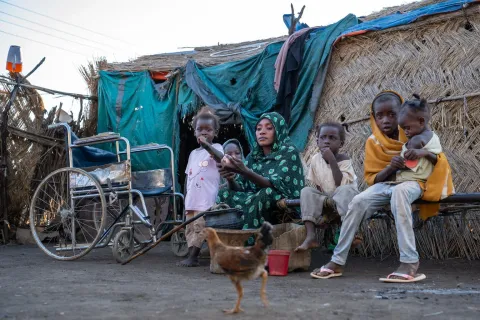
Sarah’s condition worsened when the family fled the fighting in Aj Jazirah State to Um Rawaba in North Kordofan. But even there, they could not stay long. As the conflict spread, they were forced to move again—this time to a remote village with no access to health services.
For more than a year, Sarah’s life was marked by displacement and ill health. Her breastfeeding and complementary feeding were disrupted as the family remained constantly on the move.
“Sarah started falling sick when we were in Kordofan,” Fatima says.
When the family finally decided to return home, Sarah was weak and severely malnourished.
“She could not latch onto the breast, she could not sit, and she had no hair or nails,” Fatima recalls.
For months, Fatima watched her daughter’s health deteriorate—an experience that took a heavy toll not only on Sarah’s wellbeing, but also on her own mental health.
But at Alenaz, Fatima found more than medical care for her child—she found hope, and the support she needed to heal.


Mental health and nutrition support at Alenaz
In Aj Jazirah State, UNICEF, with funding from the Government of the United Kingdom, is implementing an integrated programme delivering nutrition and child protection interventions to conflict-affected children and families.
At health facilities, trained frontline nutrition workers are not only providing lifesaving therapeutic feeding for malnourished children, but also offering nutrition counselling and psychosocial support to mothers like Fatima—helping to improve caregiving practices and overall wellbeing.
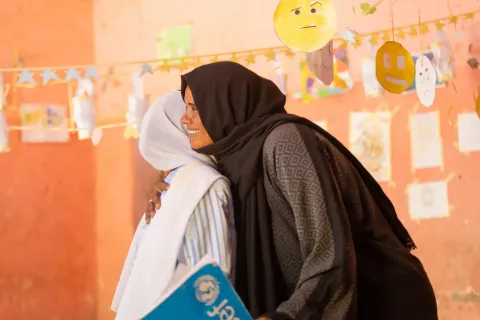
Amira, a nutritionist, is one of them. She remembers how terrified and overwhelmed Fatima was when they first arrived at Alenaz. Over the months, Amira ensured that Sarah received the urgent nutrition care and treatment she needed, while also supporting Fatima—recognizing that a mother’s wellbeing is critical to a child’s recovery.
“The period after the war has been very difficult,” Amira says.
“Mothers come to us when both they and their children are in very poor psychological conditions,” she adds.
“But in these circumstances, we try to support them emotionally.”

Supporting mothers to care for their children
Following specialised training, frontline nutrition workers have been equipped with skills to identify and provide basic psychosocial support as part of Infant and Young Child Feeding (IYCF) sessions. This approach not only strengthens early stimulation and responsive caregiving, but also ensures mothers receive essential mental health and psychosocial support—contributing to faster recovery for their children.
With the ongoing conflict and continued displacement, this training has come at a critical time.
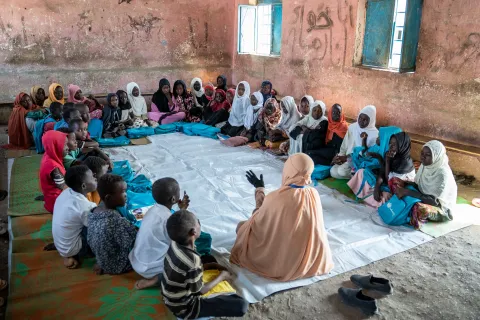
At least 40 frontline nutrition workers have been trained in basic Mental Health and Psychosocial Support (MHPSS) and Gender-Based Violence (GBV) awareness across two localities in Aj Jazirah State. They are now able to handle disclosures, refer cases for specialised services, and identify and support unaccompanied children.
In addition, social workers have been trained to identify children in their care who are acutely malnourished or otherwise in need of health and nutrition services—strengthening the link between child protection and nutrition both in health facilities and at community level.
Reflecting on the training, Amira highlights how it has improved her ability to support both mothers and children.
“We learned how to calm mothers and help solve their problems in simple ways,” she explains.
She recalls the day she first met Fatima and Sarah.
“Fatima had almost lost hope.”
While Sarah was suffering from severe malnutrition, Amira quickly recognized that Fatima was deeply distressed by her daughter’s condition.
“But she has since followed our guidance, and her child is recovering very well.”
Today, Amira can identify mothers, caregivers and children in urgent need of psychosocial support and provide immediate assistance or refer the complex cases for specialized care.

A different visit
Fatima and Sarah have returned to the facility for their monthly follow-up. Both mother and child are in a much better state.
Sarah can now latch onto the breast, sit without support, and her hair has grown—tied neatly with coloured ribbons.
With her Mid-Upper Arm Circumference (MUAC) now in the moderate range, Sarah receives sachets of nutrient-rich paste fortified with essential vitamins and minerals to support her continued recovery.
“Now the mother is psychologically stable, and Sarah is improving greatly,” Amira says with a smile.
Across the two supported localities, trained frontline health workers like Amira are helping hundreds of children recover from malnutrition through this integrated nutrition and protection programme. At the same time, mothers affected by conflict are receiving the guidance and emotional support they need to rebuild their confidence—and provide better care for their children.
***
UNICEF and partners, with funding from the Government of the United Kingdom, is implementing an integrated programme, delivering nutrition services with nutrition-sensitive water, sanitation and hygiene and child protection interventions to conflict-affected children and families in River Nile and Aj Jazirah states to comprehensively address high levels of malnutrition.