Separated, reunited but scarred for life
One year on, Walaa endures the scars of the brutal war that separated her from her family
Walaa once dreamed of a brighter future, relishing happy moments with her friends. When war erupted on 15 April, 2023, in Sudan, her life took a devastating turn. On that fateful day, Walaa and her family found themselves trapped in their home in Khartoum.
Previously they had a blissful life together , but now they struggle to find safety, food and water. They rationed their supplies and prayed for the bombings to stop. Tragedy struck when a neighbouring house was bombed, claiming the lives of everyone inside. Gripped by fear and panic, Walaa and her family scattered in different directions.
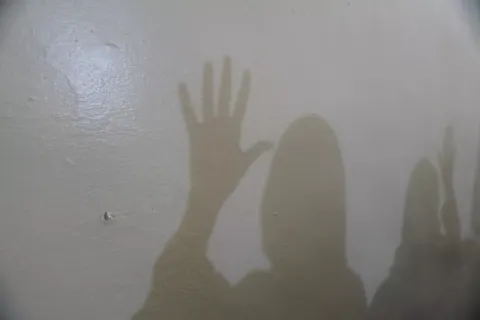
Amidst the chaos, Walaa and her sister Shegn were separated from the rest of family, forced to fend for themselves. Following the path of other fleeing families, they embarked on a harrowing four-day journey, with no clue of where they would end. They traversed miles under the schorching sun, their feet bare, until they reached Al-Faw, a town bordering Gezira state. The haunting images of decomposing bodies and damaged buildings continue to haunt the two young girls.
"It is difficult to forget the sight of all those lifeless bodies and the sight of fluids flowing from them," recalls Walaa. Amidst their prayers for safety, they clung to hope of reuniting with their family.
“We were very thirsty and drank contaminated water,” she adds.
Days and nights passed on the streets of Al-Faw, with no clothes, water or food. Yet, the support of other displaced families sustained them. It was this same support system that eventually helped the sisters reconnect with their mother through a telephone call. After five long days of waiting, Walaa and her sister were finally reunited with their mother.
“I was terrified. All I wanted was to find my mother,” Walaa recounts.
The moment of their runion was filled with ovwerwhelming joy and relief. “I was overjoyed when I saw her. I hugged her so tightly and we cried together,”Walaa remembers.
Together, they embarked on a search for safer haven far from the ravages of the war. Their journey led them to Madani and eventually to Kassala state, where they now reside.
Despite their reunion, Walaa carries the scars of separation, and the emotional burden of their ordeal, one day at a time. “I used to cry a lot”, she admits.
Starting a new life
In a city where she has no roots, Walaa grapples with uncertainty, but her mother’s encouragement keeps her going. She struggled to adjust until she discovered the UNICEF-supported Alshargia safe learning space, also known as a makanna which means ‘my space’ in Arabic. Here some 600 children from displaced and host communities find refuge each day.

For Walaa, and other children, the makana became a sanctuary, offering integrated services like play, music, dancing, structured learning, digital learning, psychosocial and mental health support, clean water and much more.

“I want to come to this place to heal and get rid of the memories of the war. I have become strong, and I am laughing more,” she shares.
Noha holds Walaa’s hand through healing
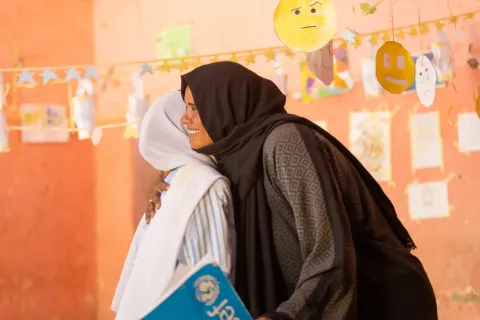
Noha, a dedicated psychologist and trained by UNICEF, guides Walaa through the journey of healing. As a displaced person herself, Noha understands the children’s suffering and empathises deeply with their trauma.

"When the children first arrived, they were tense and stressed. They didn't initially participate in any activities. However with time, they gradually began to engage and now spend most of their time here," says Noha.
Through individual counselling sessions, Noha helps Walaa navigate her trauma, offering a safe space for her to express her fears and dreams. Together, they journey through moments of darkness and light, finding solace in each other’s company.
"I find peace and comfort when I come to the makanna. It helps me forget my sadness and embrace a new beginning ,” Walaa reflects.

Hundreds of children, like Walaa, who frequent the makanna, receive professional support from social workers and psychologists trained in mental health and psychosocial support (MHPSS) by Jasmeer, UNICEF's implementing partner.
Walaa continues to receive support and looks forward to resuming her studies to successfully become an engineer or doctor. However, she acknowledges that this can only happen if the war stopped.
“Please stop the war. There are people who have died and haven’t been buried and those that are still missing and separated like I was. We have been humiliated. We want to return to our homes. What I miss the most is my English lessons,” she implores.
The impact of one year of war, displacement, and deprivation on Sudan’s 24 million children is horrific. Without urgent action and additional resources, the country risks a generational catastrophe that will have grave implications for the country, the region, and beyond. Above all, Sudan’s children need a ceasefire.