When a war changes everything
In Sudan, children affected by conflict are rebuilding their lives after displacement, separation and trauma
For children growing up through war, the consequences are often measured in things that once seemed ordinary.
A friendship interrupted by displacement.
A precious memory left behind.
A child who stops going outside because it no longer feels safe.
Or a family making decisions about a child's future based on fear rather than choice.
For some children, the disruption lasts weeks or months. For others, it changes the course of their lives.
And getting children back to safety is only the beginning.
Taking away the ordinary
For one young girl from Khartoum, the war began one week before her final examinations.
She had been preparing for her exams when fighting reached her area.
“I was frightened. I stayed at home all the time and rarely left my bed.”
She had grown up with her grandmother, who had cared for her since she was very young. When violence intensified, they left their home and were displaced several times before eventually settling in River Nile State.
With each move came another disruption to a life that had once followed a familiar routine.
School stopped.
Daily life became uncertain.
Fear replaced a sense of safety.
During this period, the family faced difficult choices as they tried to protect her from harm. She entered a marriage to a young man affiliated with armed actors, believing it might provide protection for herself and her family. She was later detained for several months.
Her experience is not simply a story of one child.
It is a story of hundreds of children that found themselves on the frontlines.
It illustrates how conflict can compound the risks faced by children. Displacement can separate children from familiar surroundings and support networks, interrupt education, and increase their exposure to violence, abuse, exploitation and other protection concerns.
Since the start of the conflict in Sudan, children – both boys and girls - have witnessed violence, endured abuse, or forced to marry. Some children have been threatened, coerced or manipulated or recruited by armed actors. Others are driven by poverty, compelled to generate income for their families. Children are not only used as fighters, but also as scouts, cooks, porters, guards or messengers and in some cases, they are detained after being perceived as accomplices. No matter their involvement, the recruitment and use of children by armed actors is a grave violation of child rights and international humanitarian law.
In another state, a young girl was detained while four months pregnant and was not released until her seventh month of pregnancy. Besides being forced into marriage, the harsh conditions she endured in detention had serious consequences for both her health and that of her unborn child.
“When we found her, she urgently needed both medical and psychological support.”
“We provided psychosocial care and continued to follow up after her release and reunification with her family,” a social worker explained.
She would later give birth safely and reunited with her family.
Finding a way forward
In 2025, 71 children were released from detention after being held due to their association with armed actors. For children who had endured so much, from conflict, displacement to detention, what they needed most was someone to listen.
Through frontline social workers trained by UNICEF and partners, children receive psychosocial support to help them recover from past experiences, reconnect with family, and navigate the difficult process of returning to normal daily routines.
“Many children were confused. They could not understand why they were detained.”
And when the time came to return home, some faced additional barriers. But the social workers remained by their side.
“Some communities do not readily accept them because they are perceived as former child soldiers, which creates anxiety for the children,” said one social worker.
But the support extends beyond the children themselves. Social workers also work with families and communities to help ensure children are welcomed and supported when they return home.
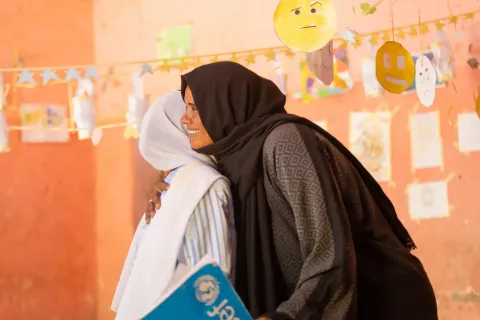
UNICEF/UNI546800/Ahmed Mohamdeen Elfatih
A new beginning
A new beginning
As part of healing and rebuilding, the children are also provided with opportunities and activities that help them move beyond the trauma they experienced in detention. This includes vocational training, helping them return to school, recreational activities, and continuous psychosocial support. The options also help them rebuild confidence.
For one young girl returning to school after months away, the emotional barrier was as difficult as the practical one.
“At first, I was scared and anxious because of my personal problems and did not feel ready to study,” she said.
Going back to school was unfamiliar. Other students asked questions about where she had come from. After a long absence, studying and preparing for classes again felt difficult.
But gradually, the classroom became a place where she could begin to gain some sense of normalcy.
She received a school uniform, notebooks, and other supplies, while her school fees were covered. Social workers visited her at home and at school, providing psychosocial and social support and helping ensure that her needs were addressed.
“I felt happy and at ease when talking with them.”
The support did not erase what she had experienced.
It helped her move forward.
Her story is part of a wider effort to help children affected by armed conflict return to their families and communities.
Their circumstances and needs are different.
Some are returning to secondary education. Others are continuing intermediate education or preparing for examinations. Others are pursuing vocational training or considering ways to build greater independence. While for others, support also includes humanitarian assistance or legal counselling.
What connects them is not a single experience or a single outcome. It is the beginning of their healing journey that could last a lifetime.
########################################
UNICEF, with the generous support of the Elteva Foundation, supports children formerly associated with armed actors through a comprehensive package of services, including psychosocial and social support, family reunification, educational assistance, and humanitarian assistance. These interventions help them recover, reintegrate into their communities, and rebuild their lives despite the ongoing challenges posed by the conflict.