Rebuilding life: one block at a time
How UNICEF’s child-friendly spaces are giving refugee children the tools to heal

- English
- العربية
Active conflict has forced millions of families to flee from Eritrea, South Sudan, and Ethiopia — hundreds of them arriving in Kassala, in eastern Sudan.
Today, Kassala hosts the third-largest refugee population in the country, with more than 116,000 refugees and asylum seekers who now call it home.
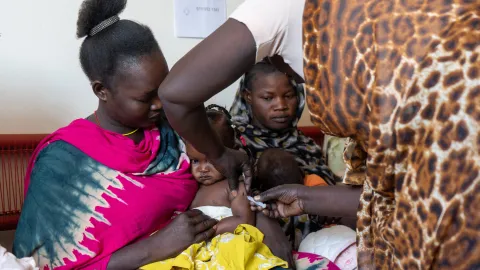
Far from home, refugee and migrant children face heightened risks of trafficking, smuggling, abuse, and exploitation. To protect them, UNICEF — through its child protection programmes — has established Child-Friendly Spaces (CFSs) where children can play, learn, and receive psychosocial support in a safe environment.
These spaces help them rebuild daily routines, reconnect with childhood, and find comfort amidst uncertainty.
A safe place to be a child
At Shagarab Refugee Camp, home to thousands of families and children, UNICEF has set up Child-Friendly Spaces through the PROSPECTS initiative, funded by the Government of the Netherlands.
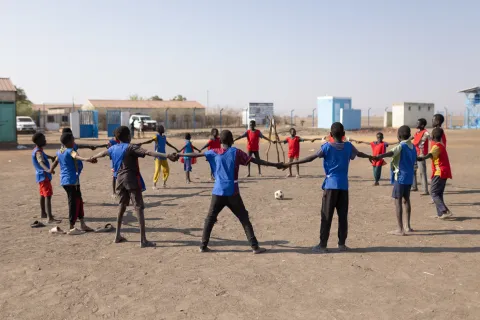
Strategically located near the reception centre, the CFS welcomes more than 600 refugee children every month. Supported by trained social workers, children under 17 take part in age-appropriate recreational activities, playful learning, and awareness sessions on abuse prevention and child protection — topics that are especially critical during displacement.

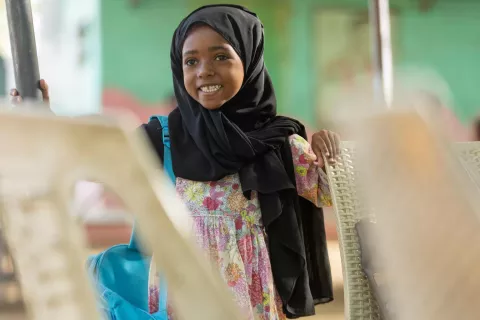
Ten-year-old Sabah arrived at Shagarab a year ago. Since discovering the child-friendly space through her friends, she hasn’t missed a single day — attending both morning and evening sessions.
“The space is really nice and has good activities,” she says shyly, as she colours yet another picture of her “new home.”
For Sabah, drawing and colouring have become her way to process her experiences and build new memories. Each stroke of her crayon is a step towards healing.

In Shagarab, Wajan met Najah — and the two have been inseparable ever since.
Najah doesn’t remember exactly when her family arrived at the camp, but she remembers the day she met her friend.
Every day, they meet to draw, laugh, and build puzzles together using colourful blocks.
“The absence of one is a dull day for the other,” says Alisia, a facilitator who has watched their friendship grow stronger over time.
These safe spaces do more than protect children — they create a sense of belonging and trust that helps them overcome fear and uncertainty.

Twelve-year-old Sabrin and her family arrived in Sudan five years ago. Back home, she loved reading, art, and watching television.
Now, at Shagarab, she continues her education at a temporary learning centre, and after school, she never misses her time at the CFS.
“I love spending time with my friends,” Sabrin says. “We draw, play, laugh, talk, and help each other study.”
For Sabrin, the space is more than a classroom — it’s a refuge of creativity and friendship.


Youth engagement and participation
Adolescents like Montasir and Hussein, who arrived from Eritrea in 2023, attend activities at a multi-purpose youth centre nearby. Here, young people engage in sports, games, and adolescent clubs that promote leadership and life skills.
At the renovated computer lab, refugee youth also gain digital literacy and vocational skills to prepare for future livelihoods.
Through child-led clubs, adolescents use drama, songs, and skits to spread awareness on violence prevention, gender equality, and child protection within the camp — becoming agents of change in their community.

Giving back: Khulood’s story
Khulood, a young refugee who endured her own traumatic journey, now volunteers at the CFS. She helps new arrivals settle in, teaches them life skills such as beading, sewing, and make-up, and mentors younger girls on how to stay safe.
“I guide them on how to behave and warn them of wrongdoing,” she says. “But I also learn from them every day.”
Thanks to the support of the Government of the Netherlands through the PROSPECTS initiative, UNICEF and partners are providing refugee children in Shagarab and beyond with safe spaces to learn, play, and grow.
These centres not only protect children and equip them with vital life skills, they also help them reclaim joy, confidence, and hope.
With every building block — through play, learning, and friendship — these children are rebuilding their resilience and taking one step closer to a brighter, more self-reliant future.