Displaced but not deterred
Halima champions anti Female Genital Mutilation drives while on the move

20-year-old Halima grew up in a small village in Sudan’s South Kordofan state. A state where traditional harmful practices like female Genital Mutilation (FGM) and child marriage are prevalent until today. Like thousands of girls, Halima has been scarred by these deeply rooted practices. Back then Halima was oblivious of the damage and consequences they had on girls and women. But today she knows and is empowered.
“I didn’t realize the extent of the damage or believed someone when they explained the suffering of women and girls subjected to these harmful practices,” she shares.
Life before the war
About nine months ago, Halima was a second-year scholarship student at a university in Khartoum. She dreamt big for a bright future. But the war has turned her plans and dreams upside down.
“The ongoing war has forced me to stop my studies, and this is very painful,” Halima echoes.
Through a horrific journey, Halima and her family fled Khartoum and now settled in a gathering point with over 30 other families in the relatively calm Kosti in White Nile. But the memories of the bombings and gunfire, days spent under the beds as they shielded from bullets, occasionally linger on.
While at university, Halima participated in several social activities and engagements, something she greatly misses. But in Kosti, didn’t have much to do until recently.
In November 2023, she was selected to join other adolescents and young girls in a life-skills and Gender Based Violence (GBV) risks mitigation workshop. The workshops are among other child protection activities delivered by UNICEF in partnership with the State Council and Community Safety Organization, for children and young people affected by conflict under the Sudan Free from FGM programme funded by the Governments of United Kingdon and Canada. The workshops aim at equipping adolescent girls with skills and knowledge to reduce the risks of GBV as well as empower them economically.
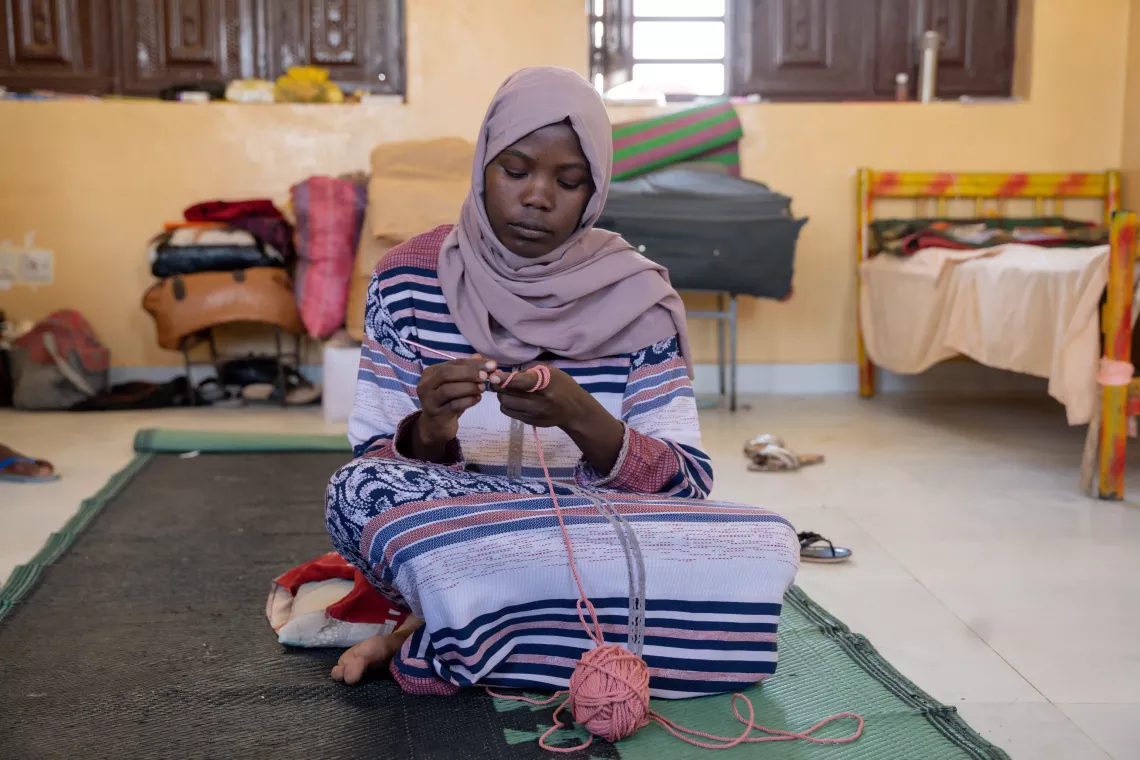
“These new skills have helped me fill my free time. Currently, I engage in crocheting, and I sell the products. This has become a source of income for me and my family.”
But what is even greater about the workshop is the information and knowledge on GBV, FGM and early marriage that Halima obtained. When empowered, children and young people can contribute to solutions around issues that affect their well-being.
“I now see things differently. My perspective on early marriage and FGM and their consequences has greatly changed,” she stresses.
While Halima learned about the negative aspects of female genital mutilation, she was introduced to the Saleema initiative. Launched in 2008 by NCCW and UNICEF Sudan, the initiative aims at changing the way that people talk about female genital cutting by promoting, at the community level, wide usage of new positive terminology to describe the natural bodies of girls and women. It focuses on keeping girls Saleema. (Saleema means whole, healthy in body and mind, unharmed, intact, pristine, and untouched, in a God-given condition.)

Life after the workshop
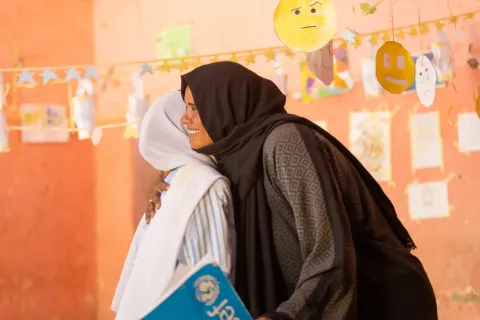
With ample free time on her hands, Halima has now channeled all her energy into championing the rights of children, especially girls. She spends the majority of her time conducting anti-FGM and early marriage awareness sessions and Saleema workshops in markets, gathering points for displaced families and in host communities. Empowering girls and women to protect themselves from gender-based violence and encouraging them to make the appropriate decisions to safeguard themselves.
“The vices can be common during such circumstances. We also provide details of reporting pathways,” she continues.
She has also been equipped with Saleema IEC materials like posters and leaflets to support the delivery of messages to the communities and she often refers to them during the sessions. The sessions are engaging and interactive.

For children, Halima has mastered the game. She uses songs to drive the messages home.
At a gathering point for displaced families, after the session with adults, she quickly forms a circle and together they join in chorusing a Saleema song.
La la la la A healthy (Salema) body in a healthy (Salema) girl La la la la” they sing collectively. Through these playful games, they learn through the messages within the song.
But what motivates Halima to do all this, especially during these difficult moments - “I have personally experienced these harmful practices, and I don't want anyone else to go through what I went through or suffer as I did. I often find myself resisting and with the urge to wipe these practices, especially for the girls who come after me. They should remain Saleema.”
She reminds parents who still practice these harmful traditions that it is a grave mistake that must be stopped before advising them to completely abandon them.

“I say no to child marriage and no to female genital mutilation. Every girl is born saleema, let her grow up healthy.”
Through her contribution to creating communities safe for children and young people, Halima reminds girls in the displacement camps to stay strong and stand firm, as people will stand behind them.
“Say no to violence. There is a hotline available to contact the authorities for assistance. Don't be afraid of reporting,” she emphasizes.
Halima takes pride in her efforts that have contributed to creating safe spaces for women and girls in her community and vows to continue with the cause, no matter what.
“One day I hope to return to my village to save children and later contribute to causing change not only in my village but in the rest of Sudan, and subsequently the whole world.”
“Violence against women and children must stop!”

Halima and her peers are also producing crocheted bags with key messages on Saleema and selling them within the communities to purchase essential commodities they need as well as supplement their household incomes. Through these materials, the Saleema initiative is reaching more and more people, one community at a time.