Conflict, Hunger and Cholera
Children in Tawila struggle to survive

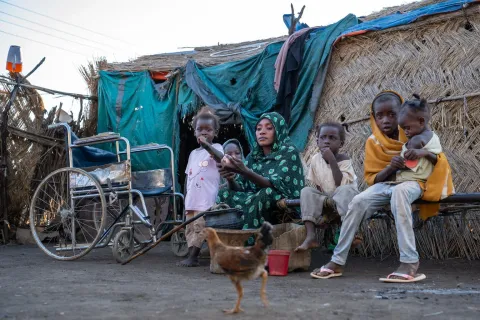
Samahir and her children sit in their makeshift shelter in Tawila. She carefully wraps her youngest child in a thick blanket, the only thing she managed to bring when they fled the violence in Al Fasher. It is one of the few possessions she has left, keeping her children warm as they face life in displacement with almost nothing.
As conflict rages in her hometown, Samahir and her family remain uprooted, struggling daily with hunger, disease, and uncertainty.
Tawila, a small town 70 kilometres from Al Fasher, has become a refuge for more than 500,000 displaced people. For families like Samahir’s, meeting the most basic human needs—food, safe drinking water, and shelter—is a daily challenge.
Her youngest child is now malnourished and weak. The little food they find is not enough, and safe water is scarce. The lack of clean drinking water, poor sanitation, and inadequate hygiene have left families exposed to deadly diseases like diarrhoea and cholera.

“My son woke up fine, but suddenly he had diarrhoea. By evening his condition had worsened, so we rushed him to the clinic,”
Unbeknownst to her, cholera had arrived at her doorstep. In the days that followed, the illness spread through her family. Cholera is especially dangerous for children, and for Samahir’s youngest—already weakened by malnutrition—the risk of death was even higher.
“We had no fever, but all of us had diarrhoea. My eldest was also vomiting,” she said. “He would go to the toilet, and before he made it back, it would start again.”
These are the tell-tale symptoms of cholera—a disease that spreads rapidly through contaminated food and water, causing severe diarrhoea, dehydration, and potentially death without urgent treatment.


Responding Fast to Save Lives
Seven-year-old Abdallah stares into space as he lies on a bed inside a large UNICEF tent, now converted into a cholera treatment unit (CTU). His face is pale, his stomach twisted in pain. Across the tent, several other patients receive urgent care—oral rehydration salts and intravenous fluids to fight dehydration.
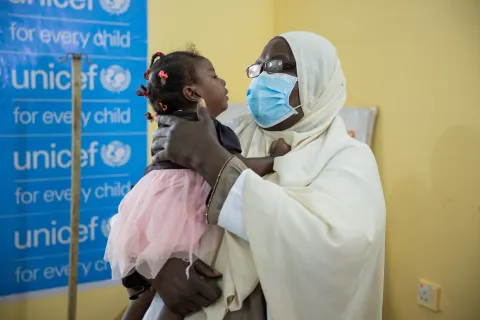
Children, women, and the elderly make up the majority of patients. With only 20 beds, the CTU is full. This is just one of the temporary treatment units UNICEF and partners have set up, and in each, the number of cases grows daily. Quick, coordinated action is critical to stop the spread.
UNICEF and partners are tackling the outbreak through life-saving interventions:
- Setting up cholera treatment units and oral rehydration points for early care.
- Distributing medicines, cholera kits, and oral rehydration salts.
- Trucking in safe water, rehabilitating water yards, chlorinating water supplies, and installing storage tanks.
- Constructing latrines to improve sanitation.
- Distributing hygiene kits and promoting handwashing with soap and safe practices through community awareness campaigns.

Out of danger but still at risk
Samahir and her family were eventually discharged and are now recovering at home. But her children remain frail—especially her youngest, whose fragile body has been further weakened by cholera.
Thanks to health education sessions at the treatment unit, Samahir now knows how to protect her family from future infections. Still, the risks remain high.
“The situation is very difficult. Unfortunately, children, pregnant women, and the elderly are the most affected. They are experiencing multiple crises including conflict, displacement, and disease,” said Salim Abdulaziz Adam Abdalla, UNICEF WASH Officer.
Since the first case was detected on 21 June 2025, more than 1,180 cases have been reported, including 300 children and at least 20 deaths. Stopping the outbreak remains an urgent priority. But without immediate and sustained lifesaving services, the risk of preventable child deaths will only increase.