Breaking Taboos
Samer’s mission to support menstrual hygiene for displaced girls in Sudan

It is not every day that one meets an adolescent boy so passionate about supporting his female peers with the challenges posed by menstruation.
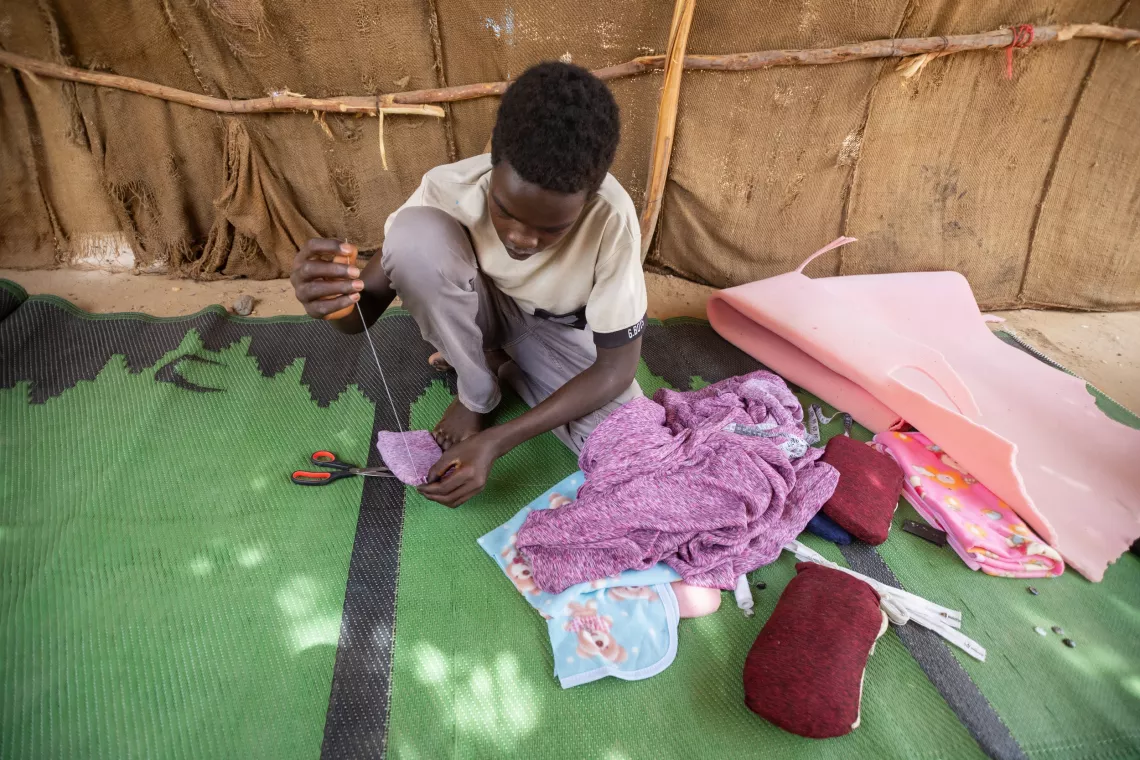
Samer, a 16-year-old boy, sits quietly under a shade, carefully measuring and cutting fabric and sponge. He then stiches the two pieces together to make a reusable sanitary pad in less than 15 minutes. On an ordinary day, he makes 20 reusable pads- enough to relive 20 adolescent girls from shame and difficulty of managing their menstruation without proper supplies.
“I use scissors, a sponge, cloth, a button, a zipper and a needle,” Samer said.

In Sudan, as in many other countries, it is taboo for boys and men to publicly associate with or even speak about menstruation. But in Atbara state, Samer is changing the narrative. Displaced by the war in Khartoum, Samer has witnessed her female peers struggle to obtain sanitary pads.
“Some disappeared for days, while others were stained because they lacked even one pad,” Samer recalls.
In his community, displaced parents and caregivers are struggling to make ends meet. Left with no sources of income, many cannot afford the sanitary pads sold in the market. At home, Samer has also watched his mother struggle to provide these materials for his sisters when they needed them.
“While pads a necessity for girls, they do not have access to them, especially during these times of war and displacement. Parents cannot afford them,” he shares.
He has since vowed to help ensure that girls- especially those who are displaced- can manage their periods safely and with dignity, regardless of what society thinks of him.
“I do not feel ashamed; the needs are more important and go far beyond people’s feelings,” he affirms.
The UNICEF hygiene club
When Samer and his family arrived in Atbara, he enrolled in the hygiene club at a UNICEF-supported child-friendly space. He was later selected as one of the role models to attend a UNICEF-supported workshop on menstrual hygiene management, where he was introduced to making reusable pads, especially for adolescent girls affected by the crisis.
Since then, he has never looked back. Samer has mastered the art of making these essential materials, which today benefit hundreds of girls in his community, including his four sisters. To further support his great work, UNICEF continues to provide all the materials like fabric, sponge, scissors, sewing kits to ensure he has enough to support the continuous supply chain.

“I make the pads here at home, and I give them to women and girls free of charge,” Samer says proudly.
Today, he takes pride in the contribution he makes daily. Every day, girls and women come to his home to pick up sanitary pads. He has also designed a small fabric bag where the pads are safely tucked to prevent any fear of stigma and discrimination.
“I felt that this is what women need the most during displacement. That’s why I make them and distribute them free charge,” Samer concludes.
On other days, Samer joins the other hygiene club members to deliver hygiene and sanitation campaigns in the IDP gathering sites, educate adolescents on positive social norms around menstrual hygiene management, and teach them how to make and use reusable menstrual products.
He is also a member of the environmental club, educating the communities on impact of climate change, especially on children and environmental degradation, given that Atbara is one of the states that are prone to the climate crisis.
UNICEF, together with partners and the generous support from USAID and the UN Central Emergency Response Fund (UN CERF), is supporting hygiene clubs by providing safe and clean water, critical supplies, and promoting hygiene across the River Nile state.