Breaking the cycle of female genital mutilation and child marriage
In eastern Sudan, a community-led protection network is challenging deeply rooted harmful practices — and changing lives

Outside a small health facility in rural Id Altin, in Sudan’s Gedaref State, a group of women and men sit in a tight circle. They are members of the community child protection network committee- neighbours, parents, teachers and elders brought together by a shared determination to protect girls.
Their discussion is urgent and personal: how to accelerate efforts to end female genital mutilation (FGM) and child marriage in their community.
For decades, harmful practices were widespread in this locality, affecting hundreds of girls and women. For more than ten years, FGM was not only common—it was publicly celebrated.

UNICEF 2025/Rajab
“The practice was so deeply rooted that it was done openly,” “Families were proud of each ceremony.”
“The practice was so deeply rooted that it was done openly,” recalls Muna, a committee member and poet. “Families were proud of each ceremony.”
The consequences were devastating. Girls suffered severe bleeding and long-term complications. Some died. Others, married too young, struggled through pregnancy and childbirth.
“The impact—both physical and psychological—lasts a lifetime,” Muna says quietly.
Shamim, another member, nods. “Every one of us sitting here was subjected to FGM,” she adds. “We have lived with the consequences all our lives.”
It was through UNICEF-supported awareness sessions and training that many of them first began to understand the root causes of their trauma—and the dangers the practice posed to future generations. They decided to act.

A committee determined to protect children
Through the Sudan Free of Female Genital Mutilation programme- implemented with partners and supported by the United Kingdom Government- UNICEF has helped establish community child protection networks in areas with high FGM prevalence, equipping members with knowledge, dialogue skills and referral pathways.
The Id Altin committee is just one of many. Made up of ten volunteers –six women and four men- they stand united around a single goal: ending FGM and child marriage.
After completing training, the group began reaching families wherever they could.
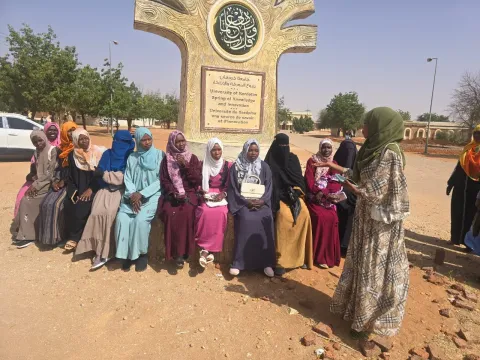
They visit schools and Khalwas (religious schools), working with teachers and students to form Saleema clubs that promote girls’ rights and bodily integrity. Saleema – an Arabic word- means whole, healthy in body and mind, unharmed, intact, pristine, and untouched, in a God-given condition.
At weddings, markets and community gatherings, they speak directly with parents and caregivers.
“Whenever there is an occasion, we speak up,” says Muna. “Wherever people go, we go.”
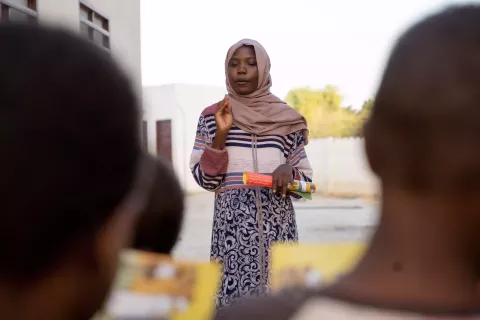
A poet by passion, Muna often uses verses to deliver messages about protecting girls.
“I recite poems at weddings and women’s gatherings,” she says with a soft smile. “People listen. The words stay with them.”
Over time, the committee has earned trust. Today, community members refer to them simply as ‘the people who protect children’s rights.'
Standing up when girls are at risk
The committee does more than raise awareness—it intervenes when children face immediate danger.
In June 2025, they heard that a midwife from another area was planning to visit Id Altin to carry out FGM on more than ten girls.
They acted quickly.
As word spread, the committee mobilized community leaders and confronted the midwife upon her arrival. They explained the health risks, the law, and the harm caused to girls. The visit was stopped, and she was prevented from returning to the village.
For the members, it was a powerful moment—proof that collective action could protect children.
Resistance has not disappeared entirely. At times, the committee faces criticism or insults from people who still believe in the practice.
“When someone resists, we speak to them privately,” explains Al Bashir, one of the male members. “We follow up again and again.”
For him, the work comes at a personal cost.
“Some people talk behind my back,” he admits. “But I now understand the suffering these practices cause.”

Shifting social norms
While progress has taken years, the committee says the shift is becoming visible.
“The numbers have reduced,” one member says.
“Public celebrations are no more,” adds another.
Families who once supported harmful practices are beginning to reject them—learning about the risks and the law, and increasingly becoming advocates themselves.
The movement is growing.
For Muna, the motivation is simple: imagining a child growing up safe, nurtured and free from violence.
“That is what keeps me going,” she says.
Together, the committee continues to push forward—one conversation, one visit, one poem at a time—working to change social norms and protect girls from harm.
“I am ready to fight for the next generation,” Muna says.