Breaking Barriers and Taboos
Mazza leads fight against female genital mutilation in her community

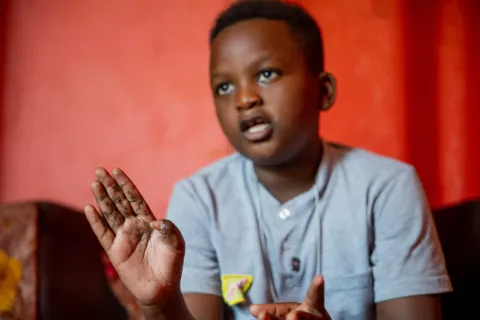
At Alshargia School, 15-year-old Mazza passionately speaks to adolescent girls about female genital mutilation (FGM), a deeply entrenched harmful practice still prevalent in Sudan. The girls listen attentively, cringing as she describes the dangers it poses to girls like them.
A former member of the school’s anti FGM club, also known as the Saleema club- initiated with UNICEF’s support- Mazza has been at the forefront of advocating against FGM since joining three years ago. Like many in her community, she once believed FGM was a necessary rite of passage for girls.
“But when the Saleema initiative came to our school, I became curious. Now, I have learned so much about FGM and child marriage,” Mazza shares.
Today, she and her peers educate both boys and girls about their right to protection, particularly against harmful practices like FGM and child marriage.
The Prevalence of FGM and Child Marriage in Sudan
Harmful traditional practices such as FGM and child marriage remain widespread in Sudan. These practices not only endanger thousands of girls but have also shattered many dreams—and, in some cases, lives.
Before the conflict, it was estimated that more than 86 per cent of women aged 15–49 had undergone FGM, while about 21 per cent of girls aged 15–19 were already married. With the ongoing conflict leading to displacement and increasing poverty, these numbers are expected to rise.

Saleema clubs – anti FGM platforms in schools
In 2008, the National Council for Child Welfare (NCCW) and UNICEF Sudan launched the Saleema initiative to protect girls from FGM.
The word ‘Saleema’ in Arabic means whole, healthy in body and mind, unharmed, intact, pristine, and untouched—signifying a girl’s natural state.
Since its inception, UNICEF and its partners have supported the establishment of Saleema clubs in schools across Sudan. These clubs remain active, even amid conflict, with young advocates like Mazza leading the charge.
The clubs serve as platforms to educate and empower girls, encouraging parents and caregivers to abandon FGM. Club members use creative approaches, such as plays and morning assemblies, to spread awareness.
“We spread awareness through plays and share information during morning assembly. Now, the girls in our school are enlightened,” Mazza explains.
Overcoming resistance and changing mindsets
Despite her efforts, Mazza has faced resistance from peers who associate FGM with purity, cleanliness, and suitability for marriage.
“We knew it wouldn’t be easy to change such deeply rooted beliefs, but we also knew that we had to try,” she says.
Her determination remains unshaken.
“They will not change overnight, but I will do my part to ensure the girls in my community are safe and protected. I will try once, if I fail, I will try again, and if I fail again, I will try a third time. But I will not give up.”
“FGM has no benefits at all. When I learned about its dangers, I didn’t wish them upon anyone. I knew people were already suffering because of it, and I don’t want anyone else to suffer due to a lack of knowledge.”
A lifelong advocate
Though Mazza has graduated from Alshargia School, she continues her advocacy. During a recent visit, she left the students with a powerful message:
“I dream of a world that respects girls and women, putting their best interests above customs and traditions. The world needs to change. Taboos and sensitive topics like these must be discussed, and I will remain a strong advocate wherever I go.”
With financial assistance from the Government of Canada and the Foreign, Commonwealth and Development Office (FCDO), UNICEF supports nearly 1,070 Saleema clubs across Sudan—ensuring that girls are protected, empowered, and safe.