Against the River’s Flow
One family’s struggle to flee the year-long war in Sudan, and the consequences of the World’s largest child displacement crisis.

While the snaking Nile River flows lazily northwards – draining out of the great equatorial Sud wetlands in central South Sudan – another mass displacement of people in this instance, is occurring in the opposite direction. More than 630,000 people over the past year have fled the brutal civil war in Sudan, seeking a safe haven in South Sudan. Almost the same numbers have escaped into Chad and Egypt, and another 6.5 million are internally displaced inside Sudan. More than half are children.
But refuge from war and conflict are not easy to come-by in this part of Africa, with South Sudan experiencing its own protracted humanitarian crisis. Within South Sudan alone, more than 9.4 million people, or more than 70% of the population, need humanitarian assistance, with the highly aid-dependent, conflict-weary residents – particularly along the border regions with Sudan – experiencing high levels of child malnutrition, disease outbreaks, water and food shortages, and crushing poverty.
Crossing into South Sudan is a last resort for Sudanese refugees like Mey Sidig and her family. The former English teacher and mother of five were on the run inside Sudan for four months after their house in Khartoum, Sudan’s capital, was ransacked and the fighting intensified in their neighborhood. But they had little idea of what to expect when finally crossing the border into South Sudan in March this year. All their belongings were packed in a few suitcases loaded on a rented donkey cart, when they arrived at the small border post near Renk Town.


“We have been suffering so much, moving from place to place. We came here with the great hope that we can find a solution for the problems we met there (in Sudan) - education problems, medical care - and find a secure place to live,” said Mey, registering her family as refugees with the humanitarian agencies at the border.
While they remained hopeful at the border, their next journey and struggle as refugees are just beginning. In Renk, a dusty yet peaceful trading town on the banks of the Nile, most of the people arriving from Sudan are South Sudanese people returning to their home country after running North from the civil war a decade ago. But now, more and more Sudanese people are crossing into Renk (around 40% of arrivals since January), a sign of the shifting and continued violence in Sudan.
“We heard about killings. We saw many people injured and saw women frightened,” Mey said.
They told us many stories about how whole villages, including women, girls and kids, would run from their houses to the farms to hide themselves. I expect some people (soldiers) were coming, and some of the boys and the men there were killed. People are so frightened. They moved like us, from place to place, and from village to village, searching for secure places.


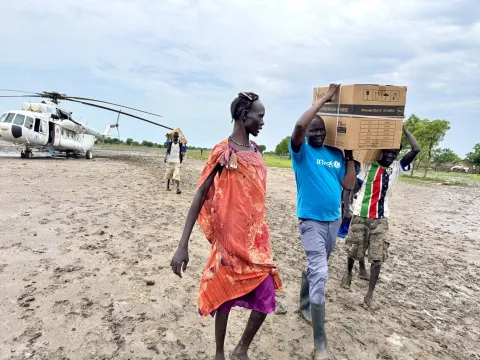
After a day and night waiting at the border, Mey and her family were moved to the back of a large truck to the Renk Transit Center, about an hour's drive from the border. The sprawling camp-like facility was set up by UN Agencies and the Government to shelter and support people arriving in the short-term. While South Sudanese returnees await onward transportation to their homes across the country, refugees are moved to existing Refugee Camps dotted around the border regions.
But many refugees like Mey and her family, are refusing to move to the refugee camps. They hope to travel to Juba or onward to other countries in the region. The result is growing pressure on the bulging transit centers in Renk. People are resorting to makeshift shelters, made out of pieces of old fabric and items of clothing, to avoid the blistering 40-degree heat.
Disease, hunger, and desperation are setting in. After one night in the Transit Center, three of Mey’s children were severely ill. Exhausted and hungry, with high fevers from Malaria, they could only take relief on the concrete floor of a shelter.


Humanitarian agencies are being pushed to the brink, struggling to keep up with the demand from the constant flow of people and new arrivals. Existing resources are stretching thin between the support for the constant flow of new arrivals, and the continued support for the existing humanitarian needs in highly vulnerable parts of South Sudan.
In support of the large UN-led humanitarian operation underway, UNICEF and its partners are providing health services, treatment for staggering rates of acute malnutrition in children and mothers, water provision, and safe spaces for children to play, learn, and receive counselling and care for the traumas they have experienced.
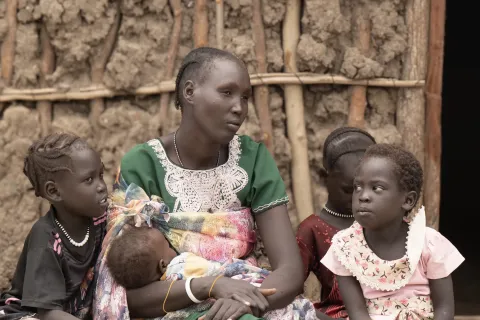
Mothers are waiting for malnutrition treatment for their children.
Verity Rushton, UNICEF South Sudan’s Chief of Field Operations, said additional resources are crucial to support the continued influx of returnees and refugees into South Sudan.
“We also need to continue to move people onwards, particularly the South Sudanese that want to go back to their places of origin, and in those places of origin, we need to provide them with the tools to restart their lives. They’re landing here with very little after very long journeys that have been very unpleasant. What can we do to provide a new start for them, a new start for their families and their lives?” she said.


As the war evolves inside Sudan, there is a growing call to begin supporting the humanitarian operations from neighboring countries. Humanitarian practitioners such as Verity Rushton are rallying decision makers to enable this process to start.
“We need to think about how we can increase and provide additional support for those in Sudan who have needs that are driving them across the border to South Sudan. And that involves additional resources, and it involves access being made available to some of those communities for us to reach those civilians that have nothing to do with the conflict that have inadvertently been affected.”
And lastly, we just need peace. The people who are here, don't want to be here. Many of them want to go home, and it's crucial to enable that to happen and allow them to restart their lives.


But until that happens, for families like Mey Sidig’s, the journey as refugees in one of the toughest and most volatile places on the planet continues.
“The citizens are the victims here, really. The war has only affected its citizens. I lost my job, I lost my home, and I lost my secure place. I lost even hope, and this is a bad experience for me and for my family, but this is life,” she said stoically.
*Mey, her husband Mohamad, and five children remain in Renk. They are still trying to get to Juba and eventually to Rwanda for their eldest son, Suliman, to pursue his university studies and the younger children to go back to school.