Escalating conflict in South Sudan threatens safety and survival of women and children
UNICEF Deputy Executive Director Ted Chaiban’s final statement after 5-day visit to South Sudan

JUBA/NAIROBI, 2 April 2026
I have just concluded a 5-day visit to South Sudan and during my stay I witnessed how the renewed fighting which began at the start of the year has upended thousands of lives and left many already vulnerable children in a precarious situation.
I held productive meetings with government representatives and appreciate the frank dialogue and insights into the current situation. It was very valuable to get a national perspective before leaving for Jonglei state.
The conflict in South Sudan has displaced 286,000 people since the beginning of the year and in Chuil, northern Jonglei I witnessed the scale of the displacement. The original population was 6,000 and in the last two months it has expanded to 30,000 with another 25,000 in nearby villages spread along the Sobat River. Health workers and mothers there told me continued food and nutrition support, shelter, vaccines and increased provision of clean safe water are all critical right now. But the population is in bad shape and much more is needed. And let’s remember, the children of South Sudan were already in a vulnerable situation before this conflict started, with over two million at risk of acute malnutrition and 2.8 million outside the safety of school.
The health workers also raised concerns that there are still displaced communities in Northern Jonglei unable to reach safety. UNICEF is appreciative of efforts to allow access to many parts of the state and my successful visit to Chuil and Yuai shows how important such access is. But we need more: safe, unhindered access to ALL those in need, regardless of where they came from to reach them where they are.
In particular let me mention that we are having discussions on unlocking access to locations such as Nyatim with positive indications that we hope will be confirmed.
I also visited Yuai town in Uror county and was shocked to see the level of destruction at the primary health care centre. The reception and waiting rooms were destroyed and burned, the cold storage system for vaccines broken with solar panels removed and the water system vandalized. UNICEF has received reports of 28 health facilities damaged or destroyed across the state this year. Years of investment by UNICEF and other agencies, with generous support of donors, into health, water and other public infrastructure cannot be recovered or quickly restored. Civilians and this critical infrastructure need to be protected by all parties. Lives depend on it.
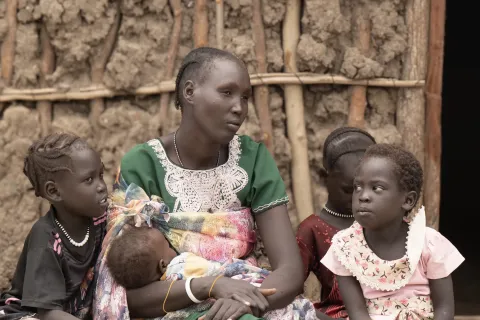
The women and children of South Sudan have done nothing to contribute to this escalation of violence, and yet they find themselves, many not for the first time, displaced, sometimes separated from their children, without shelter, limited food and no security.
After speaking with the UNICEF team and partners in Jonglei, and visiting the conflict affected areas I have become increasingly concerned that we have a real and present protection crisis for women and children.
Several of the women I met had lost children on the treacherous journey to find safety. Some lost their children as they were fleeing violence in different directions. UNICEF has registered 540 unaccompanied children, separated from their parents whilst fleeing. Some spoke of children abducted by armed youth – a terrifying experience for the mothers, who were clearly beside themselves with shock and fear. UNICEF and partners are working to trace children and reunite them with their families and to do that we need funding and a scale up of protection services for tracing and critical case management to help recovery. We are working to provide mental health and psycho-social support services to all children impacted by the violence.
In conclusion I would like to make two final points:
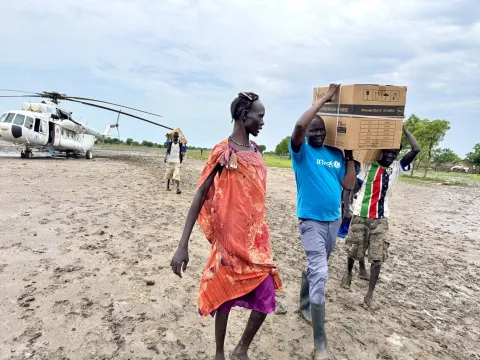
UNICEF is responding to the crisis in Jonglei. We have delivered 200 metric tonnes of supplies to date, and we have staff and partners working to scale up services. We will expand our support in the areas of health and nutrition supplies and malaria bednets, including through the assets of the Health Sector Transformation Project which have been part of the first line of defence; water, sanitation and hygiene activities to beat back water borne diseases building on the good work done to address cholera; non-food items and dignity kits to address the needs of displaced families and family tracing and reunification with child protection partners to reunite missing children with their families. And negotiations led by local authorities to release abducted children. Our sister agencies are working on food distribution and the provision of shelter materials among others. The rainy season is around the corner and we need to act with urgency to respond now and pre-position supplies and personnel before roads become impassable.
This is helping, but we know it is not the solution. UNICEF with our UN partners are calling for all parties to end the violence and return to peaceful dialogue. The current crisis risks reversing the small and hard-won gains in improving the life chances of South Sudan’s children. No progress can be made without lasting peace.
In addition, there needs to be sustained investment in social services led by the government and supported by external development partners. We understand that oil revenues are still flowing and we are asking for those funds to be invested by the government in basic social services and, in particular, the salaries of frontline workers in health, water, education and social welfare. These are part of a social contract that every South Sudanese expects from its government and that the government has committed to deliver.
I remember when this young nation won it’s hard fight for independence. That was a time of great optimism. And whilst that sentiment is being tested there is still hope. With fertile land and a young population there is much potential for a bright future. Peace, dialogue, development and education are the best prospects for South Sudan’s future.
Media contacts
Additional resources

About UNICEF
UNICEF promotes the rights and wellbeing of every child, in everything we do. Together with our partners, we work in 190 countries and territories to translate that commitment into practical action, focusing special effort on reaching the most vulnerable and excluded children, to the benefit of all children, everywhere.
For more information about UNICEF and its work in South Sudan visit: www.unicef.org/southsudan
Follow UNICEF South Sudan on Twitter, Facebook, Instagram and YouTube