Rebuilding social infrastructure in Eyl District
Inclusive local governance improves access to basic services and the engagement of citizens decision-making
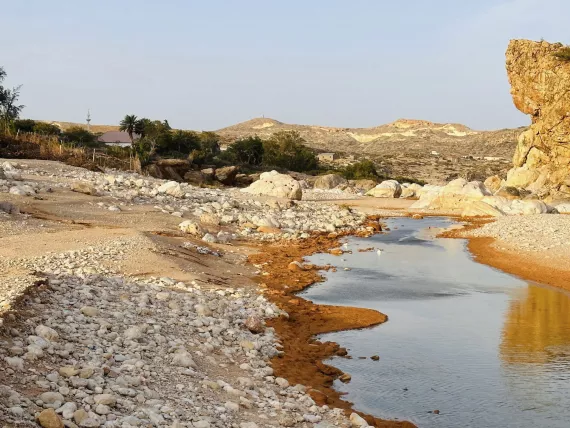
Eyl is a historic coastal town located in the Nugal region of Puntland, forming the district’s administrative center. The visitor from Garowe will first take a steep, curvy road down to Dawaad, the previous base of Zayid Mohamed Abdule Hassan, dubbed “Mad Mullah” by his adversaries. Four kilometers downstream of the seasonal watercourse, Nugal River, lies the second part composing Eyl town, Badey, overlooking the coastline of the Indian Ocean. Most livelihoods in the district depend on the fishery sector, agro-pastoralism, and small-scale businesses.
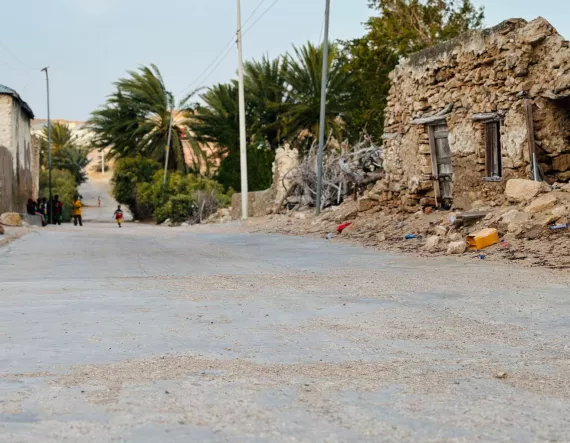
Once a pirate stronghold in 2010 with weak government institutions and untapped productive sectors, Eyl is undergoing a remarkable transformation into a thriving district restoring its physical and social infrastructure, including providing public goods and services. Since 2014, the UN Joint Programme on Local Governance and Decentralized Service Delivery (JPLG) has supported the local government in the transformation. The visitor from Garowe is guided to the local government’s headquarters by recently installed solar-powered streetlights financed through JPLG’s local development fund mechanism. “JPLG means everything to us. The capacity of the local government has improved, and we have taken increasing leadership in local governance”, explains Abdinasar Yasin Ali, Director of Planning of Eyl.
Within JPLG, UNICEF has taken the lead in supporting the local government in re-establishing mechanisms to involve citizens in decision-making processes. In 2020 and 2021, UNICEF, in partnership with the Puntland Research and Development Center (PDRC), supported a massive outreach campaign offering civic education on local governance. According to the director of planning, Abdinasar Yasin Ali, the impact was significant. “Our citizens are more aware of their rights and responsibilities. The increased knowledge led to more active participation in all components of local governance.” The civic education campaign also contributed to the large voter turnout during the 2021 elections, the first to be held with a “one-person-one-vote” electoral system. The directly elected local government has recently taken office. “We are elected by the people, and we feel the responsibility to perform for the people. We are held accountable”, emphasizes Deputy Mayor Abdirisak Kilwe Yusuf.
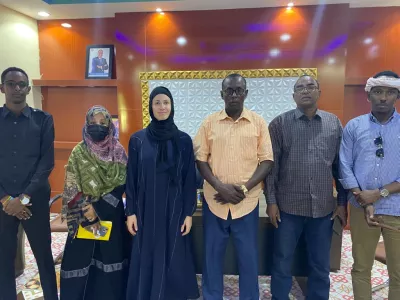
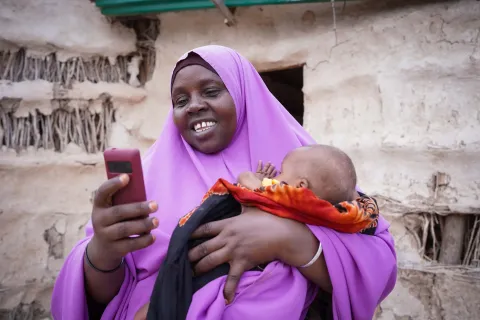
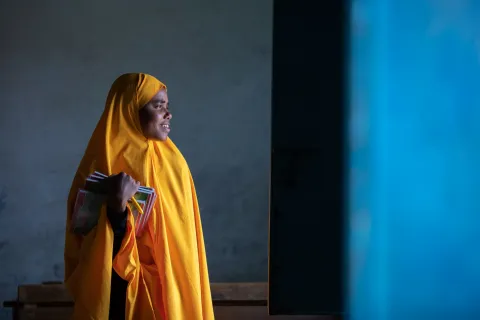
Inclusive local governance includes better representation of marginalized groups, including women. Across Somalia, women persistently face structural barriers entering most leadership and decision-making positions in the economic, social and political realms. Leading up to the first direct elections in Eyl, UNICEF, in partnership with the Puntland Ministry of Women and PDRC, supported increased participation of women in local councilor positions through public mobilization, and advocacy among political associations and traditional leaders. These efforts contributed to a significant improvement in the representation of women in the local council, increasing from one to six seats out of 27 (from 3% to 22%). Five of the six elected councilors engaged in capacity-building training for female candidates organised by UNICEF in partnership with PDRC. Local councilor Amina Hassan Egal recollects, “We learned how to manage an election campaign, public communication and strategies, and most importantly, how we can support each other in the elections, especially among women. It gave us the confidence and strength to be successful.”
Improved access, especially of women, is a powerful catalyst to enhance representation in other areas. Mariam Abdishakuur Farah, local councilor, emphasized that she is advocating for women’s rights on a daily basis, in addition to advocating for the needs of the entire community. “If we see specific needs for women, we try to bring it into the council or start a community project to collect funds.” Abdinasar Yasin Ali, Director of Planning, highlights, “Our elected female councilors are a game-changer for mobilizing women to participate in local governance mechanisms.”
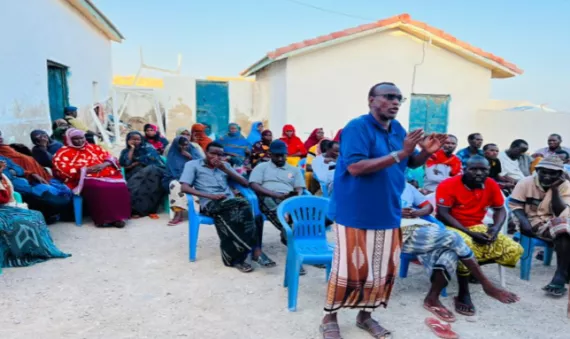

One such mechanism is developing a five-year strategic District Development Framework DDF, outlining visions, and goals for Eyl district. With the support of UNICEF, local governance institutions facilitated participatory community consultations in 23 locations across the district to gather citizens’ needs and priorities for the DDF. “Thanks to the positive impact of JPLG in the past years and the civic education on local governance, citizens were eager to engage,” underlines Abdinasar Yasin Ali. For the first time, the DDF has also been informed by outcomes of children’s consultations, utilising child-friendly methodologies. “We were asked for the first time what we like and don’t like in our town. It felt important to express what we want to get what we need,” said Amina, a girl participant in Dawaad. The director of planning concludes, “The entire DDF process was inclusive and transparent and included all walks of society. It was an especially remarkable experience to consult children”. The local government of Eyl was so impressed with the rich discussions that it is considering institutionalizing consulting children in annual planning processes.
With the support of JPLG and UNICEF, Eyl has taken important steps toward rebuilding social infrastructure, providing public goods, and empowering members of society to include in decision-making processes. In the words of Deputy Mayor Abdirisak Kilwe Yusuf, “We are building a great momentum between the community and local leadership.” Ultimately, inclusive and accountable local governance is crucial for fostering a culture of trust and cooperation between local institutions and the community, a precondition for a functioning social contract and maintaining peace.
UNICEF thanks partners and donors who make the JPLG programme possible, like the governments of Denmark, Netherland, Norway, Sweden, Switzerland and the USA, along with the European Union.