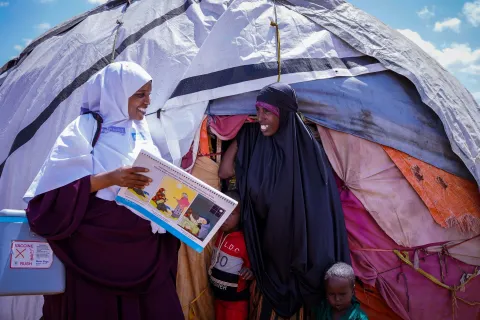
Proper hand hygiene helps curb malnutrition
Integrating nutrition, water, sanitation and hygiene services in health centres

“Since I started checking if my children have washed their hands with soap before eating, they get sick less,” says Deqa Abdullahi, as she washes Issak with the soap that she has received from the Kabasa Outpatient Therapeutic Centre (OTP) in Dollow.
Deqa, along with thousands of others, came to the sprawling Kabasa Internally Displaced Persons (IDP) camp in 2019 at the height of a devastating drought that ruined crops, dried up water points, and decimated livestock. Shorn of their primary sources of survival, thousands of families were forced to leave their homes in search of help, and IDP camps were the place where humanitarian aid was being provided.
Although climatic conditions have since improved, families are yet to fully recover after decades of cyclical droughts, insecurity, and economic hardship. The Kabasa IDP camp, established in the aftermath of the 2011 famine, has remained a glimmer of hope; at the OTP centre, integrated nutrition, health, water, sanitation and hygiene (WASH) services are provided to families desperate to avoid malnutrition and diseases like diarrhoea. By ensuring multiple services are available in one centre, mothers and caregivers can save time, money and energy by meeting their children’s nutrition, WASH and health needs all at once. The children are not only checked and treated for ailments but also given proper vaccinations per the childhood routine immunization schedule.
Deqa has brought Issak, two years old, to the OTP centre after his weight continued to wither down following days of diarrhoea and low energy.


“We screened her child and found he had severe acute malnutrition. He is being treated with ready-to-use therapeutic foods [RUTF] to help him recover,” says Aden Abdi Ibrahim, the OTP Nurse. Not only was Issak attended to for malnutrition, but Deqa was also sent home with a hygiene kit to help keep her and her family safe from waterborne diseases. The kit contains a jerrycan for fetching water, bars of soap and chlorine tablets to purify drinking water.
The Kabasa OTP and 2,000 health centres across 15 districts in Somalia have been supplied with 52,420 cartons of RUTF to treat children under 5 years old for malnutrition and 48,714 hygiene kits. When caregivers have a child treated at the centre, they have an education session about infant and young child feeding and personal hygiene and a hygiene kit to take home with them.
The integrated programme providing critical, lifesaving assistance to Deqa and thousands of others has been made possible through a joint partnership between the Ministry of Health, the King Salman Humanitarian Aid and Relief Center, the UK government, and UNICEF. So far, the programme has screened around 1 million children under five years old for malnutrition and admitted over 76,000 children for treatment of severe acute malnutrition. Also, information, education, and communication (IEC) materials are being distributed to 76 nutrition sites.
“As soon as my children are sick, I can count on the clinic. Also, the treatment is free,” says Deqa. Projects such as this give mothers confidence in local health systems, and the skills to care for their children, which will build a healthier Somalia.