Saving baby Qamar
How peanut paste, digital tools, and a mother’s unwavering strength gave baby Qamar a second chance at life.

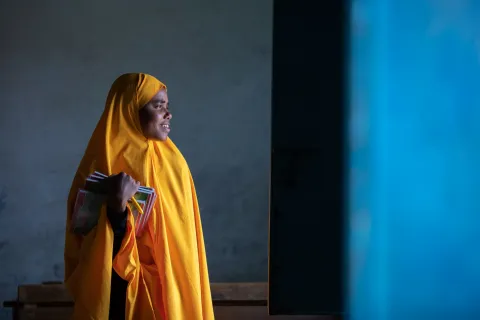
In a quiet corner in Kismayo, Somalia, Binta Mohamed Muse holds her daughter Qamar close, gently feeding her a packet of peanut-based paste. Just weeks ago, Qamar was weak, her tiny body showing signs of severe malnutrition. Today, she is alert and smiling, slowly gaining strength, thanks to her mother’s love and the care she received at a local health center supported by UNICEF.
Binta is 30 years old and a mother of nine children. She and her family were forced to leave their home in Mogambo village in Lower Jubba five years ago because of drought. Since then, they have been living in a camp for displaced people on the outskirts of Kismayo town. Life in the camp is difficult. There is little food, water is hard to find, and jobs are scarce.

The family’s struggles grew worse when Binta’s husband, the main breadwinner, died in a tragic accident at a construction site where he was working. Suddenly, Binta found herself alone, trying to care for nine children while grieving and surviving on very little.
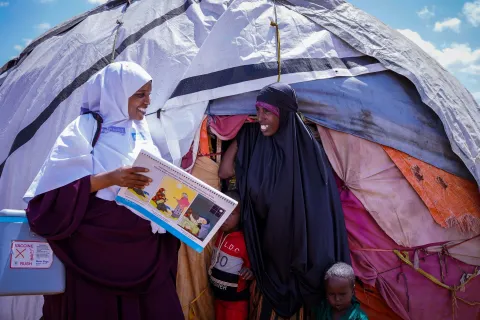
Not long after her husband’s death, Qamar, her youngest daughter, fell ill. She stopped eating, was losing weight fast, and becoming very weak. Binta knew something was wrong. She decided to take Qamar to the Outpatient Therapeutic Programme (OTP) center run by UNICEF partner CARE in Kismayo.
There, she met Nurse Ayan, who welcomed her and immediately checked Qamar. The little girl was diagnosed with severe acute malnutrition, but thankfully, it was not too late. She was quickly enrolled in a nutrition program and started on Ready-to-Use Therapeutic Food (RUTF) a special peanut-based paste filled with nutrients to help malnourished children recover.

What made Qamar’s recovery faster were two important tools used at the clinic, both introduced with support from UNICEF. The first is a new Last Mile Supply Monitoring system. This system helps health workers like Ayan keep track of nutrition supplies, like RUTF, from the main warehouse all the way to the health center. It helps ensure that there is always stock available when a child like Qamar needs it. Ayan can see exactly what has arrived, what is running low, and when to expect new deliveries, all on a simple digital dashboard. This reduces delays and ensures children receive treatment right away.
The second tool is called the OGOW digital patient record system. Instead of using paper files, Ayan now uses a tablet provided by UNICEF to record important health information about the children and mothers who visit the clinic. When Qamar arrived, Ayan registered her on the tablet, creating a digital profile that included her weight, height, symptoms, and treatment plan. This made it easy to follow up on her progress and ensure she received the right care every time she came back for a checkup.

“These tools have really changed the way we work,” says Ayan. “I can now focus on treating the children, because I know I have the information and supplies I need, right at my fingertips.”
Thanks to this care, Qamar is getting better. She now plays with her siblings and is eating again. “I was worried I would lose my daughter after losing my husband,” Binta says. “But the nurse helped us.”

UNICEF and partners are working to bring lifesaving care closer to families like Binta’s. With simple, smart digital tools, health workers across Somalia can now provide faster, better treatment, even in the hard-to-reach areas. And for children like Qamar, that can mean the difference between life and death.
UNICEF thanks donors who have made this LMSM project possible, as well as those who support the procurement and distribution of Ready-to-Use Therapeutic Food (RUTF), like the European Civil Protection and Humanitarian Aid Operations (ECHO) and the US Government.