Rwanda’s investment in children is paying off, with progress and priorities highlighted in a new budget brief
UNICEF Rwanda in collaboration with the Ministry of Finance and Economic Planning today launched Social Sector Budget Brief focusing on education, health, social protection and water, sanitation and hygiene, as preparations for the FY2027/28 budget begins
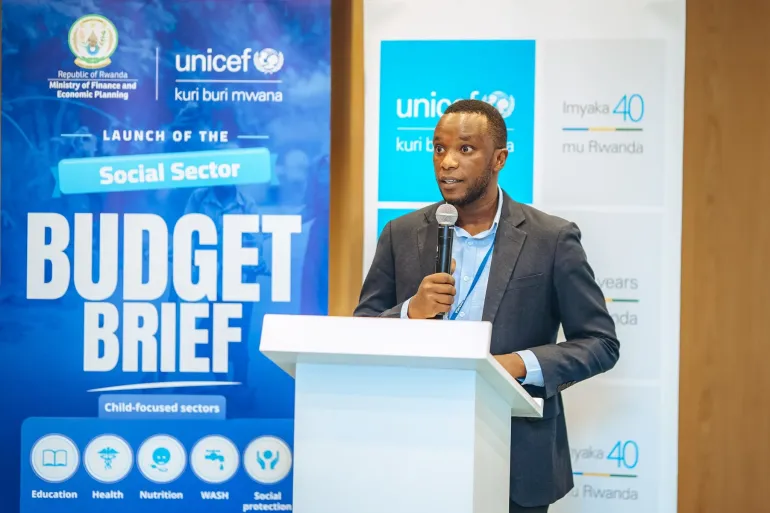
KIGALI, 12 November 2026 – UNICEF Rwanda and the Ministry of Finance and Economic Planning (MINECOFIN) today launched the FY2026/27 Budget Brief, an analysis of public spending in the four sectors on education, health, social protection, and water, sanitation and hygiene (WASH), with the brief showing a nominal increase of 4.2 per cent in these sectors that are important for children.
The launch comes as Government begins preparing the FY2027/28 budget, giving ministries and partners a shared evidence base for the choices ahead.
Rwanda’s national budget for FY2026/27 stands at Frw 7,796.3 billion, 12.1 per cent higher than last year, with domestic resources now financing more than two-thirds of public spending. The combined allocation to education, health, social protection and WASH rose by 4.2 per cent to Frw 1,711.3 billion, or 22.0 per cent of the national budget. With inflation projected to peak at 10.5 per cent this year, the brief highlights the importance of protecting the real value of these allocations so that recent gains for children are sustained.
“Rwanda has shown what steady investment in children can achieve. Fewer children are dying before their fifth birthday, more are finishing primary school, and far fewer families are living in poverty,” said Lieke van de Wiel, UNICEF Representative in Rwanda. “As the FY2027/28 budget takes shape, protecting these investments is one of the surest ways to build the healthy, skilled workforce that Vision 2050 depends on.”
The brief shows that Rwanda continues to invest in services for children. Education is now about 88 per cent domestically financed, and domestic funding for social protection rose by two-thirds to make up for lower partner contributions. This investment has gone hand in hand with important gains for children. According to the seventh Integrated Household Living Conditions Survey (EICV7), poverty fell from 39.8 per cent in 2017 to 27.4 per cent in 2024, while extreme poverty more than halved over the same period, from 11.3 to 5.4 per cent. Stunting among children under five declined from 33 per cent in 2020 to 27 per cent in 2025, and under-five mortality dropped from 45 to 36 deaths per 1,000 live births between 2019/20 and 2025. In education, pre-primary net enrolment more than doubled, from 24.2 per cent in 2021/22 to 50.3 per cent in 2024/25.
Key findings by sector
- Education (Frw 907.3 billion) remains the best-protected social sector, with about 88 per cent financed from domestic resources. Progress is evident: more children are completing primary school on time, although one in five pupils still repeats a grade and secondary attendance among the poorest households (20 per cent) is well below that of the richest (55 per cent).
- Health (Frw 500.2 billion) has supported continued progress on child survival: under-five mortality fell to 36 deaths per 1,000 live births in 2025, against a target of 20 by 2028/29 under the fifth Health Sector Strategic Plan (HSSP V). Partners finance close to half of the sector budget, which makes sustained support for maternal, child and adolescent health and nutrition a priority as external assistance evolve.
- Social protection (Frw 157.3 billion) remained broadly stable as domestic funding rose by two-thirds to offset lower partner contributions. Reaching the national target of covering 20 per cent of poor and vulnerable people will require coverage to nearly double.
- WASH (Frw 146.5 billion) recorded the strongest growth of the four sectors, at 15.8 per cent. Most of the increase went to drinking water, creating room to extend investment to sanitation, where gaps between the poorest and richest households remain.
- Climate finance: Frw 761.8 billion about a tenth of the budget, is tagged as climate-related spending. With children making up nearly half of Rwanda’s population and recognized as core stakeholders in the country’s third Nationally Determined Contribution (NDC 3.0), there is a clear opportunity to link more of this financing to schools, health services and social protection.
“Investing in people remains at the heart of Rwanda’s development agenda,” said Jeanette Rwigamba, Head of the National Budget Department at MINECOFIN. “This brief, which we developed together with UNICEF, gives us a common evidence base as we prepare the FY2027/28 budget. We look forward to working with line ministries and partners to make every franc count for children.”
Looking ahead to FY2027/28, the brief points to a set of practical priorities: keeping allocations to child-focused sectors in step with rising prices; protecting maternal and child health, early childhood and nutrition programmes as external financing changes; building a stronger domestic base for WASH and social protection; and bringing child-focused sectors more fully into Rwanda’s climate finance architecture.
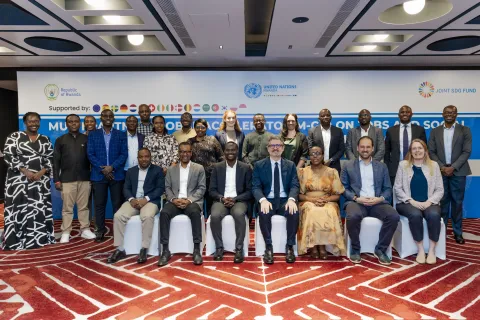
The half-day launch at the Kigali Marriott Hotel brings together senior officials from MINECOFIN, the Ministries of Education, Health, Local Government and Infrastructure, the National Institute of Statistics of Rwanda and the Local Administrative Entities Development Agency, alongside development partners, research institutions and the media. Participants agreed on priority actions to inform the FY2027/28 planning and budget process.
– ENDS –
Notes to editors
- The FY2026/27 Social Sector Budget Brief was co-developed by UNICEF Rwanda and MINECOFIN’s National Budget Department and validated on 13 August 2026.
- Figures are drawn from the State Finance Laws (2022/23 to 2026/27), the Budget Framework Paper 2026/27, EICV7 (2025) and the Rwanda Demographic and Health Survey 2024/25 (DHS7).
- “Child-focused sectors” refers to education, health, social protection and WASH.
- The full brief is available at https://www.unicef.org/rwanda/reports/budget-brief-child-focused-sectors-20262027
Media contacts
About UNICEF
UNICEF promotes the rights and well-being of every child, in everything we do. Together with our partners, we work in 190 countries and territories to translate that commitment into practical action, focusing special effort on reaching the most vulnerable and excluded children, to the benefit of all children, everywhere.
For more information about UNICEF and its work for children in Rwanda, visit www.unicef.org/rwanda.
Follow UNICEF Rwanda on Twitter, Facebook, Instagram and on our YouTube channel.