Rwanda Stock Exchange and UNICEF Rwanda join global campaign to put children’s rights on the capital markets agenda
Rwanda Stock Exchange becomes the first Stock Exchange in Africa joining exchanges in 25 countries to promote child-responsive business and investment practices ahead of World Children’s Day.
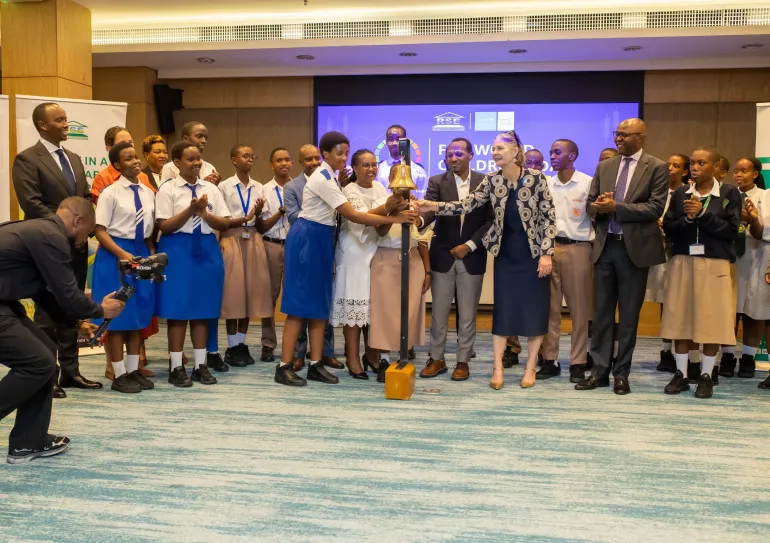
KIGALI, 11 November 2026 – The Rwanda Stock Exchange (RSE), in partnership with UNICEF Rwanda, today became the first Stock Exchange in Africa to Ring the Bell for Children, joining exchanges in 25 countries around the world in calling on businesses, investors and financial institutions to place children's rights and well-being at the heart of investment and business decisions.
The ceremony marks Rwanda's participation in the inaugural global Ring the Bell for Children campaign, led by the United Nations Sustainable Stock Exchanges (UN SSE) initiative and UNICEF under the theme My Day. My Rights. My Future. The campaign brings together stock exchanges across five continents in the lead-up to World Children's Day on 20 November.
With children accounting for almost 45 per cent of Rwanda's population, their rights and well-being must be central to decisions that shape the country's economic future. Children are not only tomorrow's workforce, entrepreneurs and consumers; they are stakeholders in today's economy, directly affected by business operations, investment choices, employment practices and environmental decisions.
The collaboration between RSE and UNICEF Rwanda seeks to raise awareness of the importance of integrating children's rights into business strategies and investment decisions, while encouraging responsible business practices that contribute to better outcomes for children.
Pierre Célestin Rwabukumba, Chief Executive Officer of the Rwanda Stock Exchange, said:
“Children are important measures of our success, but behind every investment, there is a broader story. A company that raises capital may expand its operations, create jobs, and support families. An investment in infrastructure can improve access to essential services, and growing business can create opportunities in communities where they are needed most. In each of these examples, children are affected, even when they are not directly involved in the transaction.”
Lieke van de Wiel, UNICEF Representative in Rwanda, said:
"Children may not be present in boardrooms or investment committees, but the decisions made in those spaces have a profound impact on their lives and futures. From the products businesses put on the market to their employment practices, supply chains and environmental footprint, children are affected by business decisions every day. Bringing children's rights into investment decisions is therefore not simply the right thing to do; it is essential to building responsible businesses, sustainable markets and a stronger economy. We encourage Rwanda's financial sector and private sector to recognise children as important stakeholders and ensure that their interests are considered in the decisions that shape our country's future."
Children represent nearly one-third of the world's population, yet their rights and well-being are not always adequately considered in business and investment decisions. In Rwanda, despite progress in reducing child poverty, significant challenges remain. Some 26.8 per cent of adolescents aged 15–17 and 11.9 per cent of children aged 5–14 continue to experience multidimensional poverty, facing deprivations in areas including health, education, water, sanitation and housing.
These challenges underscore the importance of recognising that children's well-being is shaped not only by public policies and public investment, but also by the decisions businesses and investors make.
Through the Ring the Bell for Children campaign, RSE and UNICEF Rwanda are encouraging companies, investors and other capital market participants to apply a child-rights lens to their business practices and investment decisions.
This means considering how business activities – including products and services, employment practices, working conditions, supply chains and infrastructure investments – affect children's safety, development, opportunities and well-being. It also means identifying and addressing potential risks to children while recognising opportunities to generate positive social and economic outcomes.
Considering children in investment decisions can help businesses and investors identify and manage risks, strengthen workforce resilience, build consumer trust and contribute to sustainable, long-term market growth. More fundamentally, it helps ensure that economic development creates opportunities for every child to survive, learn, develop and thrive.
The campaign coincides with the forthcoming launch of the UN SSE–UNICEF Model Guidance on Applying a Child Lens to Business and Investor Practices, which will provide practical recommendations for stock exchanges and listed companies on identifying, managing and disclosing child-related impacts, risks and opportunities.
The guidance builds on UNICEF's Child-Lens Investing framework, recognised by TIME magazine as one of its Best Inventions of 2024. Further training opportunities will be made available through the SSE Academy, with an online course expected by December 2026.
As the first country in Africa to mark the occasion, RSE and UNICEF Rwanda intend to introduce the guidance to listed companies and issuers, promote responsible business practices and explore further opportunities for joint engagement around World Children's Day 2027.
As Rwanda continues its economic transformation, bringing children's rights into the capital markets agenda offers an opportunity to ensure that economic growth translates into a better future for all. By working together, businesses, investors and financial institutions can help build an economy in which commercial success goes hand in hand with the rights and well-being of every child.
ENDS
Media contacts
About the Rwanda Stock Exchange
Rwanda Stock Exchange Limited was incorporated on 7th October 2005 with the objective of carrying out stock market operations. The RSE serves as the cornerstone of Rwanda's capital markets, playing a pivotal role in mobilizing domestic and international investments for sustainable economic growth. Currently, the RSE has 10 listed companies, 5 of which are domestic companies and 5 are cross-listed companies from Kenya and South Africa, and a standalone fixed-income board with 85 treasury bonds and 5 corporate bonds.
For more information, visit: www.rse.rw
About UNICEF
UNICEF promotes the rights and well-being of every child, in everything we do. Together with our partners, we work in 190 countries and territories to translate that commitment into practical action, focusing special effort on reaching the most vulnerable and excluded children, to the benefit of all children, everywhere.
For more information about UNICEF and its work for children in Rwanda, visit www.unicef.org/rwanda.
Follow UNICEF Rwanda on Twitter, Facebook, Instagram and on our YouTube channel.