Why Didina had her children vaccinated
Didina is both mom and dad to her seven children. None of the three fathers ever come to see them. But that, in Didina’s home, has never been an issue.

- English
- Română
BUHUSI, Bacău County – Didina is both mom and dad to her seven children. None of the three fathers ever come to see them. But that, in Didina’s home, has never been an issue.
“They grew up with me, and I never mistreated them, I never drank or smoked, they had all they needed: they had shoes, were clothed, and fed on time.”
Didina’s schooling ended with the second year of high school. Now she works daily jobs wherever she’s given a chance and looks after the house. That would be a small hallway giving into the cellar, where she keeps the firewood and the preserved cabbage, and a large room divided in two, where she lives with the kids. The only windows are in the hallway.
Her life is filled with numbers: how much is a carriage load of wood? The equivalent of $170. She buys it cheaper at times, but they burn faster. She needs about four over the winter. How much is the bread for a month? $49. Kids will jam salami between the slices and take off. When’s the shopping day? On the 12th, when child benefit is paid, and on the 28th, when she gets another social aid payment.
Mihaela, her first born, works in Italy, taking care of a child. With the money she sends, Didina pays the electricity bill. She also wants to build a kitchen and finish the fence.
The other siblings all go to school and kindergarten, except for the youngest, Rarian, who’s been diagnosed with hydrocephalus. He’s two already but cannot talk or walk.
When he was a few months old, “one of my aunts said ’not to upset you, but your boy only grows in the head’. I got very upset.” She has been going to hospitals in the cities of Bacau and Iasi ever since.

The first yes is the hardest
Didina heard on TV of moms who don’t have their children vaccinated because they are afraid. She even heard talks on her street.
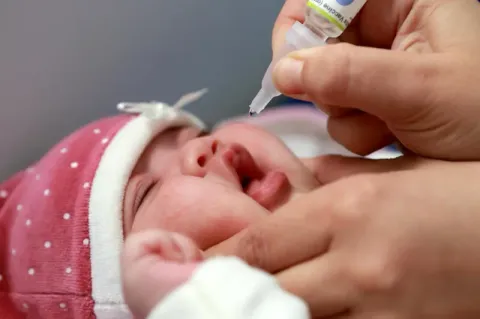
People would say “no”. ”We’d say ‘hello’ from the gate. –‘You’re scheduled for vaccination’. But the response would be: ‘We’re not doing it. I’ll sign to waive it,’” remembers Mrs. Magda, social worker at the city hall in Buhuși and part of the UNICEF program “Community-based child services.” Together with her colleagues, they went door to door and talked to every family supported through this pilot program.
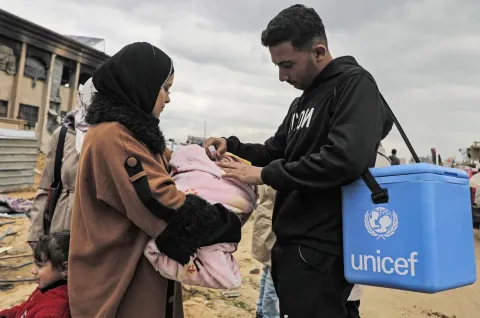
They went to Didina’s too. They’ve been helping her and all the other families in the program with applications for social aid, medical, education and family support. They find out what each one needs, and then guide and advise them in the right direction. Didina can read and write, but that’s not always the case with other families. “And with the first obstacle, many times they get discouraged,” says Mrs. Gabi, the health mediator. “It’s complicated.” others to agree. They understood the vaccine was not going to harm their children, that it was to support their health and protect them from diseases. Mrs. Gabi and her colleagues had 45 children vaccinated as part of a larger door-to-door awareness and catchup campaign launched in 2018 by Romania’s Ministry of Health in partnership with UNICEF and the World Health Organization to vaccinate children in the most vulnerable communities - people living in hard to reach areas, those affected by poverty, and Roma communities. These vulnerable groups often have children with the lowest rates of immunization.
Over 20,000 people in Romania have been diagnosed with measles since 2016. To date, 64 people have died – 58 of them children. The outbreak is the result of a drop-in immunization coverage over the past two decades, with many parents fearful of vaccination, due to the spread of misinformation. For example, the proportion of children who have received a second dose of the measles vaccine – which is needed to adequately prote
Didina doesn’t really listen to what people say. When Mrs. Gabi told her she should bring children in for measles vaccination, they came in first at the community center. “[It’s] so they don’t get sick. I was glad it happened. I only care about me and my children, and their health, not about what people say.”
After the first moms, like Didina said yes, it was a lot easier for the ct a child form the deadly disease - dropped from 97 per cent in 2000 to 76 per cent in 2016. It was only after UNICEF started re-engaging in the national measles programme that this drop was stopped, and the coverage is currently up 5 percent from 2016 for the second dose. UNICEF focused on improving immunization awareness of the general public via TV, radio and social media, as well as on redesigning the national electronic vaccination registry, on conducting catchup immunization campaigns in areas with extremely low coverage, and on improving behavior and communication skills of local health workers on immunization.
Besides these actions, UNICEF supported teams of health and social workers in 45 communities in Bacău county, in eastern Romania. Their interventions focus on providing a minimum package of community-based health services, including access to vaccination, to save and improve children’s lives.
What comes after the vaccine?
Alexandra will be in second grade and wants to be a cook. She already makes snacks for Rarian sometimes. When she got vaccinated, she didn’t cry at all. “I sat on the chair, and I got pricked here, but I stayed put.” Madalina is 13 and she wants to be in a profession that helps others. She cried. “They weighed us and asked our name. They said to clench my fist and I did. I teared up.” Dumitrita, the third sister, didn’t cry, but Dumitrita never cries. She wants to be a seller in a shop, but she wants it to be her shop, to be the boss.
Going to the doctor with her kids, Didina found out she has a heart condition. “I’m not afraid, I believe God gives me strength to raise them, be their mom and take pride in them.”
She’d rather worry about her boy. “I don’t need anything, only to see him walk. However, many days God may have [for him], he needs to live them, and I go to doctors as much as I can, and care for him. If he’s to go about in a wheelchair, I’ll carry him in a wheelchair, but I won’t part with him.”
Until they are grown up, Didina’s children will need healthcare support and for someone to give their mom advice. Someone like Mrs. Gabi, Mrs. Magda and their colleagues.