Schools as Safe Spaces for Children's and Adolescents' Mental and Emotional Well-Being
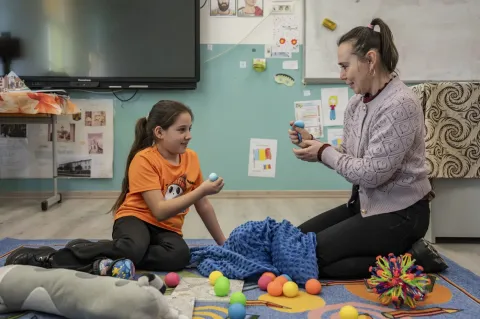
A group of teachers explore their own emotions during a course on socioemotional well-being

- English
- Română
In everyday life, we often hide what we really feel. We mask our feelings as if they were a sign of weakness, we tend to avoid difficult subjects that might upset us and tell ourselves that we need to be strong, to always keep everything under control. It's almost a reflex - to smile when we're actually not well, to rush through emotions when we should really just stop and reflect.
In school, children—just like adults—often hide their emotions, whether out of fear or because they lack the tools to understand them. The difference is that they are still learning how to manage their feelings, and at this stage, the support of teachers can make a huge difference. This is how authentic relationships can be built, transforming school into a safe space where children can experience balanced growth and truly thrive.
On November 16, 2024, at the “George Coșbuc” National Bilingual College in Bucharest, a group of teachers had the opportunity to explore their own emotions during a course on socioemotional well-being titled "Guide to Well-Being and Mental Health." This course was developed as part of the project "Creating a Functional Intervention Model for Mental Health and Psychosocial Support for Children and Adolescents," implemented by UNICEF in partnership with the Romanian Angel Appeal Foundation.
The training was part of a broader program aimed at equipping 350 teachers, school nurses, school doctors, school counselors, school managers, librarians, and administrative staff with the knowledge and skills needed to support the mental health of children and adolescents.
For two days, teachers set aside the daily pressures of their classrooms and engaged in a reflective and learning experience. The atmosphere was unexpected—relaxed, fun, filled with laughter and jokes, yet also marked by moments of deep introspection.

For those who participated, the course meant more than just acquiring information about mental health. Over the two days, the trainers created a safe space where teachers could openly share their fears, moments of joy, and challenges. They left not only with new knowledge and practical strategies, but also with a sense of community. And perhaps most importantly, they realized that emotions—no matter how complex they may sometimes be—can serve as a bridge, a way to build stronger relationships with their students.
"From a teacher's perspective, this course is extraordinary. It helps you understand that teaching and assessing are not enough," said Magda Ghercă, deputy director and course participant. "You need to focus on students' well-being in order to effectively convey information and develop their skills. But first, you have to take care of yourself so that you can help others," she added.


Participants were invited to reflect on their own values and empathize with children of different ages, as well as with parents, by answering thought-provoking questions from various perspectives, such as: “What do I care about the most?”, “What bothers me?”, “What drives me crazy?”, and “What would I like to see happen when I go to school?”
This exercise—delving into deep questions about motivations, frustrations, and aspirations—offers significant psychological benefits. It helps cultivate a more nuanced understanding of diverse perspectives, clarify core personal values, and foster greater compassion. Additionally, it enhances communication skills, promotes self-awareness and interpersonal awareness, and supports a sense of authenticity and purpose. These elements are essential for meaningful interactions and personal growth, both in educational settings and beyond.
In another exercise, teachers were invited to imagine receiving a letter from a future student, describing how their guidance had influenced their life. Some smiled, while others were moved to tears. This was more than just a creative exercise—it was a powerful reminder of the lasting impact teachers have on their students’ lives.
"This activity was deeply moving," said Ana Anica, one of the trainers who facilitated the course. "It was difficult for them to consider how they are perceived by their students, but when they reflected on the messages of gratitude they had received over the years from former students, they realized just how important their work truly is. A teacher may see up to 500 students in a year, but for a student, the number of teachers they encounter in a lifetime is much smaller—maybe just a few dozen. Even if teachers don’t remember every student, their impact is far greater than they often realize. It’s important to remember that," she explained.
The course was also an invitation to openness. Teachers were encouraged to allow themselves to be vulnerable, to acknowledge what isn’t working, and to become willing to learn alongside a generation of students who bring their own challenges and perspectives.
"We resist change, but I believe we should be the ones adapting. From children, we can learn to stop hiding," says Alina Plohi, a Romanian language teacher, with conviction. She then adds, "Our generation believes that emotions are something to be locked away, hidden deep in a closet. But children, especially when they are young, say what they think—and that can teach us to be more open."
This ability to grow alongside students is essential. A teacher’s role goes beyond imparting knowledge—they are role models and can serve as guides during a stage of life when emotions can feel overwhelming and difficult for children to manage. These relationships become even more critical when considering the vulnerability of adolescents in Romania.
According to UNICEF, 32% of 15-year-old girls and 21% of boys in Romania report feeling lonely most or all of the time over the past year1, and 11.2% have been diagnosed with a mental health disorder2. Depression, anxiety, and behavioral disorders are among the most common challenges they face.

Teachers are often the first to notice these warning signs, and courses like the one held at “George Coșbuc” College provide them with the necessary tools to recognize and respond effectively.
Another key message emphasized during the course was the clarification of the teachers’ role. They are not expected to be therapists or to solve every problem on their own. However, teachers are an essential part of a support ecosystem. By observing and identifying situations that require further attention or support, and by collaborating with parents and school counselors, teachers can lay the foundation for helping students.
"Being reminded that we are not responsible for diagnosing or solving everything took a huge weight off our shoulders," emphasized Magda Ghercă.
At the end of the course, participants were challenged to put their newly learned concepts into practice by organizing a 50-minute lesson with a class of their choice. The goal was not just to test new methods but to pass on essential messages about empathy, emotional well-being, and the importance of a supportive school environment.

The message that teachers took away from these two days of training was simple yet powerful: change has to start with them. When they have the courage to be more open, to recognize areas for improvement in themselves, and to learn alongside their students, they can make a real, positive impact on their lives.
School is not just about subjects taught and exams passed—it is a place where children learn to communicate, manage their emotions, and learn to feel safe. Ensuring their right to mental health requires collaboration and well-thought-out interventions at all levels—within families, schools, and the broader community.
"Creating a Functional Intervention Model for Mental Health and Psychosocial Support for Children and Adolescents" 📌 Implemented by UNICEF in partnership with the Romanian Angel Appeal Foundation This training program helps teachers and school staff support the mental health of children and adolescents, creating a safe and inclusive school environment. Through learning about prevention, early recognition, and referral to specialized services, the course aims to equip educators with practical tools for fostering emotional well-being in schools. Who is it for? 📌 350 participants, including teachers, school nurses, doctors, counselors, school managers, librarians, and administrative staff. What do participants learn? ✅ How to recognize signs of anxiety, depression, and emotional distress in students. ✅ Strategies to create a positive school environment that supports well-being. ✅ How to integrate socio-emotional learning into daily classroom activities. Where and when? 📅 October 2024 – March 2025 📌 16 training groups with over 350 participants 📍 Training locations include George Coșbuc National Bilingual College, Școala Gimnazială „Ferdinand I,” Colegiul Național „Cantemir Vodă,” and others. |
1 Cosma, A., Abdrakhmanova, S., Taut, D., Schrijvers, K., Catunda, C., & Schnohr, C. (2021). A focus on adolescent mental health and wellbeing in Europe, central Asia and Canada. Health Behaviour in School-aged Children international report from the, 2022.
2 Global Burden of Disease Study, 2019