Rising tides
Life on the frontlines of climate change in Papua New Guinea

For 65 years, Nanadai Tom (pictured) has called Gaire home, a coastal village in Papua New Guinea’s Central Province. Over the decades, he has watched the shoreline retreat, vegetation disappear and flooding become a regular part of daily life for families in the community.

What was once a lush coastal village with food gardens, coconut trees and abundant vegetation has become increasingly barren as seawater pushes further inland with each high tide. Saltwater intrusion has damaged vegetation, reduced the land's fertility and made daily life more difficult for families. The community tried to fight back with a seawall, but it’s unable to hold back the raging king tides.


Repeated floods and increasingly severe king tides have since damaged the seawall beyond repair. Without its protection, seawater now floods parts of the village during high tides, leaving homes inundated and land waterlogged.
Every year, the community pools what little money it has to repair the seawall, only to see it damaged again by increasingly severe king tides.

“I saw the seawall being built in the 1980s. Back then it was working. The seawater couldn’t come into the village. Now my village gets flooded with seawater every day."


When water recedes, stagnant pools remain throughout the village, creating breeding grounds for mosquitoes and increasing health risks for children and families.
“Children and adults get sick all the time because of this. I worry about my grandchildren. They get diarrhoea and fever,” Nanadai says.
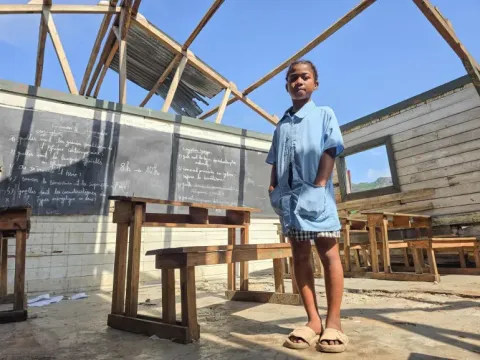
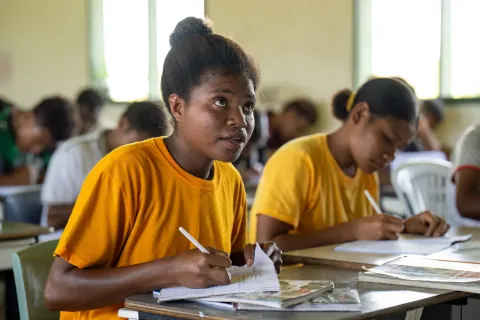
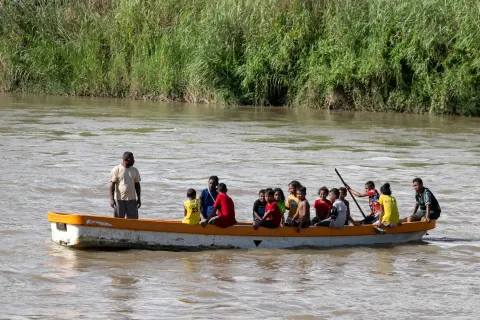
Flooding also disrupts children's education. During severe flooding, children are often unable to reach school safely and classes are frequently interrupted. Parents worry about children's safety during severe flooding, particularly when floodwaters make roads and pathways difficult to cross.

“When I built my house many years ago, the coconuts, flowers and small food gardens I planted near my house grew very well. Now, much of the village is bare,” Nanadai adds.


Saltwater intrusion has wiped out most vegetation in the village.
Coastal erosion continues to push the land inland, while high tides leave behind debris, rubbish and growing health risks for the community.
As food gardens disappear, many families increasingly rely on fishing to feed their households and earn an income.
Along the coast, canoes now anchor where the shoreline once stood. But every year they need to go further away in their canoes to catch fish, putting their life at risk in the open, unpredictable sea.


Yet life in Gaire continues. Families still gather along the beach to share meals. Children and young people can be seen playing on the beach. Elders sit under the coconut trees sharing memories of what the village once looked like. They find moments of calm and connection despite the uncertainty around them.
Across Papua New Guinea, UNICEF is working with the Government and partners to strengthen climate resilience in the systems children rely on most, including health, education, water and sanitation services. But stronger action is needed to help communities like Gaire adapt to climate change and protect every child's future.
For families in Gaire, climate change is no longer a distant threat. It is already reshaping where people live, how children learn, and how communities access safe water, food and essential services.