Papua New Guinea Parliament Holds First inquiry on Children & Youth
Special Parliamentary Committee on Children and Youth hold its first inquiry into strengthening systems for every child

In its first-ever session of the Special Parliamentary Committee on Children and Youth Well-being, Chairman of the committee, Governor Powes Parkop set the tone with a powerful message:
“Now is the time for all of us to think about our children. They are the generation that will take this country to 2075 when our country becomes 100 years.”
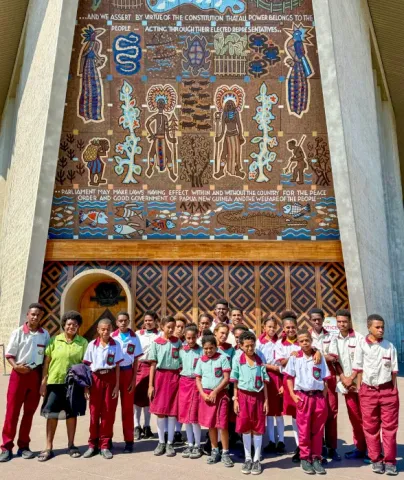
The special parliamentary committee was formed in May on the eve of the country’s 50th anniversary to reflect on the past and pave a new way forward for the next 50 years,— one that places children at the heart of national development and service delivery.
Chairman Parkop highlighted the urgent challenges facing children today: low immunization rates, poor nutrition, limited access to education, and rising violence.
“We are normalizing violence,” he warned, “and that should be a big concern to all of us.”
The special parliamentary committee’s mission is clear, — to reset national , priorities and ensure every child can thrive in a conducive environment.

Inquiry with National Department of Health
A child’s future is dependent on a healthy foundation, and Acting Secretary of Health Mr. Ken Wai emphasized the department’s responsibility of looking after a human being throughout the stages of life or as he put it: “from the womb to the tomb.”
He outlined the lifecycle approach to health, from prenatal care to immunization and nutrition. Yet, the statistics show that coverage was low in 2024. National immunization coverage for WHO approved vaccines was only 47 percent, with some provinces like Madang below 20 percent.
“Nutrition is still a major challenge for children. Poor nutrition is affecting children’s mental and physical growth. This should be a big concern for us because we are not preparing our children well and that means the future might not be as great as it could be.” Chairman Parkop relayed in terms of child nutrition challenges.
The National Department of Health is working to improve outreach, but logistical barriers like lack of vehicles or fuel, rural setting of facilities and poor provincial coordination persist. The committee pressed for stronger leadership and accountability, especially from Provincial Health Authorities, which often operates in its own jurisdiction and with limited oversight from the national department.

Inquiry with National Department of Education
Education is a powerful tool that transforms the lives of children, but retention remains a major concern for the Education Department. The Secretary for Education shared that while over 80% of children enter primary school, only a fraction continues to secondary and tertiary levels.
“Only five to ten percent of our children reach college or university,” Chairman Parkop noted.
The department has launched an Early Childhood Education (ECE) policy, integrating kindergarten into the formal system, but challenges like slow implementation, ECE teachers facing certificationissues, living conditions and formalizing teacher employment and monitoring.
The committee emphasized the need for better infrastructure, teacher integration, and community support to ensure no child is left behind in their learning journey.

UNICEF’s Partnership
UNICEF’s East Asia and Pacific Regional Director, June Kunugi, joined the session in a show of solidarity and support. Her presence underscored the importance of global partnerships in advancing child rights and well-being.
The committee acknowledged UNICEF’s technical assistance in health, education, and child protection, and called for continued collaboration.
“This committee is not just about oversight,” Chairman Parkop said. “It’s about working together, with development partners, provinces, and communities, to build better futures for our children.”