Young Voices Standing Up to End Violence
4 students from Kaugere Junior High School represent PNG in the ‘Violence Ends with Us’ Summit in Philippines

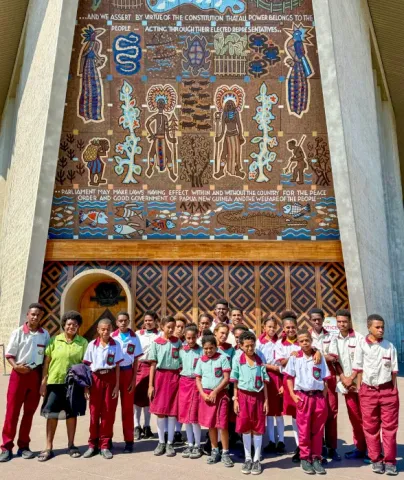
When four Grade 7 students from Kaugere Junior High School boarded a plane to the Philippines in April, they carried more than just passports and school pride. They carried stories, their own, their friends,’ and those of countless children in Papua New Guinea who live with violence as a daily reality.
Alexsandra Nandape, Delilah Tuhiana, Edward Maika, and Bruno Billy, were selected as youth champions through Equal Playing Field’s Respectful Relationships program and with the support of UNICEF to represent Papua New Guinea at the “Violence Ends with Us” Summit in Antipolo City. It was their first time leaving Papua New Guinea and stepping into an international space, and the first time realizing that what they experienced at home and at school was part of a bigger global issue.
At the summit, Alexandria learned something that stayed with her long after the sessions ended: corporal punishment is not just “discipline” it is violence.
When I learned about it, I saw how much it reflected on our community,” she shared later. “It happens a lot where I live. It even happens in my own home.

Surrounded by young people from across Asia, she realized that violence against children is widespread but not inevitable.
Delilah came away with a clearer understanding of protection and hope. She learned that children are not alone, and that help exists beyond the classroom walls.

If children are in danger, we can ask for help from organizations and NGOs that are there for children like us,
For her, knowing where and how to seek help was just as powerful as learning the laws.
Edward, quieter but no less resolute, found his purpose in peer leadership. Returning to school, he spoke about wanting to help friends recognize violence and talk openly about abuse happening around them.
“I want to talk to them about how to end it in our schools,” he explained.
A bold statement from someone still in his early teens yet already imagining safer spaces for others.
For Bruno, the summit reinforced something deeply personal: silence makes violence worse.
“It’s not safe to keep secrets,” he said. “When you tell someone, you trust, things can get better.”
His words echoed conversations many children struggle to have with adults and reflected the summit’s central message that speaking up is the first step toward change.

Back home in Port Moresby, the four students did not keep what they learned to themselves. They shared their experiences with peers, student leaders, and teachers at student representative council camp, sparking conversations that rarely take place so openly. They spoke about corporal punishment, child labor, and the need for positive parenting, drawing inspiration from creative advocacy tools they learned from in the Philippines, including skits, role-plays, videos, and comics.
Supported by Equal Playing Field, UNICEF PNG, and Kaugere Junior High School, the students are now carving out roles for themselves, not just as learners, but as advocates. They are planning videos, peer discussions, and creative awareness activities to challenge norms that harm children and to encourage adults to listen.
As Paula Vargas, UNICEF Chief of Child Protection, reminded them during their brown bag session, that big changes start with the movement of a single stone. Let us be the stones that move mountains.

Alexandria, Delilah, Edward, and Bruno may be young, but their voices are already moving others. And as they continue to speak, share, and lead, they are proving that ending violence against children can and must, begin with children themselves.
About Ending Violence Against Children (EVAC)
Ending Violence Against Children (EVAC) is a global and national effort to prevent and respond to all forms of violence against children, including physical, emotional, and sexual abuse, neglect, exploitation, and harmful practices. Violence against children can occur in homes, schools, communities, institutions, and online, and it has serious long-term impacts on children’s health, safety, development, and wellbeing. Ending violence against children is central to protecting children’s rights and achieving the Sustainable Development Goals, particularly SDG 16.2, which calls for an end to abuse, exploitation, and violence against children.
UNICEF’s Role
The Government of Papua New Guinea has demonstrated its commitment to ending violence against children through national policies, laws, and partnerships that strengthen child protection systems and promote safer environments for all children.