Rabona’s mission to help children grow healthy
How VHAs are addressing malnutrition in Papua New Guinea

Just a few months ago, Rabona Abe (pictured right) was a busy baker, selling donuts, dampa and pastries in his community and at local schools.
Today, he is one of three frontline workers from Boregaina Village in Rigo District, Central Province, trained by UNICEF to detect and treat malnutrition in their community.
“I joined the Village Health Assistant programme recently,” he says proudly. “UNICEF trained us for a week. After our training, the first thing I did was visit the health facility. We didn’t have our instruments yet - no scales, height boards or MUAC tapes - but I still helped at the health facility. Once UNICEF gave us our tools, I started looking for sick children.”

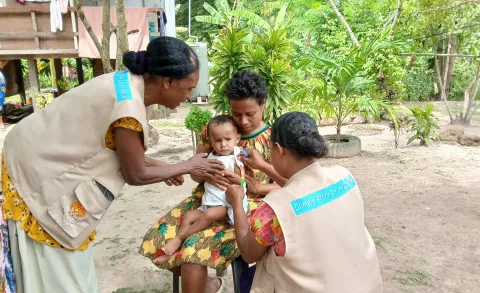
Armed with his height board, weighing scale, MUAC tape and community register, Rabona now walks from house to house in his Boregaina community, screening children under five for signs of malnutrition. During his visits, he also shares health and nutrition messages with families.


Rabona continues to work closely with the village health facility to ensure every child suffering from malnutrition receive the timely care and support they need to recover. In just one month, he identified seven children showing signs of malnutrition – one with Severe Acute Malnutrition (SAM) and six with Moderate Acute Malnutrition (MAM).
Saving Baby Nabalia
When Rabona first met 11-month-old Nabalia, she was frail and weak. Her mother, 21-year-old Laka Rima, had returned from Port Moresby, leaving her job, after hearing her baby had fallen seriously ill.


“I left my baby at six months old with my mother in the village while I worked in the city,” Laka recalls. “But when I heard she was sick, I left work and came back. The health facility gave us medicine, but she didn’t get better. I didn’t know about malnutrition then until Rabona found us.
Rabona screened Nabalia immediately and started her on Ready-to-Use Therapeutic Food (RUTF), a peanut-based paste packed with nutrients.

“At her first visit, we gave her 14 packets. Now she is on her second lot and she is improving. I check her weight every two weeks, and I will keep monitoring her until she reaches a healthy weight for her age.”
Laka smiles when she talks about her daughter’s progress. “She’s getting heavier now. I am so thankful for Rabona’s help. I didn’t know what was wrong with her, but now she is getting better.”
Stories like Nabalia’s are becoming more common as trained VHAs like Rabona deliver basic nutrition care in places where health services are often limited and families struggle to access care.
Rabona also counsels families on infant and young child feeding practices and encourages pregnant women to attend antenatal clinics. “I tell them it is not just about feeding the baby,” he says. “It is about keeping the whole family healthy.”

A Lifeline for Baby Joe
Another family Rabona helped is that of Lyn Simon and Simon Apini, parents of eight-month-old baby Joe. After months of illness and repeated hospital visits, Joe was diagnosed with tuberculosis and began treatment. Rabona screened Joe and confirmed that he was also suffering from moderate acute malnutrition.


“When we came back home from the hospital, Rabona visited us,” says Lyn. “He screened my baby, gave us RUTF, and taught me how to mix the micronutrient powder in his food. Now Joe’s weight has gone from four kilograms to six.”
For Rabona, every improvement means everything. “The satisfaction I get is seeing a child recover,” he says. “When I visit a family and the baby looks stronger, that makes me happy.”

Bringing Nutrition Care to the Last Mile
In Papua New Guinea, nearly half of all children under five suffer from stunting or malnutrition , limiting their growth, learning and potential. To tackle the challenge UNICEF is training Village Health Assistants like Rabona, bringing life-saving nutrition care and services directly to families in hard-to-reach communities.
With continued support and resources, their work could reach even further.
“A young child in the community is very important,” Rabona says. “If I can help even one to grow healthy, then I have done my part.”