Highway Heroes
Protecting children from polio at the crossroads of Rigo District

At a busy junction in Rigo District, cars, buses and trucks slow to a stop. Parents step down from crowded vehicles with children in their arms. A small tent stands beside the road. Inside, a health worker prepares a vaccine.
For some of these children, this brief stop could mean the difference between protection and missing their chance to be immunised.
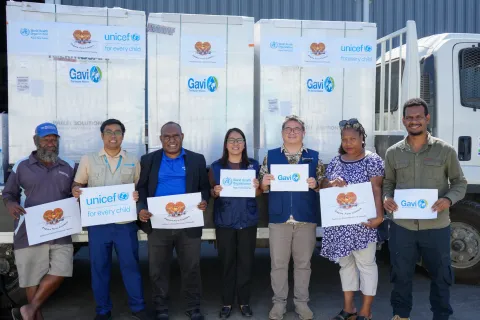
An immunization response was launched by the Government of Papua New Guinea, with support from UNICEF, WHO and partners, after poliovirus was detected in the country in April 2025. A nationwide immunisation campaign followed, funded by Gavi, the Vaccine Alliance, Australian Department of Foreign Affairs and Trade, New Zealand Department of Foreign Affairs and Trade and KSRelief.
But reaching every child is not always simple.
In Rigo District of Central Province, many families travel between villages or to Port Moresby. Some children missed vaccination days because they were on the move.
In the first round of the campaign, immunisation coverage in the district reached 68%.
To close this gap, a small team set up an immunisation checkpoint at the busy Gabagaba junction.
Just one kilometre from where the roads from Kwikila, Hula, Gabagaba and Port Moresby meet, health workers and police officers now stop passing vehicles to check if children have been vaccinated.
The initiative was organised by Kwikila Interim Provincial Hospital in partnership with the Kwikila Police Station to reach children travelling through the district.
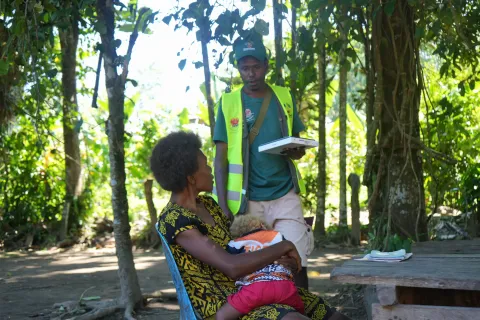
Throughout the day, vehicles arrive one after another. Health workers greet parents, explain the vaccine and check children's health books. Some children receive their polio vaccine drops right there by the roadside.

Auwa, the health worker reassuring parents
At the checkpoint, Auwa Vailah moves calmly between parents and children.
Auwa is a community health worker from Gulf Province who now serves families in Rigo District through Kwikila Interim Provincial Hospital.
Parents often arrive unsure or worried. Auwa speaks gently, explaining why the vaccine matters and how it protects their children.
“I want to urge parents and the communities to bring their children for polio immunisation,” Auwa says.
“Polio can be prevented if children are immunised. If they are not, the disease can spread quickly through our villages.”
One by one, children receive their vaccine drops. Some cry briefly. Others watch quietly from their parents' arms.

Joe, a police officer helping protect children
Standing beside the road, Assistant Constable Joe Mairi raises his hand to slow another passing vehicle.
Joe is one of five police officers deployed by Kwikila Police Station to support the health team.
Before joining the police force, Joe volunteered in HIV awareness programmes. That experience now helps him talk with parents about immunisation.
He speaks first with the driver, explaining the purpose of the checkpoint. Soon parents step down from buses and PMV trucks with their children.
Some recognise Joe and trust his advice. Others hesitate.
Joe jokes with passengers, easing the tension. Slowly, parents walk towards the immunisation tent.
“This work makes us happy because it concerns the safety of all our children,” Joe says.
“We do not know if one of these children will become a future leader someday.”
Joe believes the way conversations happen matters.
“Some parents refuse at first,” he says. “But when we explain properly and speak respectfully, many understand and agree to vaccinate their children.”
Abraham, a youth volunteer helping reach every child
Among the team is Abraham Selapui, a young volunteer who recently completed Grade 12.
Abraham grew up around health campaigns. His mother works as a nurse at Kwikila Hospital, and he has joined previous outreach efforts.
At the checkpoint, Abraham approaches parents travelling with children and explains what polio is and why vaccination is important.

Some conversations are not easy
“Some parents say it is their right to refuse,” Abraham explains.
“I tell them that while parents have rights, children also have rights. They have the right to be protected and to grow up healthy.”
Sometimes parents agree and bring their children for vaccination. Others still refuse.
“When they refuse, we do not force them,” Abraham says. “We respect their decision, but we try our best to help them understand.”
Protecting children on the move
The checkpoint has been operating for just one week.
Yet in that short time, the team has vaccinated more than 50 children each day who had missed earlier immunisation visits.
Each child vaccinated is one step closer to stopping the virus from spreading.
As vehicles continue to pass through the busy four-way junction, Auwa, Joe and Abraham remain at their posts. Their voices stay calm and steady as they speak with parents.
Their mission is simple: make sure no child is left behind, not by distance, not by misunderstanding, and not by fear.