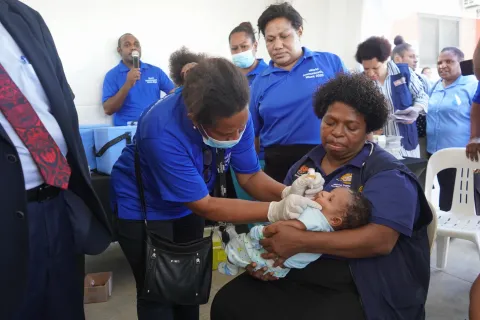
Every Wednesday, families line up for “Immunisation Day”
East New Britain shows what’s possible when health systems work

East New Britain is defying the odds with rising vaccination rates, showing how strong leadership and community partnerships can transform child health in Papua New Guinea.
A week-long field mission across Gazelle, Kokopo and Pomio districts in August found clinics humming, church health workers running WhatsApp data groups, and mothers lining up on Wednesdays for what locals now simply call “immunisation day.”
It’s a story of leadership, innovation, and community trust. But it’s also a story of the daily grind — late funding, empty staff posts, and the constant risk that fragile gains could slip away without sustained support.
The turning point came back in April 2025, when Papua New Guinean Health Minister Elias Kapavore — who hails from East New Britain — delivered a blunt message during a national immunisation review: provinces had to lift their game.
The province’s Public Health Director has long cut through bureaucratic red tape to push funds out faster, encourage data use, and link preventive services with curative care.
Dr Veera Mendonca, UNICEF Representative in Papua New Guinea, says that focus has been critical.
“Leadership really matters here,” she explains. “When provincial managers, community and church health services own the problem, you see money moving quicker, staff energised, and communities paying attention. That’s what’s happening in East New Britain.”
In Pomio District, churches manage half of all health facilities and their model is paying off. Monthly reviews, WhatsApp-based monitoring, and recognition for high performers have helped drive immunisation coverage .
Dr Mendonca says the approach taken by the Health Manager for the Catholic Church Health Services, Sr. Maria Posanek, has lessons for everyone. “The church system is showing what’s possible. They review performance every month, they use simple tools like WhatsApp, and they celebrate their staff. It keeps morale up and accountability strong.”
“The church system is showing what’s possible. They review performance every month, they use simple tools like WhatsApp, and they celebrate their staff. It keeps morale up and accountability strong.”
By contrast, in government-run facilities, there is scope to improve how performance reviews are shared with frontline staff and how their contributions are acknowledged. At Gaulim Health Centre in Gazelle District, Wednesday vaccination days have become a fixture. Families arrive on foot or by vehicle knowing the clinic will be open, stocked and staffed. Dr Mendonca says this reliability builds trust: when people know services will be available, they come. It also reduces reliance on costly mobile outreach, making the system more efficient.

This reliability has built community confidence. When health posts are consistently staffed and supplied, families don’t just come for immunisation — they also return for antenatal care, maternal health, and treatment for children.
The biggest shift is happening in villages, where nearly 150 Village Health Assistants (VHAs) are now active under the Child Nutrition and Social Protection (CNSP) project. Each VHA visits pregnant women and mothers of infants at home, giving advice on breastfeeding, diet, hygiene, and clinic visits.
“Field teams heard repeatedly that these visits are changing behaviour,” Dr Mendonca says. “Mothers report eating better, attending more antenatal appointments, and feeling stronger during pregnancy. Health workers have observed babies gaining weight more consistently and families understanding the risks of harmful habits like smoking or chewing betel nut.”
Coverage figures confirm the trend. Measles vaccination in Gazelle District rose from 39 per cent in 2023 to 65 per cent in the first half of 2025. Penta3 coverage jumped from 44 per cent to 75 per cent over the same period.

Dr Mendonca describes it as “a quiet revolution.” “It’s not flashy. It’s not a billboard campaign. It’s village health workers talking with mothers, and mums sharing with each other, practices changing, and babies growing healthier and stronger.”
New motivators are also keeping momentum alive. Launched by the Province, the Baby Bundle — a package given to mothers who complete their fourth antenatal visit or deliver safely — is making an impression.

Dr Mendonca sees it as smart psychology. “It’s about pride and dignity,” she says. “When women feel their effort is recognised, it reinforces behaviour.”
But East New Britain’s progress has not erased the province’s challenges.
National funds often arrive late, leaving clinics scrambling for fuel or supplies. Staffing ceilings limit hiring flexibility, while training often stops at the officer-in-charge and never reaches frontline staff.
Data systems remain patchy. Church-run facilities maintain monthly reviews and keep baby registers. Government posts, however, often don’t. “Good planning starts with good data”.
Integration is also uneven. In Gazelle, immunisation is delivered alongside nutrition and water, sanitation and hygiene (WASH) services. In Pomio and Kokopo, those linkages remain weak, missing opportunities of treating malnourished babies.
Despite these gaps, Dr Mendonca says East New Britain is proving that vaccination rates can climb sharply if systems are managed well and communities are engaged.
Health workers note that once mothers see babies in their community growing stronger, they are motivated to follow suit.
“East New Britain is showing the way forward,” Dr. Mendonca says. “With timely funding, stronger investment in staff, and scaling up these community approaches, Papua New Guinea can move quickly. This province is already a model for the country.”