Sama-Bajau Youths Play Crucial Role in Birth Registration
For Budong, being a BRAVE advocate is helping his Sama-Bajau community to claim their rights

On paper, Budong Kabuaji is 19 years old, but in reality, he is likely a few years older.
Now in his third year of college, an age when most students in the Philippines are usually 21 or 22 years old, Budong finds himself caught between official records and lived reality. His birth was registered late.
“My parents registered me when I was already in school. They only did it because schools require each learner to have a birth certificate,” he explained.
His family belongs to a Sama-Bajau community in Maluso town in Basilan, an island province in the Bangsamoro Autonomous Region in Muslim Mindanao (BARMM), located about 1,400 kilometers south of the national capital, Manila.
The Sama-Bajau is an ethnolinguistic group who traditionally live in boats at sea and stilt houses along the coast, in the borders of the Philippines, Malaysia, Brunei and Indonesia.
The illiteracy rate is high, and the birth registration rate is low in the community, especially among the older generation.
“The longer the delay in birth registration, the greater the likelihood of erroneous entries, especially among communities whose traditional way of life does not require diligent recordkeeping,” said Kathlyn Catan-Quinto, local civil registrar of Maluso.
“Philippine laws enjoin parents to register the birth of their child within 30 days from the time of the event, but poverty, among other factors, prevent many of them from doing so,” she added.
Because of their itinerant lifestyle, many Sama-Bajau do not register their birth and do not acquire citizenship in any of the countries, depriving them of a legal identity and excluding them from accessing government services and employment opportunities.
Taking the lead against statelessness
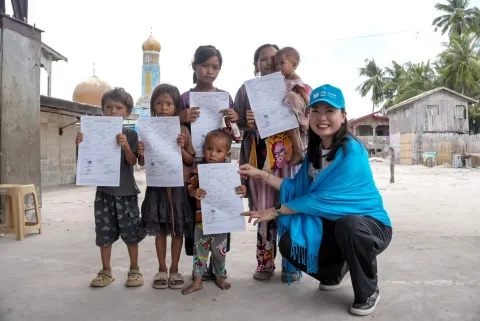
Spurred by his own experience and equipped with newly honed communication and advocacy skills, Budong now visits different Samal-Bajau communities in his town to encourage his fellow indigenous people to acquire birth certificates.
“Hopefully, because of prompt registration, inaccuracy in birth certificates will be avoided among those younger than I am,” he said.

Budong volunteered as a youth advocate under the BRAVE (Birth Registration Advocacy for Vulnerable Population to End Childhood Statelessness) Project implemented by UNHCR and UNICEF in partnership with government agencies, local government units and civil society organizations.
The BRAVE Project heroes
For Aira Tose, project coordinator of Community and Family Services International, which trained Kabujai and his fellow BRAVE advocates from Maluso and other areas covered by the advocacy project, the involvement of young people was key.
“We tapped the youth in lowering, if not eradicating, statelessness because of the energy and creative ideas they brought to the table,” said Tose.
The BRAVE advocates were given a series of training on child protection, social and behavioral change, and the importance of having a legal identity through a birth certificate.
Tose further explained that the volunteers also became co-creators of the information, education, and communication materials used in various activities, which were produced in their local language and designed to be sensitive to their culture.

In his hometown, Budong worked with his fellow college students Jocelyn Tapsani, 21; Nicole Tulayan, 21; and Faisa Jani, 22. The group was led by Belbita Bahali, a 30-year-old teacher.
“We started community monitoring and created a list of individuals who didn’t have birth certificates yet, and we encouraged them to comply with the requirements,” he said.
The group employed various methods, such as speaking in meetings and conducting house-to-house visits that sometimes meant walking on planks and riding boats. They also carried the printed education materials they had helped create during the workshop.
“We worked closely with community leaders, and we planned to launch a social media campaign since some Sama-Bajau youths had cellphones,” Budong said.
Regionwide initiative
The BRAVE Project was the advocacy component of the Initiative for Promoting Digital Birth Registration, generously funded by the Government of Japan.
The birth registration initiative focused on vulnerable communities such as the Sama-Bajaus, unregistered children in the context of displacement due to armed conflict, and decommissioned combatants in 50 selected municipalities in Sulu province and Bangsamoro Autonomous Region in Muslim Mindanao.
In Maluso alone, 650 people had their births registered in 2024, with another 1,000 expected to be reached in 2025.
To fund the advocacy activities in Maluso, UNICEF provided a seed grant of PHP 50,000 (approximately US$850) to the Claret Samal Foundation, Inc., which supervised the BRAVE advocates in the municipality.
With a budget of ¥858 million (approximately US$5.5 million) and running for 30 months from 2024 to 2027, the initiative aimed to help 30,000 individuals acquire birth certificates.
Aside from the advocacy component, the initiative also had three other pillars: capacity building, sustainable livelihood, and digitization of the local civil registry.
Local civil registrars in the selected municipalities received computers and other equipment, as well as a database system that would allow them to digitally and systematically store their civil registry files, contributing to a more streamlined process.
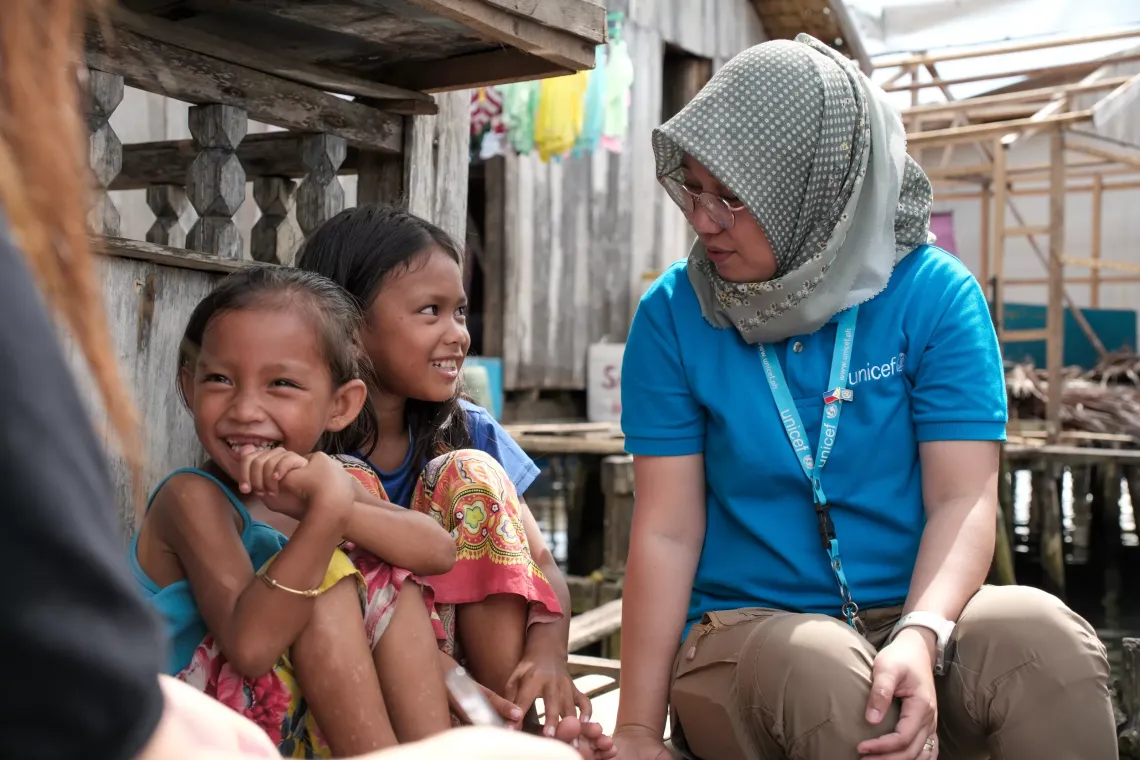
UNICEF’s child protection officer, Sitti Vilma Quin, stressed that local youth networks were critical to sustaining the initiative.
“When we engaged the youth, we were assured that even after the initiative had ended, they would continue the advocacy,” she said.
For Quin, it was also the right of young people to participate in matters that affected them and their future.
“In many cases, parents did not register the birth of their child because they found the process difficult, but once they were given proper information, they were willing to comply,” she added.
Meanwhile, Catan-Quinto highlighted how the BRAVE advocates themselves became living proof of how having a birth certificate could open doors to opportunities in life.
“Since one of the BRAVE advocates is already a professional and the others are college students, the community looks up to them,” she said.
For Budong, one of the BRAVE advocates, the experience was both personal and meaningful.
“Being a BRAVE advocate was a big opportunity for me,” he said.
At that time, he was studying education in a local college and dreamed of teaching Sama-Bajau children in the future.
“The advocacy training expanded my knowledge and honed my skills. Best of all, I was able to help my community even at an early stage,” he added.