A Second Chance to Learn
With support from the Global Partnership for Education, UNICEF is helping out-of-school adolescent girls in Tando Allahyar return to learning

TANDO ALLAHYAR, SINDH: Night has fallen by the time 12-year-old Muskan Kalroo opens her books. The day’s work is done. She helped her mother gather grass, fed the landlord’s cattle and picked cotton. Now the light at home is too dim to read by, so she switches on her torch and studies in its small circle of light.
A year ago, Muskan never imagined she would be back in school.
“I thought my education had ended after Grade 5,” she says.
Muskan has four siblings. Her father sells wood and earns about PKR 250-300 (or US $1) a day. She passed Grade 5 at the Government Boys Primary School (GBPS) in her village, but there was no further education within reach. The nearest secondary school was in Tando Allahyar city, too far for Muskan to commute.
For a year, Muskan stayed at home, fearing that her dream of studying further would never come true. Her story is common here. In Tando Allahyar district, 31 percent of females can read and write, compared to 48 percent of males, according to the Pakistan Bureau of Statistics’ 2023 Census, which measures literacy among people aged 10 and above. Long distances and a shortage of female teachers keep many adolescent girls out of school after primary education.
A Door Opens Close to Home
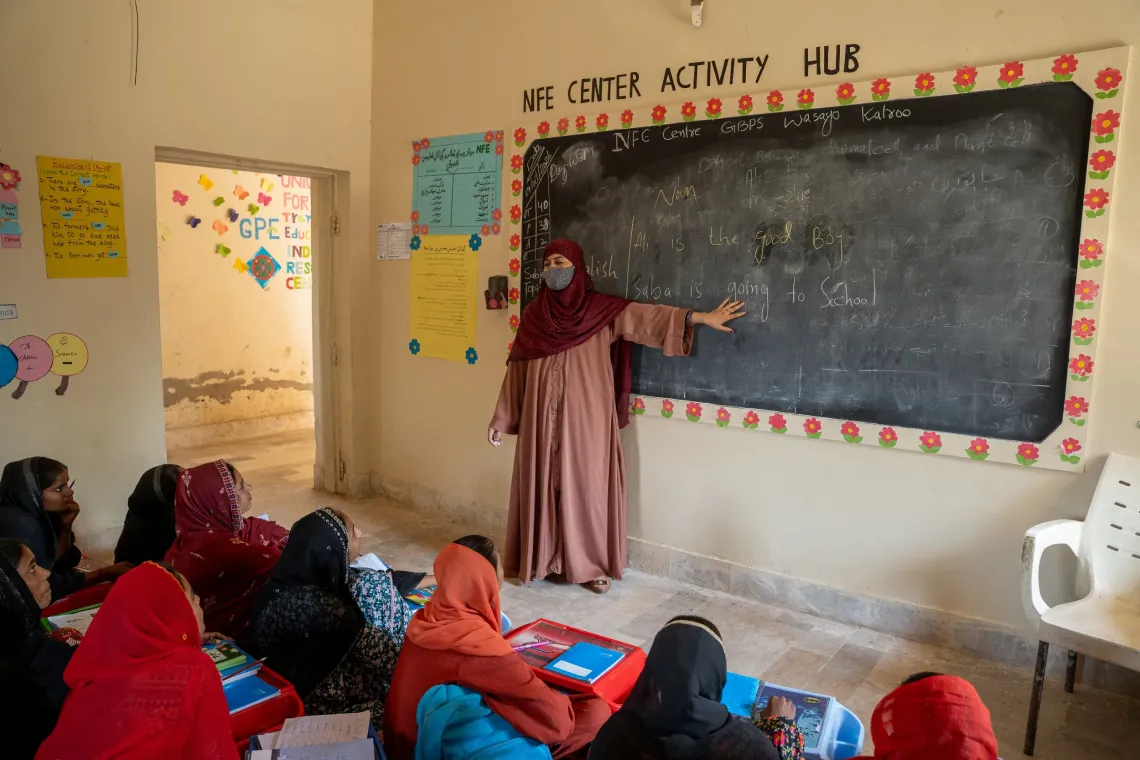
Then word began to travel through Wasayu Kalroo that a centre for girls like Muskan was coming to the village. The School Education and Literacy Department’s Reform Support Unit first mapped out-of-school children around the selected schools, and the Indus Resource Centre validated the data.
Teachers and others involved went from house to house, among them Inayat Ali of the GBPS and Noor Saba, now a facilitator at the centre. They reassured families that the programme would be free, held in the village and open to out-of-school girls aged 12 to 17, and that parents could register their daughters to join. Noor Saba promised them it would be a safe and respectable place for girls to learn.
“Girls from such areas usually do not get the chance to continue their schooling,” says Noor Saba. “It is usually expected that they will get married at a very young age, and they will help at home and work in the fields. This is an excellent opportunity for them. It took us some time to convince the parents to allow their daughters to come.”
Muskan’s father was unwilling at first. Then Inayat Ali explained that it would be right there in the village and it would be a safe space. He finally agreed Muskan could attend. Muskan’s mother, who never went to school herself, was supportive from the start.
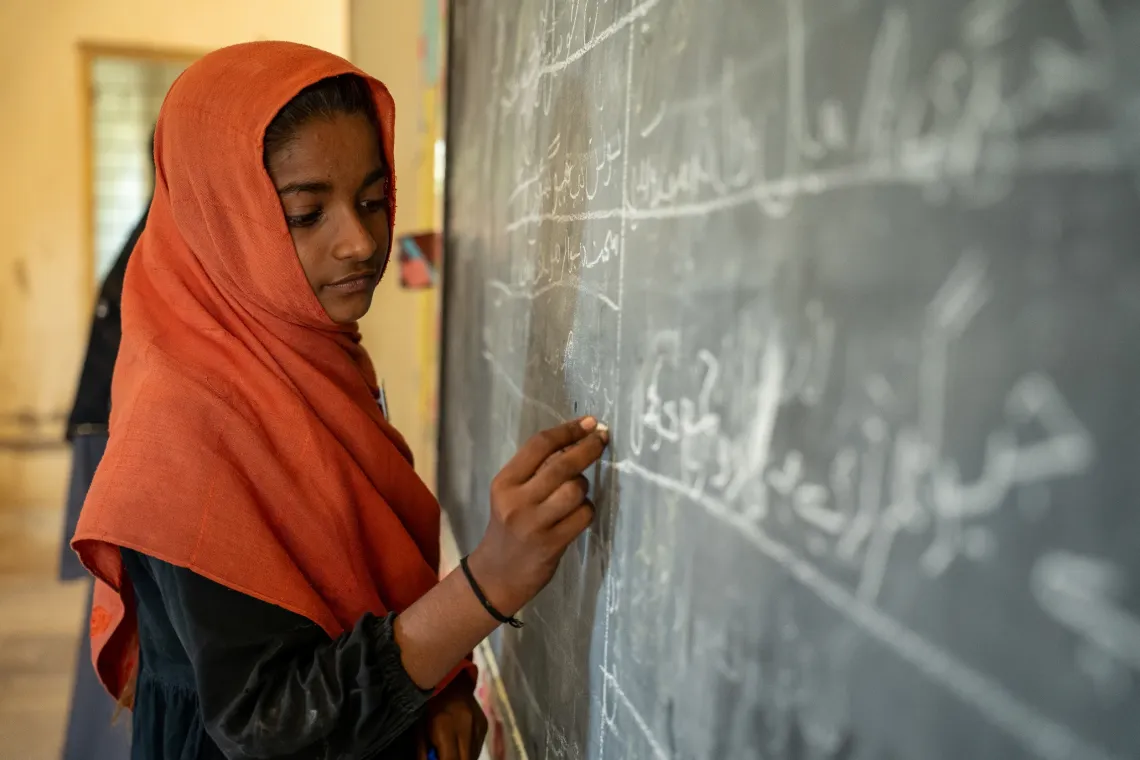
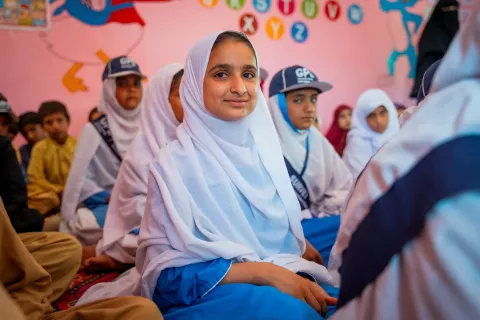
The centre opened in June 2026 in a space the School Education and Literacy Department allocated within the local primary school complex. Muskan remembers her first day well. She was excited and happy because she could carry on with her education. The school, the facilitators, the learners and teachers from the local primary school cleaned and improved the room together, and the walls were painted.Today the girls are proud to have a place of their own in their village.
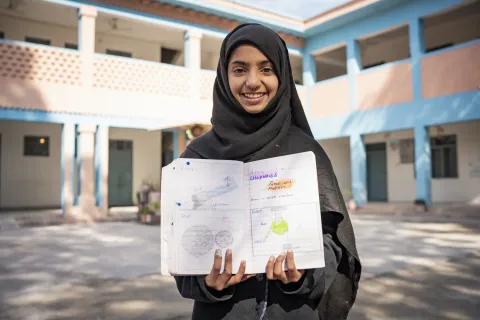
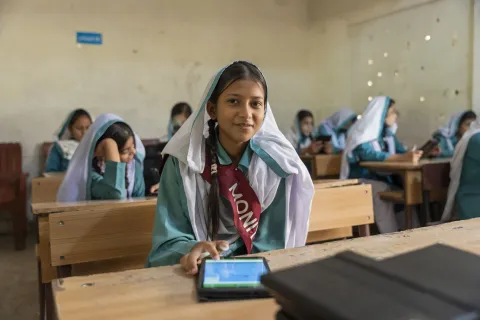
Thirty learners aged 12 to 17 now attend from 8:30 a.m. to 1:30 p.m., six days a week, studying Maths, English, Science, Sindhi, Information and Communications Technology (ICT) and Religious Studies (Islamiyat). Muskan is in Package D, a 10-month course equal to Grade 7.
UNICEF has given every learner hygiene, menstrual and sports kits, and the torch Muskan studies with came in her hygiene kit bag. She is also a Child Protection Champion in the centre’s Adolescent Club, where girls lead sessions on health, hygiene and child protection for their classmates. English and Sindhi are her favourite subjects.
“I want to learn English so that I can communicate confidently with people. Sindhi is very special to me because it is my mother tongue,” says Muskan.
Her centre is one of 120 Non-Formal Education (NFE) centres established under the Sindh Learning Programme in cooperation with the School Education and Literacy Department, with funding from the Global Partnership for Education (GPE). There are 30 in each of Tando Allahyar, Dadu, Umerkot and Tharparkar, and 3,474 adolescent girls are enrolled across them. In Tando Allahyar and Dadu, UNICEF manages the centres through the Indus Resource Centre. All facilitators are women.
The programme aims to help at least a quarter of its learners move on to formal secondary school, which many girls find hard to reach, while others may pursue vocational skills such as tailoring and IT.
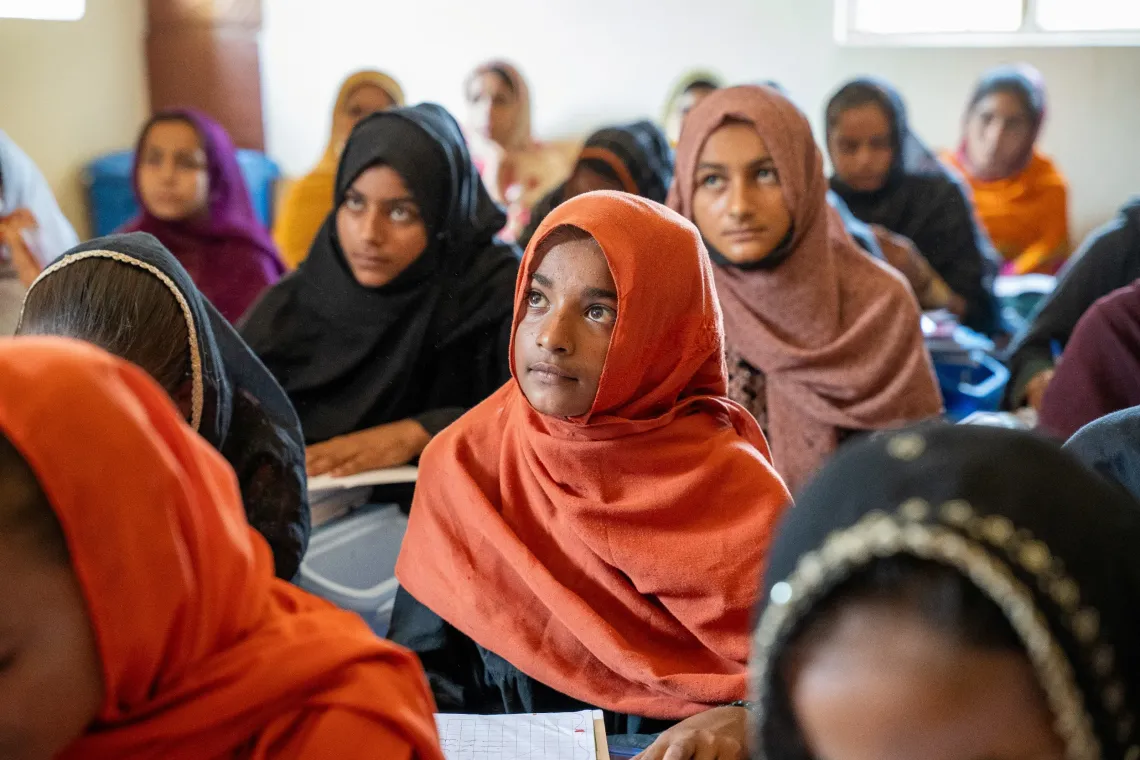
Muskan’s days are long. She wakes up early, prepares breakfast for her family and cleans the house before heading to the centre, and she fits farm work around her classes. It is not easy, she says, but she has not given up. She already knows where she wants to go. The centre has given her a second chance to learn and an exciting glimpse of what her future could hold.
“I want to become a good teacher,” she says.