Invisible Struggles. Unlocked Potential.
UNICEF and Education Cannot Wait are ensuring children with learning difficulties in Khyber Pakhtunkhwa are seen and supported so they can thrive.

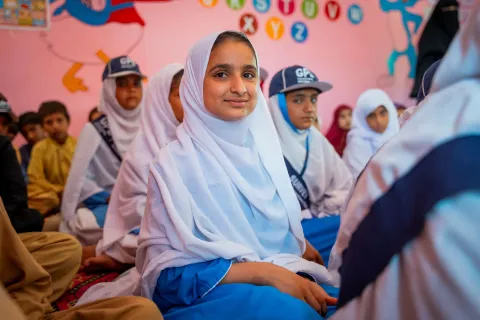
Peshawar, Khyber Pakhtunkhwa -The fourth-grade students in one of the Government Girls Primary School in Peshawar sit at their desks immersed in their notebooks. Mrs. Fatma is walking around observing their work. She pauses just a little longer at 12-year-old Madiha’s desk and smiles as she sees her working at pace with her peers. She walks over to the front of the classroom. As she starts to ask questions, Madiha’s arm flies up, clicking her fingers eagerly. Her confidence shines through.
“I want to be a doctor, a bone doctor,” shares Madiha. When asked why, she added without hesitation, “because I want to help people become stronger.”
There are no visible signs of the immense struggle she was going through until recently. Although slightly smaller in build, Madiha is three years older than her friends. That is because she repeated third grade twice. She is one of almost 40,000 children with learning difficulties across Khyber Pakhtunkhwa.
Madiha’s struggle did not end in the classroom; at home she had to deal with her parents’ disappointment and the teasing of her siblings.
A mother’s pain
“I was struggling to read and write. My teachers used to put a lot of pressure on me, and I didn’t know what to do. I thought something was wrong with me.”
“We wanted Madiha to drop out of school. Things were not good at home. Her father was upset she was not showing any improvement. I almost gave up too,” admitted Madiha’s mother Gulnar. Like other girls, Madiha faces compounded barriers to education with underperformance often leading to dropout.
Madiha often argued with her siblings. Sometimes she would tear apart her notebooks. The frustration affected her health; she started eating less. We didn’t understand what was wrong with her,” said Gulnar.

A Teacher’s Realization
“Her struggle became especially clear in third grade. Madiha was not reading or writing. But that’s not how we saw it. We thought it was a behavioural problem. We simply didn’t know any better,” said Ms Fatma.
In September 2023, the Directorate of Elementary and Secondary Education, Khyber Pakhtunkhwa (KP) launched the Teacher Training for Learning Difficulties in partnership with UNICEF with funding from Education Cannot Wait. As part of the Multi-Year Resilience Programme over 500 teachers were trained in Peshawar, Kohat and Mansehra on Learning Difficulties, Mental Health and Psychosocial Support, Menstrual Hygiene Management and Disaster Risk Reduction. 15 psychology interns were also trained and are now supporting children and their families. This is the first time that structured screening, teacher-led identification tools, and school-based psychosocial referral mechanisms have been introduced at scale in public schools across KP. The initiative is changing individual lives but also transforming how the education system understands and responds to learning difficulties.
“We called Madiha’s mother and explained that we knew that she had a problem but that it was manageable. We had to work together,” explained Mrs Zarsanga Bibi, the school Headmistress.

After assessment, Ms Fatma and Mrs Zarsanga Bibi established that Madiha had dysgraphia and dyslexia, both of which are learning differences. Dysgraphia affects a person’s ability to write, while dyslexia affects reading and language processing. With the right teaching techniques and support, children with these learning differences can make significant progress and thrive in their learning.
Better days
“Mrs. Fatma’s support made the biggest difference. She showed me new ways to learn,” explained Madiha.
“Now Madiha wakes up very early and excited to go to school. She eats well and looks healthier. This gives me great relief,” said Gulnar.
For over 15,000 other children in Khyber Pakhtunkhwa, inclusive learning support is the difference between struggle and success. A Special Advisory Group of community experts from various fields is ensuring the best tools and mechanisms are in place for inclusive learning. To scale up the support, the Directorate of Elementary and Secondary Education is investing in an additional 2,500 interns. Strengthening inclusive education and equipping teachers with the right skills is helping create a better reality for children like Madiha.

Madiha was once confused, frustrated and even blamed for her learning difficulties. Understanding the right approaches to learning slowly broke the invisible chains holding her back. She leaves school with her friends in high spirits, ready and excited for tomorrow. “Coming to class is not scary anymore,” she shares happily.
Like every other child experiencing a learning difficulty, she just needed to be seen and supported to shine.