Unleashing dreams
How a digital passport is empowering girls in Pakistan

Recently in Karachi, I saw hope come alive in the eyes of young girls. Walking into classrooms in North Nazimabad and Azizabad, I was greeted not just with smiles, but with a sense of possibility so powerful it lingered with me long after I left. These girls were using the Sindh Learning Passport, a digital platform that is giving them something many once thought out of reach: the chance to dream bigger, and the means to chase those dreams.
The programme was born out of crisis. After COVID-19 shut down schools and the 2022 floods left millions of children displaced, the need for new ways of learning became urgent. UNICEF Pakistan, together with the School Education and Literacy Department, Government of Sindh, responded with the Sindh Learning Passport which is a digital learning platform with content mapped to essential student learning outcomes in mathematics, science and social studies. The programme is being implemented in 30 schools across Karachi, Hyderabad, Sukkur, and Jamshoro and has benefitted 7,000 students to date. Remarkably, 90% of these schools serve girls. In Sindh, there is a severe shortage of girls’ middle schools. As a result, many girls complete primary education but are unable to transition to middle school due to lack of nearby facilities, safety concerns, mobility restrictions, and social norms. Boys, by contrast, have relatively greater access to middle-level schools and are therefore less likely to drop out at this stage. The Sindh Learning Passport is designed to reach the most excluded learners, particularly adolescents who are out of school or at high risk of dropping out. Addressing girls’ learning gaps at the middle level is essential to prevent permanent dropouts, early marriage, and intergenerational poverty.
But numbers only tell part of the story. What moved me most were the moments I witnessed in the classrooms.

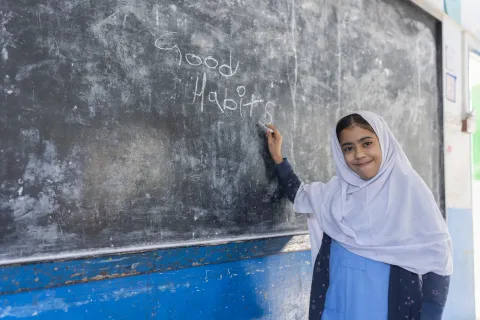
In one Grade 8 classroom, the energy was electric. The girls sat huddled over their tablets, navigating mathematics problems with focus and determination. In another, they explored the wonders of science, their eyes widening as new concepts clicked into place. For many, this was their first time using a personal digital device. Yet they embraced it with confidence, replaying videos when they struggled, moving at their own pace, and cheering each other on. It wasn’t just learning, it was the power of discovery.
I was struck by how modest and sincere their request was to UNICEF. With 25 or 30 tablets running videos at once, the classroom sometimes grew noisy. Their simple ask? Headphones. Such a small thing that meant so much. It wasn’t frustration, it was determination. They wanted to concentrate, to do better in their exams, to make the most of the opportunity in front of them.
The school principals, too, shared their dreams for the future. They imagined LED screens in classrooms, enabling teachers to guide everyone through the same lesson while still giving students space to explore individually. It was clear to me that technology isn’t replacing teachers. It strengthens their efforts and helps schools unlock new ways of teaching and learning.
Now, that promise is being carefully tested so it can grow. Working with the Government of Sindh, UNICEF is tracking how the Learning Passport is changing the way students learn. Learners in Grade 7 have already completed a baseline assessment, and they will be assessed again at the end of the academic year to see what progress has been made. The results will help shape the next step: expanding Learning Passport to reach many more schools and communities across Sindh, so that opportunity does not stop with a few classrooms, but reaches every child who needs it.

But it was the girls themselves who gave me the deepest sense of hope. Wania, 14, told me with a confident smile that she wants to become a banker like her elder sister or maybe even a civil servant. Maryam, 13, the class monitor in the school in Azizabad, spoke with a quiet determination about her dream of becoming a lawyer.
Their voices, filled with ambition, reminded me that education isn’t only about textbooks or exams. It’s about possibility. It’s about showing a girl that her life can be more than what tradition or circumstance dictates, that she can step into any role she chooses, if only she is given the chance.

The Sindh Learning Passport is doing just that. It is not just a digital platform. It is a doorway. A light. A promise. It shows these girls that their futures are worth investing in, and that with the right tools, nothing is out of reach. To unlock scale and reach more excluded learners, UNICEF is assessing learning gains so the Learning Passport can grow and give more children, especially girls, the chance to keep learning.
As I left the schools that day, I carried with me the sound of laughter, the sight of eager faces bent over glowing screens, and the echo of dreams spoken out loud. These girls are not waiting for the future to happen to them; they are preparing to shape it. And that, to me, is the true power of education.