Lessons that inspire
With support from the Global Partnership for Education (GPE) and UNICEF, education in Balochistan is transforming.

Hub, Balochistan: The school courtyard is full of life. Children run, laugh, and chase each other under the open sky, while some sit on the ground with their books, quietly revising for their exams.
As the bell rings, children slowly make their way into classrooms. There is excitement, nervousness, and hope in the air. This is a regular school day at the Government Girls Higher Secondary School, Hub, Balochistan
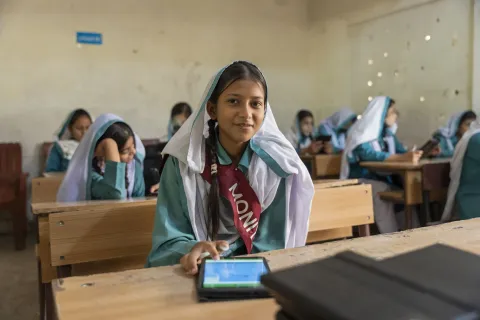
In one of these classrooms sits 13-year-old Sonia.
Not long ago, Sonia was one of the quietest students in class. She rarely spoke, avoided eye contact, and never raised her hand. Reading aloud made her anxious, and classroom activities felt overwhelming. Even when she knew the answer, she chose silence and preferred to stay invisible.
That began to change in 2025, when Sonia’s school started using new classroom activities from the Foundational Numeracy and Literacy (FNL) training for teachers. The training is part of the Government of Balochistan’s Continuous Professional Development reforms for teachers, funded by the Global Partnership for Education and supported by UNICEF through the Secondary Education Department.
The programme is focused not only on academic skills but also on building confidence and encouraging children to participate actively.

Sonia had a teacher who noticed her potential. Using the FNL methods, Nargis gradually included Sonia in classroom activities. She paired students in mixed groups so they could help one another. Simple, low-cost tools like sticks, rhymes, cards, and balloons turned lessons into interactive games. Everyday words and numbers became hands-on exercises that students could enjoy and remember.
At first, Sonia hesitated. But with every activity, her confidence grew. Now, she is often the first to raise her hand. She eagerly reads aloud, and her classmates clap loudly when she successfully completes a task. The girl who once stayed invisible now leads by example, helping her peers and inspiring others to try.
Sonia’s story is just one example of the broader transformation happening across Balochistan.
The teacher training programme on foundational literacy and numeracy is currently being implemented simultaneously across 21 districts of Balochistan, reaching nearly 4,400 primary school teachers across 1,500 schools.
Nargis has also seen a major shift in trust. “Teachers who once sent their own children to private schools are now enrolling them in government schools after seeing the improvements in teaching quality. Many other families have done the same, showing growing confidence in public education.”
Rukhsana Ali, a teacher with nearly thirteen years of experience, has seen how this approach is changing classrooms across Balochistan.
“Our training started in 2024. For us, it was something entirely new. We learned how to bring children towards activity-based learning, which makes lessons more effective and enjoyable. It also helped us build stronger relationships with our students and boosted our own confidence,” Rukhsana explains.
“Earlier, we just taught lessons and left. Now, we focus on understanding how students think, encouraging critical thinking, creativity, and teamwork. We use role play, group work, project-based learning, and even simple strategies like pairing fast learners with slower learners so everyone can progress together,” she adds.
Rukhsana also shares how modern tools have helped teachers innovate. Teachers learned to use AI models and online videos to design activities, explain difficult concepts, and engage students.

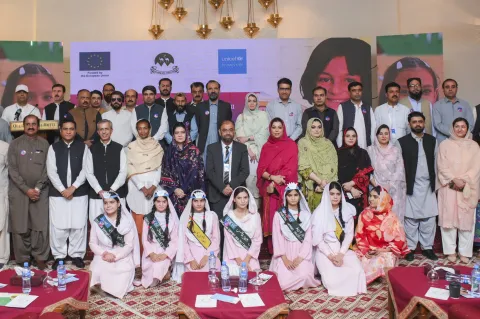
Nargis and Rukhsana now play a key role in training and mentoring fellow teachers through the monthly Professional Development (PD) sessions. These sessions bring teachers together to learn new approaches, share experiences, and strengthen classroom practices, especially for those working in remote areas.
During PD days, teachers are introduced to practical pedagogical ideas such as classroom management and multi-grade teaching. Academic supervisors support this process by observing classrooms, providing feedback, and preparing reports. The main challenges identified during these observations are then discussed during PD sessions, which usually last one to one-and-a-half hours.
“These sessions have helped us improve a lot,” Rukhsana explains. “We learn very simple but effective techniques, like how to stand at a 45-degree angle at the blackboard, how to manage classroom noise, and how to arrange students. Small changes like these make a big difference in student engagement and learning.”
“Seeing other teachers and their students grow is incredibly rewarding,” Rukhsana says. “We guide them on lesson planning, group activities, classroom management, and even how to use simple technology to enhance learning.”

“Every time a teacher tries an activity in their classroom, we see more children engaging, more confidence building, and more learning happening. It’s a ripple effect that keeps spreading,” Nargis adds.
Thanks to the Continuous Professional Development programme, funded by the Global Partnership for Education (GPE) and supported by UNICEF, foundational literacy and numeracy is starting to take root in classrooms across Balochistan. With better-trained teachers, activity based learning and simple, practical tools, children like Sonia are gaining confidence and looking towards the future with more hope.