The Hope Hut
How a young girl turned her own learning into lessons for out-of-school children in her village.

Khairpur, Sindh: In Kumbh, a small village in Sindh, most children grow up without access to schools. Parents work long hours in the fields just to put food on the table, and education feels like a distant luxury. For girls, it is often considered unnecessary and even discouraged. But Sadia (17) refused to accept that.
At just six years old, after losing her mother, she found hope through her friend Muskan, who helped her enrol in a UNICEF-supported Non-Formal Education (NFE) centre. Sadia studied there with determination, completing grades 1 to 8 before moving on to class 9 at a public school.

Sadia was so inspired by her teacher that she dreamed of teaching children herself.
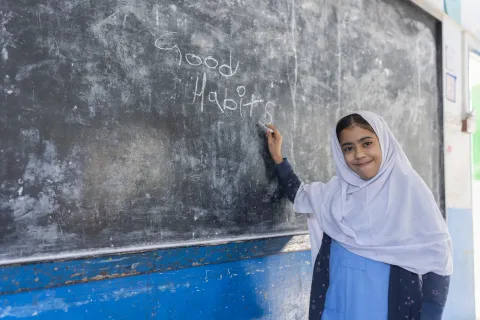
“I asked my teacher for a blackboard so I could start teaching the kids in our village. My uncle built me a small hut at home, and I began giving lessons.” she says.

News spread quickly through the village that Sadia was teaching children English, Science, Maths, Arts, and more for free. Her little classroom soon became a place of hope, and children began enrolling to learn from her.

Some of the parents would give Sadia small amounts of money in appreciation. She had been saving up to buy a mobile phone, but instead chose to spend her savings on notebooks, pencils, colours, and clean clothes for her students. It was a simple yet powerful reflection of her dedication to teaching.

Her lessons reached beyond the classroom, she went door to door, speaking to her students' parents about hygiene and behaviour, and kept reminding them to clean their homes, and to set good examples by being kind to each other around their children.

In her village, girls are often married as early as 12 or 14, leaving them no chance to study or dream.
“People here say it is a sin if a girl stays unmarried,” Sadia says softly. “This breaks my heart. I tell parents to let their daughters study, but I know poverty makes it hard.”
At first, even Sadia’s father didn’t allow her to study. One day, she went to school without his permission. “When I came back, he was very angry with me. I cried and told him, ‘I will go. You cannot stop me.’ He got even angrier, and the neighbours had to step in,” recalls Sadia.

For weeks after that, her father refused to speak to her, but Sadia kept going to school. As she learned to read, she began helping at home, reading expiry dates on medicines, food instructions, and important documents. Slowly, her father saw how education was changing her, and his attitude began to shift. Today, he is her strongest supporter.
“I wish that all parents send their children to school,” he says. “It is very important, our children can help us in ways we cannot imagine.” For Sadia, those words mean everything, and she hopes that one day her entire village will have a proper school where no child is left behind.

Today, Sadia continues to teach in her small hut, giving children in her village the chance to dream of a better future.