BISP, WFP, WHO, UNICEF extend partnership to protect 3.3 million children and women from malnutrition in Pakistan
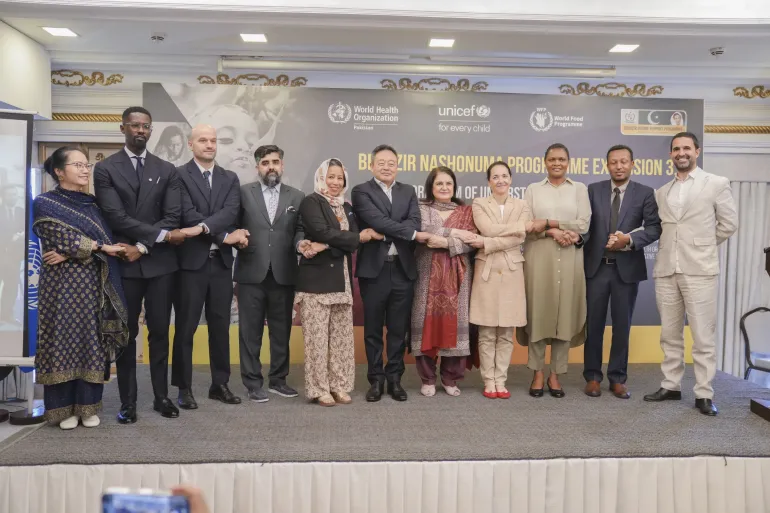
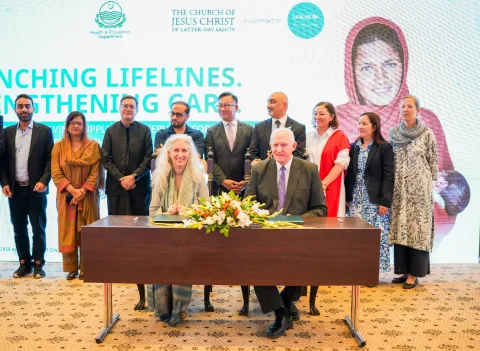
9 July 2026, Islamabad, Pakistan – Benazir Income Support Programme (BISP), together with the United Nations World Food Programme (WFP), the United Nations Children’s Fund (UNICEF) and the World Health Organization (WHO) today announced a three-year extension of the Benazir Nashonuma Programme to protect an additional 3.3 million children and women from malnutrition across Pakistan.
Integrated into BISP, the Benazir Nashonuma Programme delivers nutrition and health services to the most vulnerable pregnant and breastfeeding women and children under the age of 2 through a nationwide network of 578 facilitation centres and 224 nutrition stabilization centres. Since its launch in 2020, the programme has reached 4.7 million people. With this extension, its total reach is expected to increase to 8 million people.
“The Government of Pakistan is proud to strengthen this vital partnership,” said Senator Rubina Khalid, Chairperson, BISP. “Our commitment to the Benazir Nashonuma Programme remains unwavering, and we are dedicated to expanding its reach and effectiveness to ensure that every child in Pakistan has the opportunity for a healthy start in life, setting the foundation for a brighter and more prosperous future.”
The partnership aims to consolidate a science-based initiative that has achieved some of the strongest results ever documented globally for a nutrition programme. Children enrolled in the programme were 22 percent less likely to be stunted at 6 months of age.
In Pakistan, four in every ten children under five are stunted as a result of chronic malnutrition – equivalent to 10 million children – while wasting stands at 17.7 percent, affecting 5 million children and contributing to an estimated annual economic loss of USD 17 billion.
The Benazir Nashonuma Programme addresses these challenges by embedding nutrition services within Pakistan’s national social protection system. Evidence generated also found improved maternal nutrition and child survival, increased uptake of antenatal care, healthier pregnancy weight gain, and improved birth outcomes.
“The results of the Benazir Nashonuma Programme are extremely promising for the prevention of child malnutrition,” said Anita Hirsch, WFP Representative and Country Director in Pakistan. “Building on this success, the three-year extension will allow WFP to continue supporting the Government of Pakistan and BISP in reaching more mothers and children with the nutrition services they need, and consolidating the positive results we have seen so far.”
“We commend the Government of Pakistan for its strong leadership and continued commitment to advancing nutrition-responsive social protection through the Benazir Nashonuma Programme,” said Pernille Ironside, UNICEF Representative in Pakistan. “Together with WFP and WHO, UNICEF is proud to support the Government in improving nutrition outcomes for the most vulnerable mothers, adolescent girls and children. Building on this strong partnership, we will continue working together to strengthen systems, expand equitable access to and demand for high-impact nutrition interventions, and empower communities with essential care practices. Investing in nutrition is ultimately an investment in Pakistan’s future, ensuring that every child has the opportunity to survive, grow and thrive”.
“The positive results achieved by the Benazir Nashonuma Programme prove the power of integrated whole-of-government and science-based approaches across health, nutrition, social protection, WASH, food systems, and education,” said WHO Representative in Pakistan Dr Luo Dapeng. “WHO stands ready to work with Pakistan and partners to use science to protect every child and every mother regardless of economic and social status, no matter where they live or who they are”.
Through this renewed partnership, the Government of Pakistan, BISP, UNICEF, WFP, and WHO will continue working together to strengthen nutrition and health services, protect the most vulnerable women and children, and build a healthier, more resilient future for Pakistan.
About UNICEF
UNICEF, the United Nations agency for children, works to protect the rights of every child, everywhere, especially the most disadvantaged children and in the toughest places to reach.
Across more than 190 countries and territories, we do whatever it takes to help children survive, thrive, and fulfil their potential.
For more information about UNICEF and its work for children, visit www.unicef.org