

Adolescent and Youth Development
Equipping adolescents and young people with the skills they need to make an effective transition from school to work, and participate fully in society
- English
- العربية
Challenges
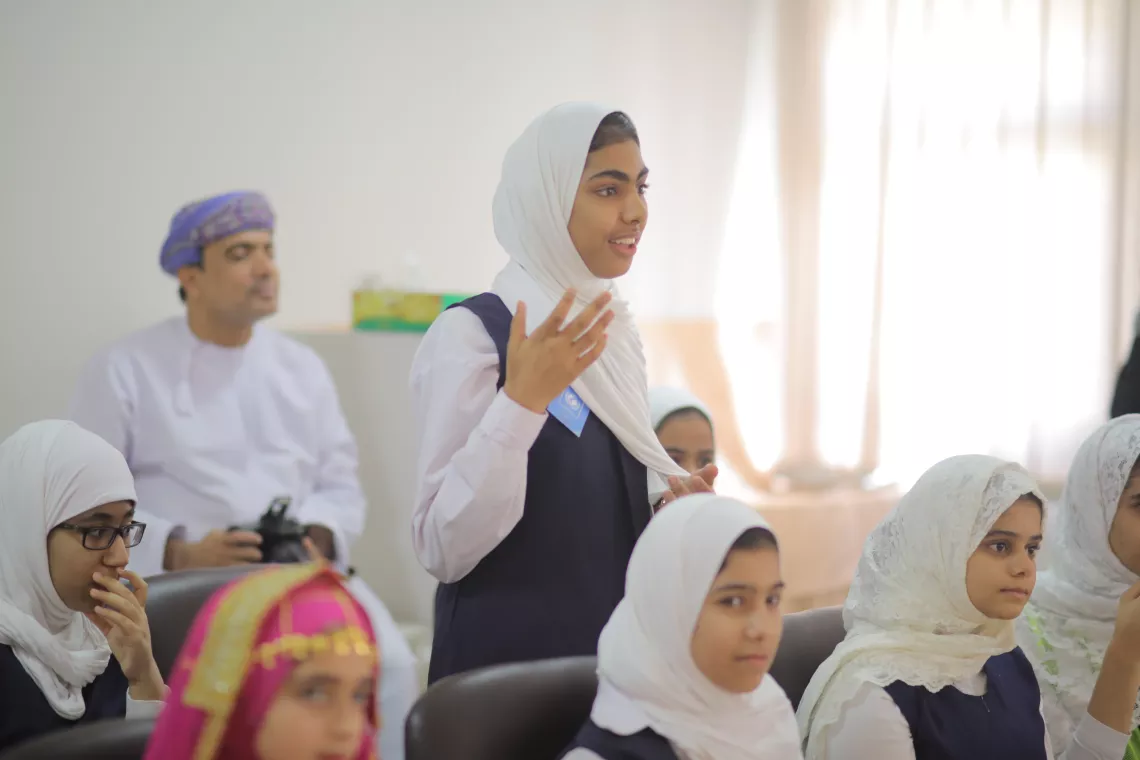
As for 2023, Young people in Oman under 29 years of age represent almost 60 per cent of the population. As such, Oman Vision 2040 puts young people at the very heart of Oman’s development goals and places a strong emphasis on education and creating an environment that fosters scientific research, innovation, and entrepreneurship.
School-to-Work Transition
By 2030 the Sultanate will see about 40,000 young people aged 15-24 enter the labour market as first-time jobseekers. While this represents a massive opportunity for Oman’s economic development, this influx of workers may increase youth unemployment if not accompanied by an educational system that adjusts to the needs of the labour market and policies that create new job opportunities.
Unemployment in Oman mainly affects the youth population. While the total unemployment rate in 2022 was 3.3 per cent, the youth unemployment rate was 15.8 per cent for the 18-24 age group and 6.8 per cent for the 25-29 age group. Upon conducting a detailed analysis of the data, it was observed that the unemployment rate among females is higher than that among males, with rates of 32.7 per cent and 12.5 per cent (18-24 age group) respectively. Similarly, the unemployment rates for females and males (25-29 age group) were 26.7 per cent and 2.1per cent respectively.
There is also a significant gender gap: In the 15-24 age group, 20 percent of young people are neither in employment, education and training. However, breaking down the data further shows that 35 per cent of young women are neither in employment, education or training, compared to only 8 per cent for young men.
It is clear that the participation of young people and women in the labour force is essential if Oman wants to benefit from the dividend.
Future Skills
The Oman National Framework for Future Skills seeks to develop young people’s learning in areas other than the traditional ones of basic literacy and numeracy. These are:
- Practical skills covering innovation and creative thinking, critical thinking, problem solving, effective oral and written communication, collective work and cooperation, leadership, taking initiatives, and resilience.
- Technical skills covering information and communication technology, data and knowledge management, and managing media information.
Data
Disaggregated data is key to understanding the situation of youth and adolescents, and to offer a foundation for evidence-driven policies and solutions.
Social Norms
Laws and regulations, as well as social norms and practices, affect the daily lives of young people in many ways. Young people should not be held back from participating fully in civic, economic and social life.
Solutions
Regional High-Level Meeting (HLM) on Young People’s Learning, Skilling, and Transition to Decent Work, organized by UNICEF, ILO, UNDP, UNESCO, and UNFPA
A government-led initiative aiming at formulating 'National Commitments' to address key challenges in the transition from learning to earning. The upcoming second regional meeting will take place in Tunisia during the period 26-27 June 2024, with participation from 18 countries in the MENA region. For more information click here.
Situation Analysis
As set out under Oman’s Vision 2040, adolescents and young people are at the very heart of Omani development strategy in coming years. UNICEF is working with the Government of Oman – particularly with the Ministry of Culture, Sports and Youth in collaboration with UNFPA to develop Situation Analysis on Youth and Adolescents – to advance the situation of young people in four key priority areas: education and skills;, employment and entrepreneurship; health and wellbeing; and engagement and rights.
Oman National Framework for Future Skills
UNICEF is working with the Ministry of Education to incorporate the Oman National Framework for Future Skills into curriculum design, linked to the regional Life Skills and Citizenship Education programme (LSCE).
SBCC Strategy
Adolescents are one of the key audiences included in the Social and Behaviour Change Strategy which aims to equip them and their parents with the knowledge they need to exercise their rights and reach their full potential.
UPSHIFT
UPSHIFT provides adolescents and young people with opportunities to acquire a broad set of transferable skills, with a focus on innovative thinking , and supports them to become a force for positive social and economic change. UPSHIFT launched in Oman in July 2021. Read more about UPSHIFT in Oman.
Generation Unlimited
Under the leadership of the Ministry of Culture, Sports and Youth, UNICEF facilitated the launch of the Generation Unlimited partnership in Oman.