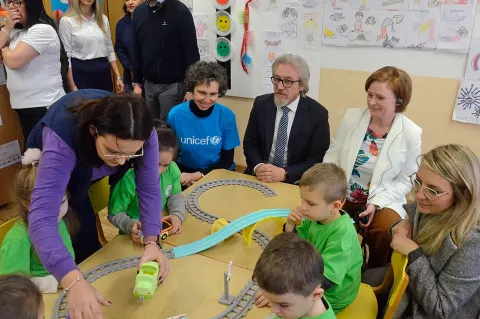
Play is not just childhood fun – it is essential for learning, health and resilience
On the International Day of Play, UNICEF calls for increased investment in parenting programmes, pre-school and learning through play for every child - statement by Lesley Miller, UNICEF Representative

- English
- Македонски
- Shqip
Skopje, 11 June 2025 – ”On this year’s International Day of Play, under the theme “Choose Play – Everyday”, UNICEF joins the global community in celebrating the transformative power of play in every child’s life.
“Play is not a luxury - it is a right. And it is essential for lifelong learning, health and resilience.
“From the earliest days of life, play is where child development begins. For babies and toddlers, playful interactions stimulate brain development and help build secure emotional bonds. For pre-school children, play provides an opportunity to explore abilities, nurture curiosity, build confidence, and lay the foundation for life-long learning.
“For vulnerable children, play is essential to experience inclusion and to express difficult emotions, offering a path for connection and healing. And for parents, playful interactions support mental well-being and strengthen the parent-child relationship.
“Yet despite its benefits to child development, playful learning is undervalued.
“Available data shows that in North Macedonia 57.2% of mothers and just 5.4% of fathers, engage in playful learning activities with their children aged 3–4 years. These activities include reading books, telling stories, singing songs, taking the child outside, playing with the child, and naming, counting, or drawing things together.
“This disparity highlights the urgent need to equip parents and caregivers – especially fathers – with tools and support to engage in early childhood development through play.
“Parenting programmes that promote playful learning and positive parenting are not just beneficial – they are also essential to preventing harmful practices. This is particularly relevant for North Macedonia, where 73% of children aged 1-14 years are exposed to physical punishment and psychological aggression by caregivers.
“Moreover, access to organized play-based learning is also limited with less than half of children aged 3-5 years attending pre-school. Expanding access to pre-school is vital, and investing in quality parenting programmes can reinforce early learning by supporting playful interactions at home.
“Playful parenting is not just a family matter—it is a societal investment.
“To ensure every child enjoys their right to play, while also advancing broader child rights and development, governments, businesses, and communities need to:
- Scale up parenting programmes that promote play, secure attachment and positive parenting, including programmes delivered through home visiting (patronage) nurses, schools and other community-based services.
- Expand access to pre-school and play-based learning for every child aged 3 to 5, ensuring no child is left behind in their early development.
- Promote family-friendly policies - paid parental leave; support for breastfeeding; child benefits; quality, affordable and accessible childcare; and mental health support – so that every mother and father has the time, means and support they need to provide the nurturing care that children need to thrive and flourish.
- Invest in safe, inclusive, and well-maintained play areas in all communities.
“Ensuring the right to play means investing in the environments, relationships, and services that enable every child to develop, learn, and thrive. When we make room for play, we make room for every child to grow, to connect—and to truly belong.“
Media contacts
About UNICEF
UNICEF, the United Nations agency for children, works to protect the rights of every child, everywhere, especially the most disadvantaged children and in the toughest places to reach. Across more than 190 countries and territories, we do whatever it takes to help children survive, thrive, and fulfil their potential.