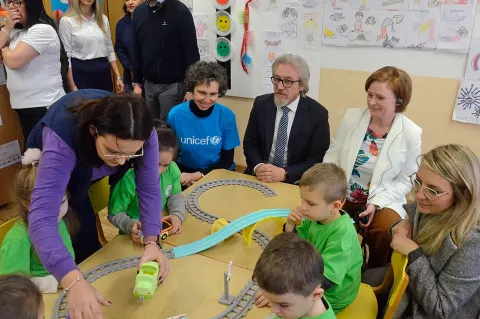
Early support for children and families can change development paths
UNICEF welcomes the multi-sectoral plan to strengthen family-based early childhood interventions
- English
- Македонски
- Shqip
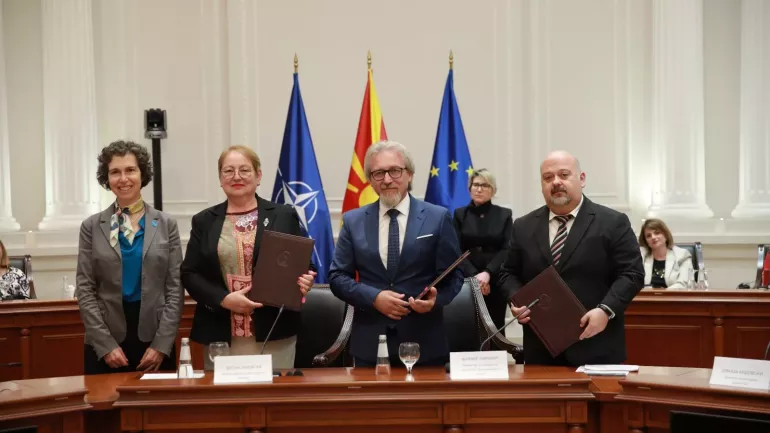
Skopje, 16 May 2025: The Ministries of Health, Social Policy, Demography and Youth, and Education and Science today signed a Memorandum of Understanding to establish the foundations of a new family-centred early childhood intervention system in North Macedonia.
The piloting of new services will be led by trained professionals from health and rehabilitation centres, kindergartens, school resource centres and licensed social service providers in the City of Skopje, empowering families and supporting children at risk of developmental delays and disabilities with a package of parental advice and specialised services.
Family-centred early childhood intervention focuses on stimulating warm and responsive interactions with children at risk of developmental delays and disabilities in the first five years of life when children develop more rapidly than at any other time in life. It emphasises the role of parents and service providers in supporting the child development in their natural environment and during the early years (0–6), when they are most ready to learn, grow, and adapt.
“This issue requires our sectors—education, health, and social protection—to no longer operate in parallel, but in synergy. It calls for our professionals to work together, not separated by administrative boundaries. It demands that our policies be aligned—not only to achieve the desired outcomes, but to achieve them efficiently, equitably, and on time,” said Fatmir Limani, the Minister of Social Policy, Demography and Youth.
“By addressing developmental challenges early, children are more likely to succeed in school and require fewer specialized services as they grow. Most importantly, early intervention can significantly improve their quality of life and enable greater inclusion in family, school, and community life,” said Vesna Janevska, the Minister of Education and Science.
“This memorandum is an opportunity to reaffirm the commitment to building a sustainable, inclusive, fair and systematically organized future for a family-centred early childhood intervention system,” said Jovica Andovski, Deputy Minister of Health.
In North Macedonia, it is estimated that over 17.000 children under the age of 6 years may require early childhood intervention services. Yet, the 2023 Situation analysis on Early Childhood Intervention highlighted significant gaps in state-level early childhood development screenings and intervention services. The study also noted that parents are usually the ones requesting referral services rather than services being pro-active in early identification and referral.
To address these gaps, a roadmap was developed with UNICEF support in partnership with the Association for Special Educators and Rehabilitators to support the health, education and social welfare sectors establishing systemic solution ensuring all preschool-aged children with a risk of developmental delays and/or disabilities, receive early childhood intervention services.
“It is during the first years that a child develops more rapidly than at any other time in life. UNICEF welcomes this new approach, through which families will receive the guidance and specialized services they need to navigate everyday challenges and foster the optimal development of their children,” said Lesley Miller, UNICEF Representative.
The multi-sector agreement includes commitment from the Ministry of Health to establish a universal screening for all children up to age of three, ensuring early detection and intervention nationwide. Upon completion of the piloting phase, family-centred services will gradually expand across the country.
Media contacts
About UNICEF
UNICEF, the United Nations agency for children, works to protect the rights of every child, everywhere, especially the most disadvantaged children and in the toughest places to reach. Across more than 190 countries and territories, we do whatever it takes to help children survive, thrive, and fulfil their potential.