From Dialogue to Action: Western Balkans Pledge to Advance Quality Education
Policymakers, education experts and practitioners from the Western Balkans agreed on a set of shared priorities to strengthen education systems

- English
- Македонски
- Shqip
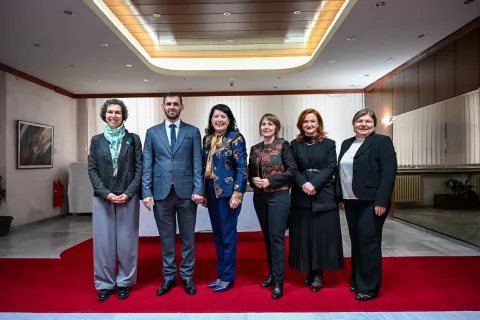
Skopje, 5 November 2025 – Today in Skopje, policymakers, education experts and practitioners from the Western Balkans agreed on a set of shared priorities to strengthen education systems and ensure that every child benefits from quality learning.
The new shared priorities were identified at the regional policy dialogue “From Data Insights to Policy Action: Co-creating Solutions for Quality Education in the Western Balkans” organized by UNICEF Europe and Central Asia in collaboration with OECD and European Commission and hosted by the Ministry of Education and Science in North Macedonia.
During the opening on the first day, the Minister of Education and Science of North Macedonia Dr. Vesna Janevska highlighted: “The PISA assessments show us that we must work on several aspects simultaneously – from strengthening the quality of teaching and extracurricular activities, to supporting students’ well-being and preparing them for how their competencies are tested.”
During the two-days, representatives from Albania, Bosnia and Herzegovina, Kosovo[1], North Macedonia Montenegro and Serbia examined the latest evidence, discussed national and regional challenges, and worked together to develop solutions and advance the education in the Western Balkans.
“This dialogue reaffirmed our shared commitment to give every child the opportunity to learn and succeed,” stated Lesley Miller, UNICEF Representative in North Macedonia in her closing remarks. “By focusing on concrete actions and sub-regional cooperation, we can build stronger and more inclusive education systems for all children.”
One of the key outcomes of the dialogue was the agreement to bridge the gap between universities and schools by reforming initial teacher education so that new teachers are fully prepared for the competency based teaching and learning. The participants also emphasized the importance of strengthening the teaching profession through the creation of modern career pathways, and establishing fair, merit-based incentives.
Additionally, the dialogue stressed that reforms must have a real impact in classrooms - not just exist on paper. To achieve this, it is important to align national assessments and curricula, and empower teachers to support children to master the competencies and skills that are essential for their future.
The discussion reflected a growing recognition of the value of cross-border learning and cooperation. To continue the sub-regional collaboration, it was agreed to develop a joint technical and analytical paper that will guide education and policy reforms across the Western Balkans.
[1]All references to Kosovo should be understood to be in the context of United Nations Security Council resolution 1244 (1999)
Media contacts
About UNICEF
UNICEF, the United Nations agency for children, works to protect the rights of every child, everywhere, especially the most disadvantaged children and in the toughest places to reach. Across more than 190 countries and territories, we do whatever it takes to help children survive, thrive, and fulfil their potential.