When Floods Silenced a Giver – but not her Spirit
Floods in Adamawa leave once-thriving families on the brink

It takes a special kind of strength, one borne out of sheer selflessness, to give when you barely have enough for yourself. Enni Ishaya was that kind of woman. A farmer and mother of six, she lived in Goro, a rural community in Adamawa, a fertile State in northeast Nigeria. Every harvest brought enough food for her family, for the lean season, and even for neighbours in need. But in early September, everything changed. Floods inundated Goro and swept all she had away.
The floods came just after dinner. The children were laughing and playing, the animals were resting in their area, Enni’s family had many of them. Enni first noticed water trickling in. But within moments, water had consumed her house and all her belongings.
Her survival instincts kicked in. She grabbed her children first and moved them to safety. Next it was the stack of harvest, the source of her family’s survival. But time was racing, and fate was not on her side. With her eldest son, she tried to salvage what she could, but the strong current swept all her hard work and life’s savings away.
“We tried our best, but the water was stronger than us. We could not save anything.”


There was no time to mourn, survival and staying afloat was the only goal. The floodwater kept rising, as did the family’s misery. After a few moments, a ray of hope came amid chaos and darkness. Brave residents of communities nearby waved strong currents and arrived in local boats, to rescue those trapped. “They saved our lives,” Enni says quietly, gratitude reflected in her eyes.
Today, Enni and her children live in Kovi, a nearby community. The floods displaced over 100 people, including children. Everything they wear, and everything they eat, comes from the kindness of strangers. “Kovi’s people have been kind to us, especially the community leader.”
For a woman who used to give freely to others, the pain of depending on handouts cuts deep. “We have now become beggars,” she says, not with shame, but with the raw honesty of a mother desperate for a way back. “My children are coughing. They are sick. The flood has put my children’s health at risk,” she says, her eyes fixed on the horizon, seeming to envision the life she once had.

In another town, about 70 kilometers away, another mother lives on edge. Adama Aliyu has witnessed the fury of floods in the past. This time around, she awaits, one moment at a time. Her eyes looking out for the furious waters. “The last time we saw floods, my children fell ill from cholera,” Adama recalls the agony, the rains brought to her in the past.
Now, with the threat looming and warnings from the government that her community may once again be submerged, Adama’s anxiety rises daily. The Federal Government has alerted that at least 30 of the Nigeria’s 36 States are at risk of floods in 2025. By September, floods had hit 25 States already, impacting over 300,000 people, mostly women and children. Adamawa remains among the hardest hit.

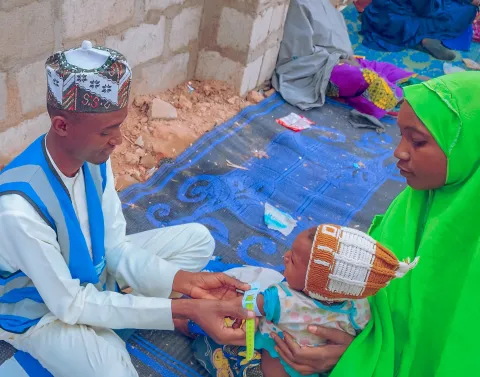
Support for Enni and Adama is ongoing. The Adamawa State Government, the United Nations Central Emergency Response Fund (CERF), and UNICEF have launched a coordinated anticipatory action plan in the State. This includes a comprehensive intervention to improve access to safe water, sanitation, and hygiene services for affected families. The support is constructing water supply systems, and separate toilets for women and men in communities threatened by floods. Families are also receiving aqua tabs for household water purification, and cholera and hygiene kits.


Perhaps the most powerful resource for families is knowledge. Hygiene promotion teams are conducting campaigns, including jingles, door-to-door sensitization, and community outreach focused on preventing waterborne diseases. “The knowledge we are getting from hygiene lessons are helpful, especially to keep children safe from diseases,” says Adama. Though she has already been dealt her loss, Enni is benefitting from the emergency response, and it is helping her to hold on.
These two women, though separated by miles, are united in circumstances. They symbolize the urgency for a strengthened flood preparedness in Nigeria. Adama is learning lessons of how she needs to avert another dreadful experience from floods. For Enni, the flood has already rewritten her story. Her farm, her food, and her generosity, which touched lives in her community have been swallowed by the raging waters but what the waters couldn’t dampen is her spirit. She still believes she can rebuild, after the waters recede. “I want to be a giver again. That’s who I am, and no water can sweep that away from me.”