She Fled With Nothing, Now She’s Fighting to Keep Her Children Alive
She Fled With Nothing, Now She’s Fighting to Keep Her Children Alive

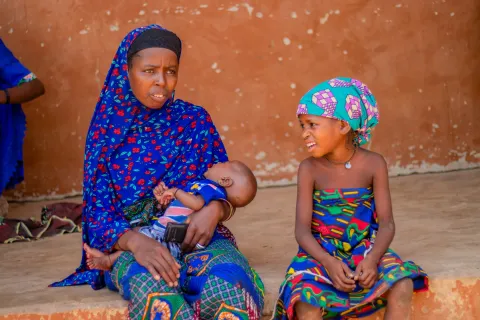
At the International Market IDP Camp in Makurdi, the rains have eased, but the struggle has not. Thousands of families displaced by violence are trying to piece their lives back together in a place that was never meant to hold so many people. Among them is Doosur Terve, 35, a mother of seven, who fled Yelewata with almost nothing, no belongings, no safety net, just her children and the instinct to keep them alive.
Life in the camp is a daily negotiation with uncertainty. Overcrowded spaces, limited water, basic services stretched thin. The kind of conditions where illness does not need much to spread, it only needs a moment. For mothers like Doosur, that moment is always close.
“I worry all the time about my children falling sick,” she says, adjusting the baby tied tightly to her back as she stands among a group of women waiting at a distribution point. Most of them are young, some barely out of their teens, all carrying the same quiet anxiety. “We lost everything when we fled. Here, we depend on what we are given. I am happy for the dignity kits. I will use them to bathe my children and wash their clothes.”
Her voice is calm, but the fear sits just beneath it. And now, that fear has a name, Lassa fever.
The outbreak spreading across Benue State has added a new layer of danger to an already fragile existence. The disease thrives in conditions like these, where overcrowding, poor sanitation, and exposure to contaminated food or surfaces make it easier to move from one household to the next. In a place like this camp, one case does not stay one case for long.
That is why the response had to move quickly. Across nine IDP camps, UNICEF has scaled up emergency WASH support, reaching the most vulnerable families with dignity kits designed to do something simple but critical, break the chain of infection. In total, 900 households have received these kits, each one carrying the tools to push back against a disease that feeds on neglect.


When Doosur received hers, it was more than just a distribution. It was a shift. Inside were items that most people would overlook, soap, water storage containers, basic hygiene supplies. But here, these are not small things. They are protection.
“Before, we had no proper way to store water,” she says. “Now, I can keep it clean for my children. It gives me some peace.”
Peace is not something that comes easily in a place like this, but it matters.
Around the camp, contactless handwashing stations are being installed, simple systems that allow families to clean their hands without touching shared surfaces, reducing the risk of transmission in a space where everything is shared. The response does not stop at supplies. Working closely with state authorities and SEMA, UNICEF is combining these interventions with something just as important, knowledge.
Through community engagement and awareness sessions, families are learning how Lassa fever spreads, and more importantly, how to stop it.
“In the face of the current Lassa fever outbreak, hygiene is our first line of defense,” says Mrs. Juliet Chiluwe. “These kits and contactless handwashing stations are not just about comfort, they are lifesaving tools. When families can store water safely and practice proper hygiene, the risk of transmission drops significantly.”
Behind the scenes, the response is being strengthened further. Training on water, sanitation and hygiene, risk communication, surveillance, and infection prevention is being scaled up at both state and local levels. It is a coordinated effort, but its success depends on something very simple, whether families can use what they are given to protect themselves.
And they do.
“In crowded camps like this, one case can spread quickly,” a health worker explains. “But simple actions, safe water storage, regular handwashing, can stop that spread. When people have the right tools and the right information, they take control.”
For Doosur, that control is everything.
“I feel safer now than before,” she says. “I still worry, but at least I know how to protect my children better.”
It is not a perfect life. The camp is still crowded. The risks are still there. The future is still uncertain. But something has shifted.
Because in a crisis like this, survival does not always come from big interventions. Sometimes, it comes from small, consistent acts, clean water, soap, a place to wash your hands, the knowledge of what to do next.
For mothers like Doosur, that is not just support. It is the difference between fear and hope.